


"These are the instruments that measured the distance between the recording and the truth."
Hi-Fi History traced the broad arc of high-fidelity audio from the post-war era to the present day. Here we pause and go deeper, examining the loudspeaker in its own right: the devices that defined what domestic music reproduction could mean, and the designers who refused to accept that the state of the art was good enough. These are the instruments that measured the distance between the recording and the truth.
The Magnet Revolution: From Alnico to the Electromagnet
Before examining the great loudspeakers and their designers, it is worth pausing to consider one element that has shaped the entire trajectory of dynamic driver development: the magnet. The history of the loudspeaker is, in significant part, a history of the magnet, and the story of how each successive magnetic material arrived to redefine what was possible tells us as much about the physics of reproduction as any account of cabinet design or crossover topology.
The first loudspeakers of the 1920s and 1930s used natural iron magnets of enormous weight and modest flux density. The arrival of Alnico, an alloy of aluminum, nickel, and cobalt developed for industrial applications, transformed the equation entirely. Alnico magnets could produce flux densities roughly three times greater than iron at a fraction of the weight, and they brought with them a characteristic warmth of presentation that many listeners still regard with affection: a gentle compression of extreme dynamics, a smoothness at high frequencies that softened transients in a manner that vinyl's own limitations rendered irrelevant or even complementary. Altec Lansing's cinema drivers and the great JBL units of the 1950s and 1960s were products of the Alnico era, and their signature sound, so different from anything that followed, remains sought after by those who find the later materials too clinical or too demanding of associated equipment.
The supply constraints that followed World War Two, combined with the increasing power handling requirements of rock music and the growing commercial pressure for lower costs, drove the industry toward ferrite ceramics. Developed from the same barium and strontium compounds that gave us the ceramic capacitors of early electronics, ferrite magnets could be produced at a fraction of the cost of Alnico and offered acceptable flux densities, with the significant disadvantage of requiring magnets of substantially greater mass and volume to achieve equivalent performance.
The ceramic era, from the late 1960s onward, democratized high-fidelity reproduction by making powerful motor systems affordable for mass-market loudspeakers, but it exacted a visual and practical price: the familiar large chunks of dark grey ceramic material that gave many speakers their characteristic proportions and weight. Ferrite loudspeakers developed a reputation for a different character from their Alnico predecessors: greater dynamic headroom and control at the cost of a certain perceived heaviness or sluggishness in the transient response that some listeners attributed to the magnet's different magnetic properties and the mechanical implications of the larger motor structures.
The revolution arrived without announcement in the early 1980s, when the commercial development of neodymium-iron-boron alloys made available a magnetic material whose energy product dwarfed everything that had come before. A neodymium magnet could produce the same flux density as a ferrite magnet weighing ten times as much, and the same flux density as an Alnico magnet at perhaps one-fifth the weight and without the supply constraints that had always haunted cobalt-dependent designs.
The first commercial neodymium drivers appeared in the mid-1980s, and their implications unfolded gradually: tweeters that had required large external magnets could now be built with motor systems smaller than a thumbnail; midrange units shed the mass that had always compromised their ability to stop and start cleanly; woofers achieved motor forces that previously would have required magnets too heavy for practical domestic use.
The neodymium era brought with it a new transparency and immediacy, a reduction in the mechanical stored energy that ferrite and Alnico motor systems had always introduced into the moving system, and it enabled the miniaturization of driver dimensions in ways that had previously been theoretical. Today, neodymium is so thoroughly dominant that few manufacturers even offer alternatives, and the sonic signature it brought, characterized by speed, clarity, and a freedom from the coloration that large magnetic structures introduced, has become the assumed baseline against which all other transducer technologies are measured.
There remains, however, one more chapter in this history, and it is the one that serious designers return to when all other compromises have been exhausted: the field coil. Rather than relying on a permanent magnet of any material, the field coil electromagnet uses a coil of wire carrying a DC current to generate its magnetic field. The implications are profound. By adjusting the current flowing through the field coil, the strength of the magnetic gap can be varied continuously: tightened for greater control and efficiency, reduced for greater dynamic range and headroom.
A field coil driver is not a fixed-performance device but an adjustable one, its character shaped by the power supply feeding it and the designer's choice of operating point. The disadvantages are equally profound: a field coil requires a dedicated power supply, it introduces additional complexity and cost, and it creates a dependency that the simplicity of the permanent magnet was always meant to eliminate. But for those willing to accommodate these demands, the field coil offers a quality of motor control, a linearity of force factor, and a sense of effortlessness in the reproduction that no permanent magnet material has ever quite matched.
The field coil was used in the great Western Electric drivers of the cinema era, in the original Altec Lansing designs, and it has survived as a choice of reference-class manufacturers who understand that the last percentage points of performance sometimes demand the first principles of the original art. It is the answer to a question that most designers stopped asking decades ago, and it remains the answer for those who find the limitations of the permanent magnet, however refined, ultimately unsatisfying.
The magnet, then, is not merely a component. It is a statement of engineering philosophy, a choice between cost and performance, between simplicity and potential, between the acceptable and the absolute. Every great loudspeaker in this history made its choice, and every choice tells us something about what its designer was willing to sacrifice in the pursuit of the truth.
The Pioneers: 1920s to 1969
Before high fidelity became a domestic aspiration, the loudspeaker was an industrial instrument: a tool for broadcasting, for cinema, for the spoken announcement. The names that follow are those of the companies and designers who changed that permanently, who established the fundamental principles that still govern transducer design today.
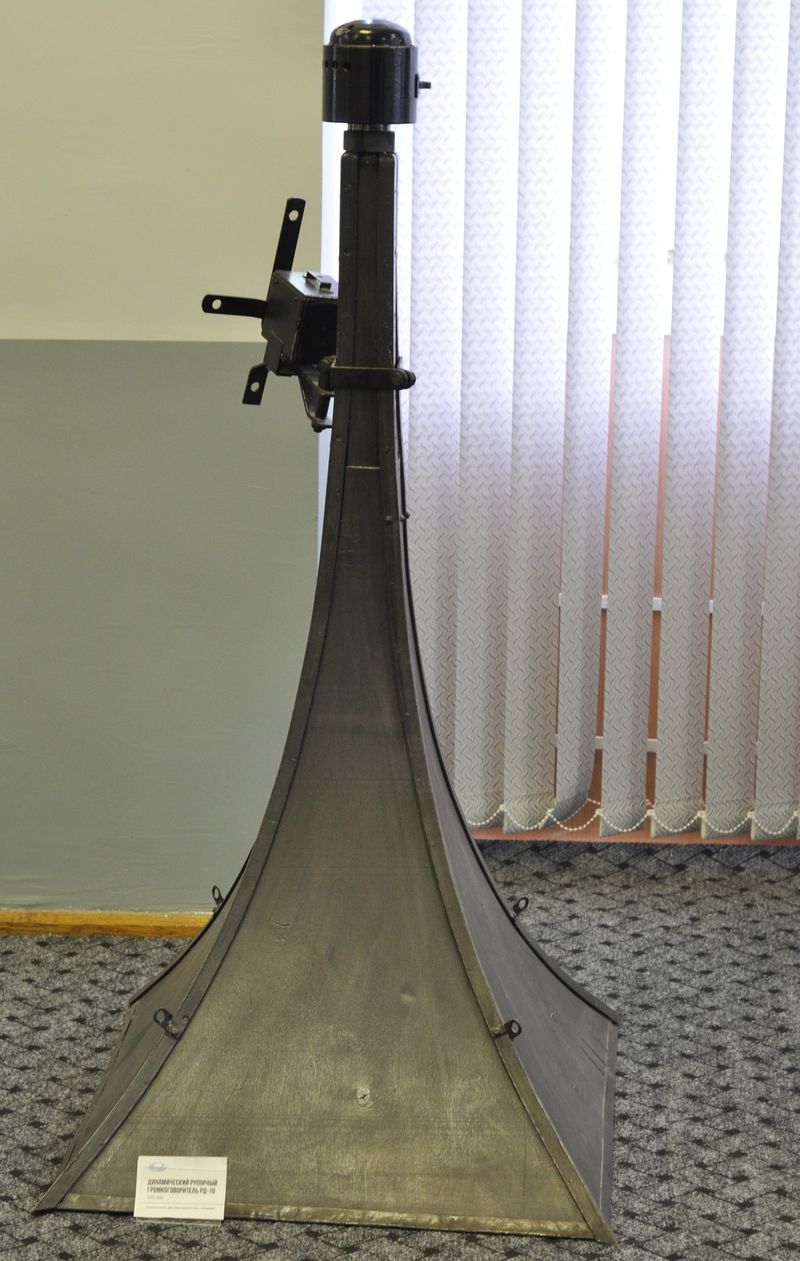
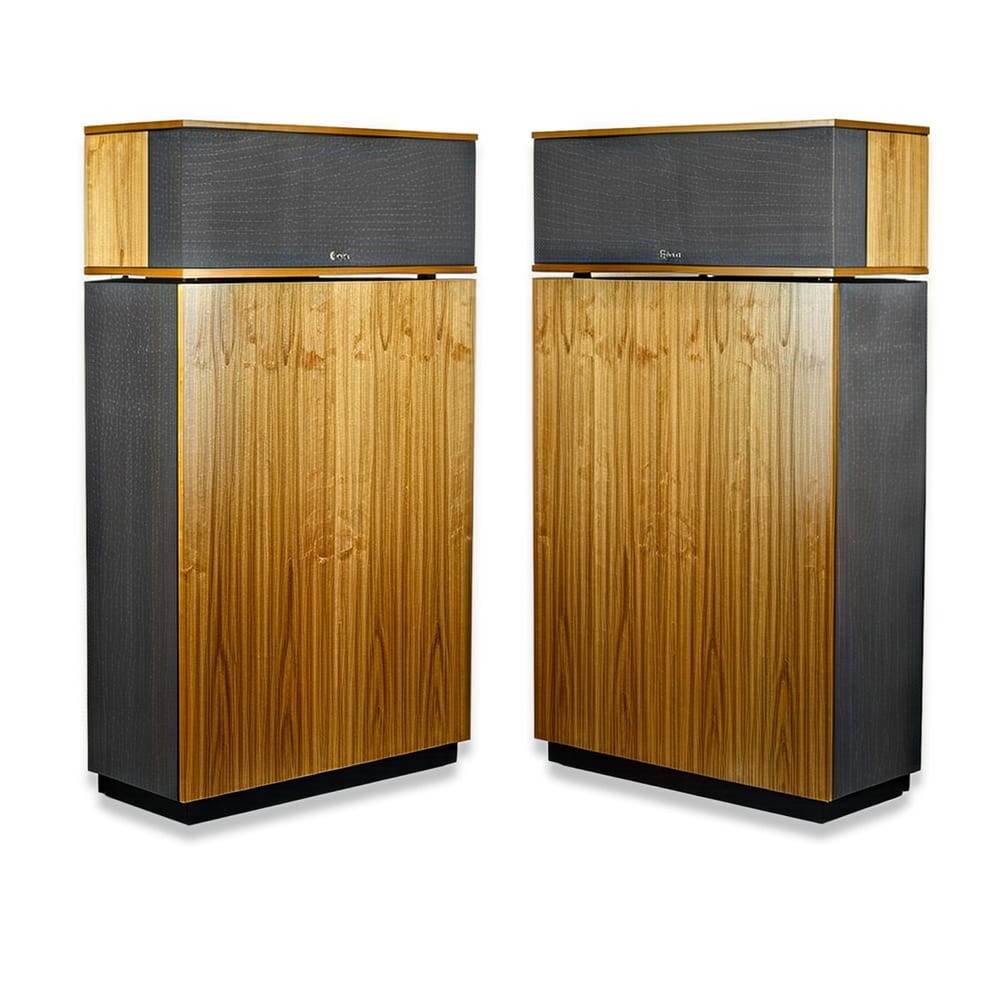
Klipsch — The Klipschorn (1946)
Paul Klipsch built his first corner horn loudspeaker in a tin shack in Hope, Arkansas, in 1946, and the result was so fundamentally correct that it has remained in continuous production ever since, a record unmatched by any other loudspeaker in history.
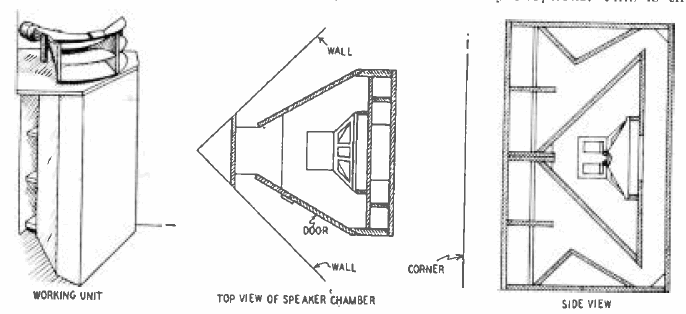
The Klipschorn operates on four principles that Klipsch held to be inviolable: efficiency, flat frequency response, controlled directivity, and dynamic range. By using the corner of the room as an extension of the horn itself, the design achieves a sensitivity that allows it to be driven by even the most modest amplifier while reproducing the full dynamic envelope of orchestral music. To hear a properly installed Klipschorn in the right room is to understand immediately why generations of engineers and listeners have returned to it: the sensation of acoustic scale and effortless power has never been replicated by any box of equal price. It was, as one TAS contributor noted, the first absolute sound.
Altec Lansing — Voice of the Theatre (1945)
The collaboration between Western Electric, Lansing Manufacturing, and what became Altec Lansing produced some of the most consequential driver technology of the mid-twentieth century. The Voice of the Theatre system, developed for cinema use, brought wide-range, high-efficiency horn-loaded reproduction to the spaces where the public actually heard recorded sound.
James B. Lansing's understanding of large-format compression drivers and horn geometry created a foundation upon which American professional audio was built. When engineers at Capitol Records, Columbia, and dozens of other studios in the 1950s sat down to mix recordings, it was very often Altec transducers that told them what they were hearing. The influence on recording practice, on what engineers learned to listen for, on what sonic qualities were enshrined in those masters, is impossible to separate from the legacy of the music itself.
JBL — The Professional Studio Monitor (1950s to 1970s)
James B. Lansing, after founding his eponymous company, created a body of driver technology that came to define the American approach to studio monitoring. Under Sidney Harman's leadership, JBL developed large-format compression drivers and horn-loaded systems capable of dynamic range and scale that nothing in Europe could match. The D130 woofer, the 375 compression driver, the 4310 and 4333 studio monitors: these were the tools with which decades of recordings were made. JBL's approach valued impact, authority, and the ability to reveal low-level detail at high playback levels. It was, in its own terms, a form of honesty, even if that honesty was calibrated to a particular acoustic environment and a particular set of musical priorities.
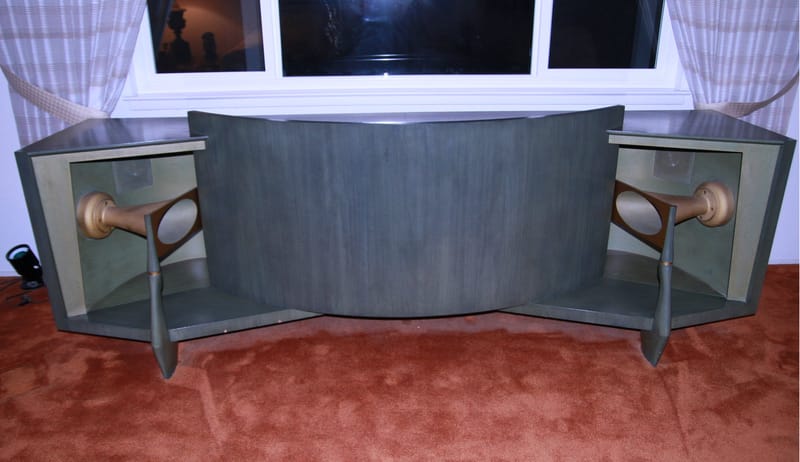
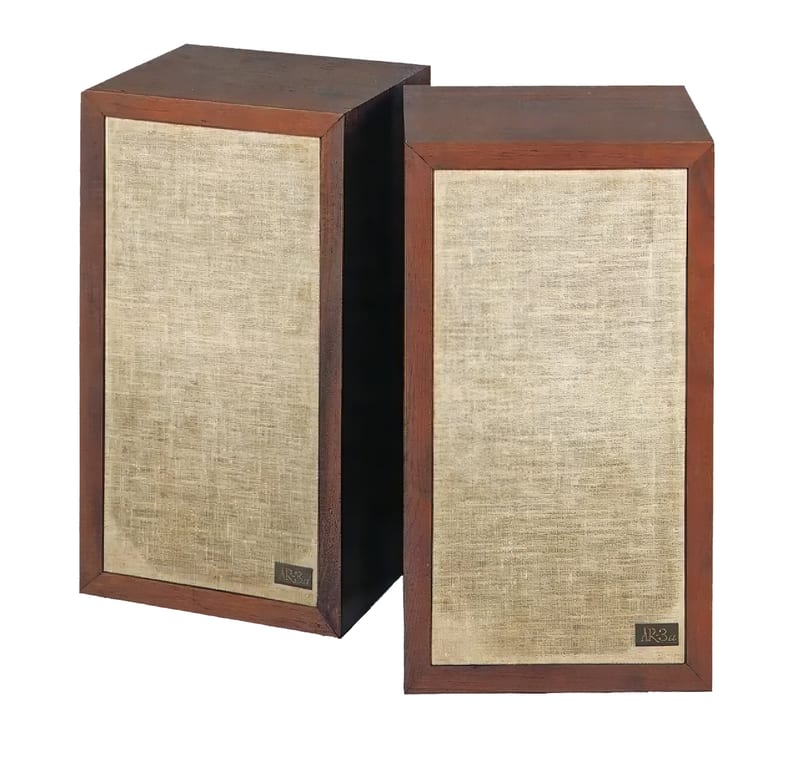
Acoustic Research — AR-1 and AR-3 (1954 and 1958)
Edgar Villchur's invention of the acoustic suspension loudspeaker in 1954, commercialized as the AR-1 and later refined as the AR-3, was one of the genuine paradigm shifts in the history of sound reproduction. By using a sealed enclosure in which trapped air acted as a restoring spring for a long-throw woofer, Villchur achieved accurate, extended bass from a cabinet a fraction of the size that horn and reflex designs required. The AR-3, with its soft-dome tweeter and midrange, was the first loudspeaker that recording engineers could reasonably use as a reference in a normal room. It did not flatter recordings; it revealed them. Henry Kloss, who co-founded AR before departing to form KLH, carried these principles forward. The acoustic suspension concept democratized serious listening and made high fidelity a domestic rather than purely professional pursuit.
Tannoy — Dual Concentric Monitors (1947 onwards)
Tannoy's Dual Concentric driver, introduced in 1947, placed a high-frequency unit at the acoustic centre of a conventional woofer, creating a point-source radiator in which both frequency ranges emerge from a single physical origin. The theoretical advantages are considerable: perfect time alignment between bass and treble, uniform dispersion, and the absence of any crossover-point interference that arises when two physically separated drivers are asked to sum coherently.
Tannoy's monitor designs, the Lancaster, the Monitor Gold series, the classic 15-inch Autograph, became trusted references in British broadcast and mastering facilities throughout the 1950s, 1960s, and beyond. The principle has proven so enduringly correct that Tannoy continues to refine and manufacture Dual Concentric drivers to this day, and the original concept remains the starting point for any serious discussion of point-source loudspeaker design.
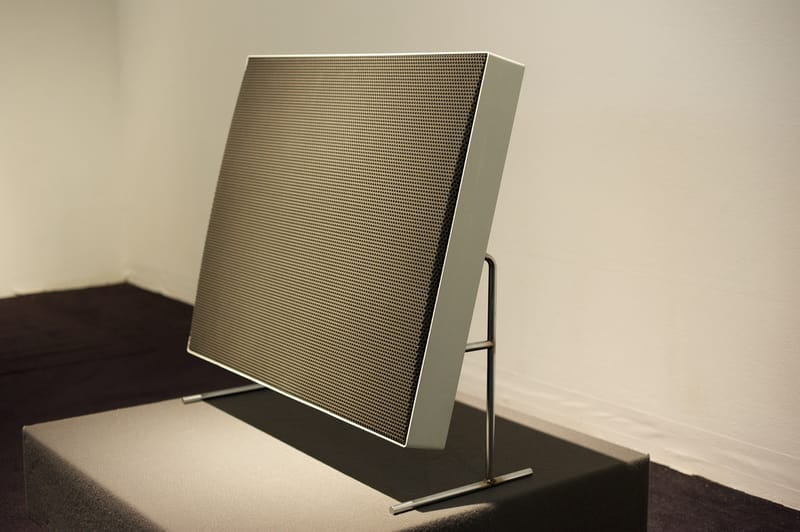
Quad — The Electrostatic Loudspeaker (ESL 57, 1957)
Peter Walker's Quad Electrostatic Loudspeaker of 1957 was unlike anything that had come before it. Rather than moving a cone through magnetic force, the ESL 57 moved an entire diaphragm of vanishingly low mass across its full area in response to the electrostatic field between two fixed stators. The result was a freedom from coloration in the midrange that cone loudspeakers, then as now, find extraordinarily difficult to match. The ESL 57 had no crossover in the conventional sense, no cabinet resonances, and a dispersion pattern that, while narrow, delivered a clarity of imaging that redefined listener expectations. Its limitations, restricted bass extension, modest dynamic range, and a sensitivity to placement and listening distance, were real, but to those who heard it in its element, they seemed irrelevant. The Quad ESL 57 is the standard against which the transparency of all subsequent loudspeaker designs has been measured.
KEF — Research-Led Driver Technology (1961 onwards)
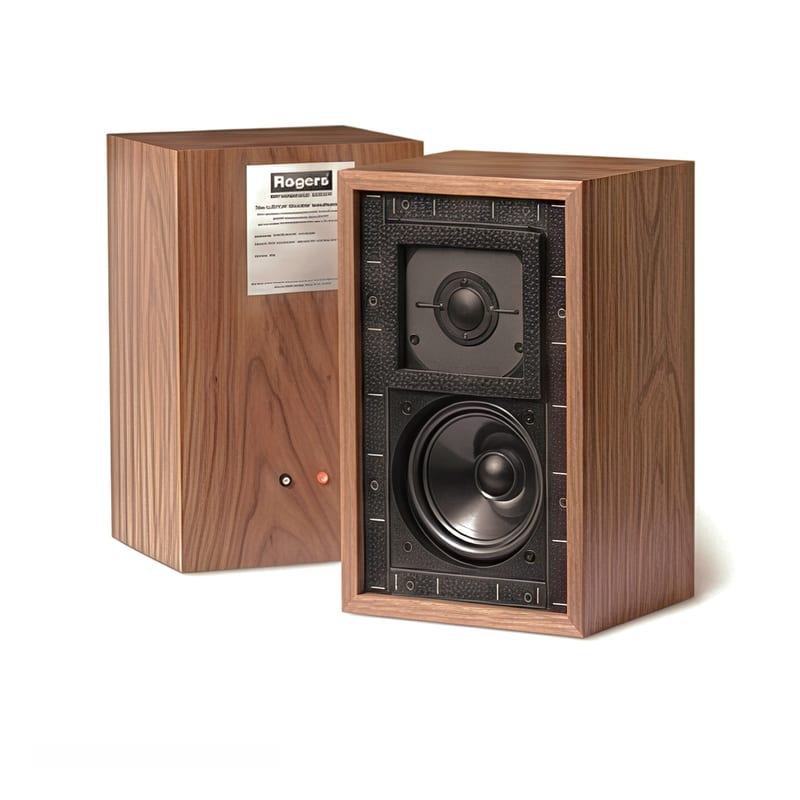
Raymond Cooke founded KEF in 1961 with an explicit commitment to applying scientific method to loudspeaker design at a time when most manufacturers were still operating largely by intuition. KEF's use of synthetic materials for driver cones, its development of the B110 bass/midrange unit that would appear in the BBC LS3/5A, and its early adoption of computer modeling for crossover design placed it at the forefront of British engineering practice.
The company's willingness to invest in research produced a series of technically distinguished designs, the Celeste, the 104aB, eventually the Reference series, that consistently offered a level of measured and subjective accuracy at their respective price points that their competitors found difficult to approach. KEF's later development of the Uni-Q coincident driver array returned to Tannoy's point-source insight via a wholly different engineering path, and the Blade and Reference series have placed the company among the reference-standard manufacturers of the current era.
Celestion — From Radio to Reference (1924 onwards)
Celestion's origins in the 1920s radio loudspeaker market place it among the oldest names in transducer manufacturing, but it is the company's work from the 1950s onwards that earned its position in high-fidelity history. The Ditton series brought genuinely extended frequency response to the domestic market at accessible prices, while Celestion's driver technology, particularly its HF1300 and HF2000 tweeters, found their way into BBC monitoring designs and the products of numerous other manufacturers. Celestion's contribution is perhaps best understood as the foundation upon which British hi-fi culture was built: reliable, well-engineered transducers available to designers at a price that made serious loudspeaker development commercially possible.
Bowers & Wilkins — The B&W Story Begins (1966 onwards)
John Bowers founded Bowers & Wilkins in 1966 with a combination of engineering ambition and commercial instinct that produced, over the following decades, one of the most influential loudspeaker catalogues in the world. The early P1 and DM series established B&W as a serious domestic manufacturer, but it was the development of the 801 monitor in 1979 that defined the company's place in audio history. The 801, with its separate head unit housing the midrange and treble units and its sealed bass enclosure, offered a combination of dynamic authority, frequency extension, and accuracy that attracted professional users at Abbey Road and beyond. It became one of the most widely used studio monitors in the world and introduced the principle of physically separated enclosures for different frequency ranges to a mass audience.
Spendor — The BC1 and the BBC Tradition (1969)
Spencer Hughes spent years in the BBC's research department before founding Spendor in 1969 and applying what he had learned to a domestic loudspeaker. The BC1 was the result: a thin-walled design using controlled panel resonance to achieve a naturalness in the midrange that more rigidly constructed enclosures struggled to replicate. Hughes understood that a loudspeaker cabinet cannot be made acoustically dead without also making it sonically inert, and that the art lay in managing the cabinet's contribution rather than eliminating it. The BC1 offered a midrange honesty, particularly with the human voice, that immediately distinguished it from its competitors and established Spendor's reputation for musical truth over technical ostentation. It remains the archetype of the monitor loudspeaker designed for extended listening rather than for specification sheets.
Infinity Systems — The Electrostatic Hybrid (1968 onwards)
Arnie Nudell co-founded Infinity Systems in 1968 with the ambition of combining the transparency of electrostatic technology with the dynamic range and bass extension that conventional cone drivers could provide. The Infinity Servo-Statik 1, introduced in 1968, was among the first serious commercial attempts at this hybrid approach, and the company's subsequent development of the EMIT (Electro-Magnetic Induction Tweeter) and EMIM (Electro-Magnetic Induction Midrange) drivers produced ribbon-like high-frequency transducers at a cost that electrostatic technology could not match. The IRS (Infinity Reference Standard) series, culminating in the IRS V, represented one of the most ambitious loudspeaker projects of the 1970s and 1980s: a statement that dynamic and spatial performance need not be mutually exclusive.
The Modern High-End Era: 1970 to 1980
The 1970s brought the transistor to maturity, the turntable to its peak, and the loudspeaker into a new era of experimentation. The assumption that a loudspeaker was necessarily a box of rectangular proportions began to dissolve. What followed was a decade of plurality and vision.
Magnepan — The Planar Magnetic Loudspeaker (1969 onwards)
Jim Winey founded Magnepan in 1969 with a technology he had developed in his own home: the planar magnetic loudspeaker, in which a flat conductive ribbon or foil bonded to a thin membrane is driven by a magnetic field across its entire surface. The Magneplanar Tympani, launched in 1971, offered a spatial transparency, a freedom from coloration, and a naturalness of instrumental scale that conventional cone loudspeakers found impossible to replicate. Magnepan's designs have always been large, current-hungry, and unforgiving of inadequate amplification or poor room conditions. They have also, for fifty years, attracted a loyalty among their users that no specification can fully explain: the experience of a properly driven Magnepan in a well-treated room, with orchestral or choral music at realistic levels, remains among the most convincing illusions of live sound that domestic reproduction can offer.
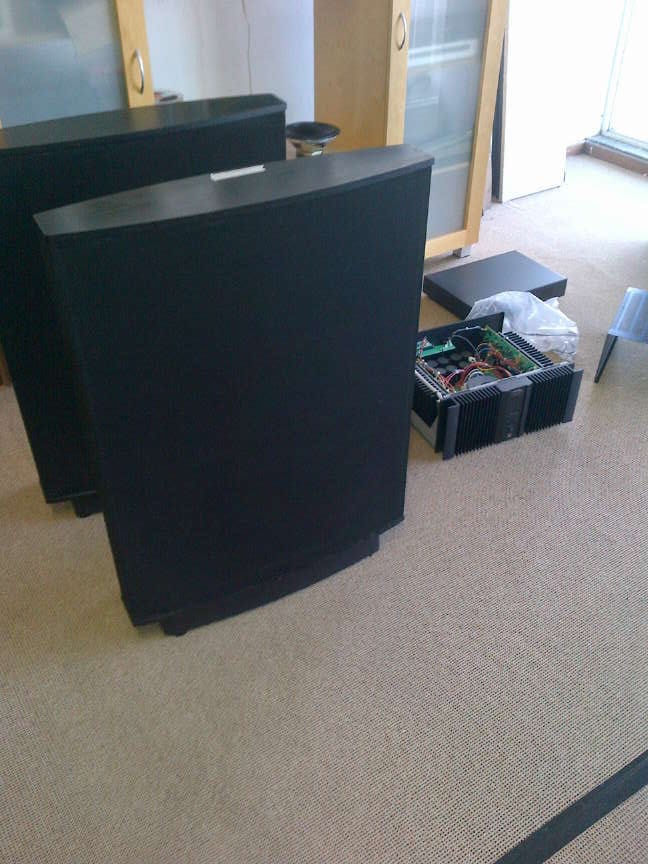
MartinLogan — The Curvilinear Electrostatic (1979 onwards)
Gayle Sanders and Ron Logan Sutherland founded MartinLogan in 1979 with the insight that the fundamental practical limitation of the flat-panel electrostatic, its narrow sweet spot and beaming high-frequency dispersion, could be addressed by curving the stator panels. The curvilinear electrostatic line-source panel, introduced in the CLS of 1984, provided a broad, even horizontal dispersion pattern while retaining the vanishing low mass and negligible mechanical distortion that made electrostatic transduction so compelling. MartinLogan went further than any previous manufacturer in bringing electrostatic technology to a wide commercial audience, developing hybrid designs with dynamic woofers that addressed the bass limitations inherent in the technology while preserving the electrostatic's mid and high-frequency virtues.
Acoustat — The Full-Range Electrostatic
While MartinLogan pursued the curved-panel hybrid, Acoustat developed full-range electrostatic designs during the 1970s and early 1980s that pushed the technology in a different direction: towards a loudspeaker that required no dynamic driver at any frequency. Jim Strickland's Acoustat designs were among the most fully realized full-range electrostatics ever produced commercially, offering a coherence and homogeneity across the frequency range that hybrid designs, by their nature, sacrifice at the crossover point. The challenge of bass extension and dynamic range limited their commercial reach, but within their operating envelope the Acoustat models offered a window onto the recording that few transducers of any technology could match.
Thiel Audio — Time and Phase Coherence (1977 onwards)
Jim Thiel founded Thiel Audio in 1977 with a set of engineering convictions from which he never wavered: that a loudspeaker should reproduce the time-domain structure of the input signal accurately, that first-order crossovers were the only slopes compatible with phase-correct transduction, and that the resulting demands on driver quality and cabinet rigidity should be met rather than evaded. The CS series, the CS2, CS3.7, CS6, and their descendants, were loudspeakers of exceptional spatial precision and transient accuracy, revealing the timing relationships in music with a clarity that most of their contemporaries obscured. Thiel's insistence on measurement-verified time alignment, carried through every design until his death in 2009, produced a body of work that remains a benchmark for loudspeaker coherence. The CS3.7 in particular is regarded by many as one of the finest full-range dynamic loudspeakers ever produced.
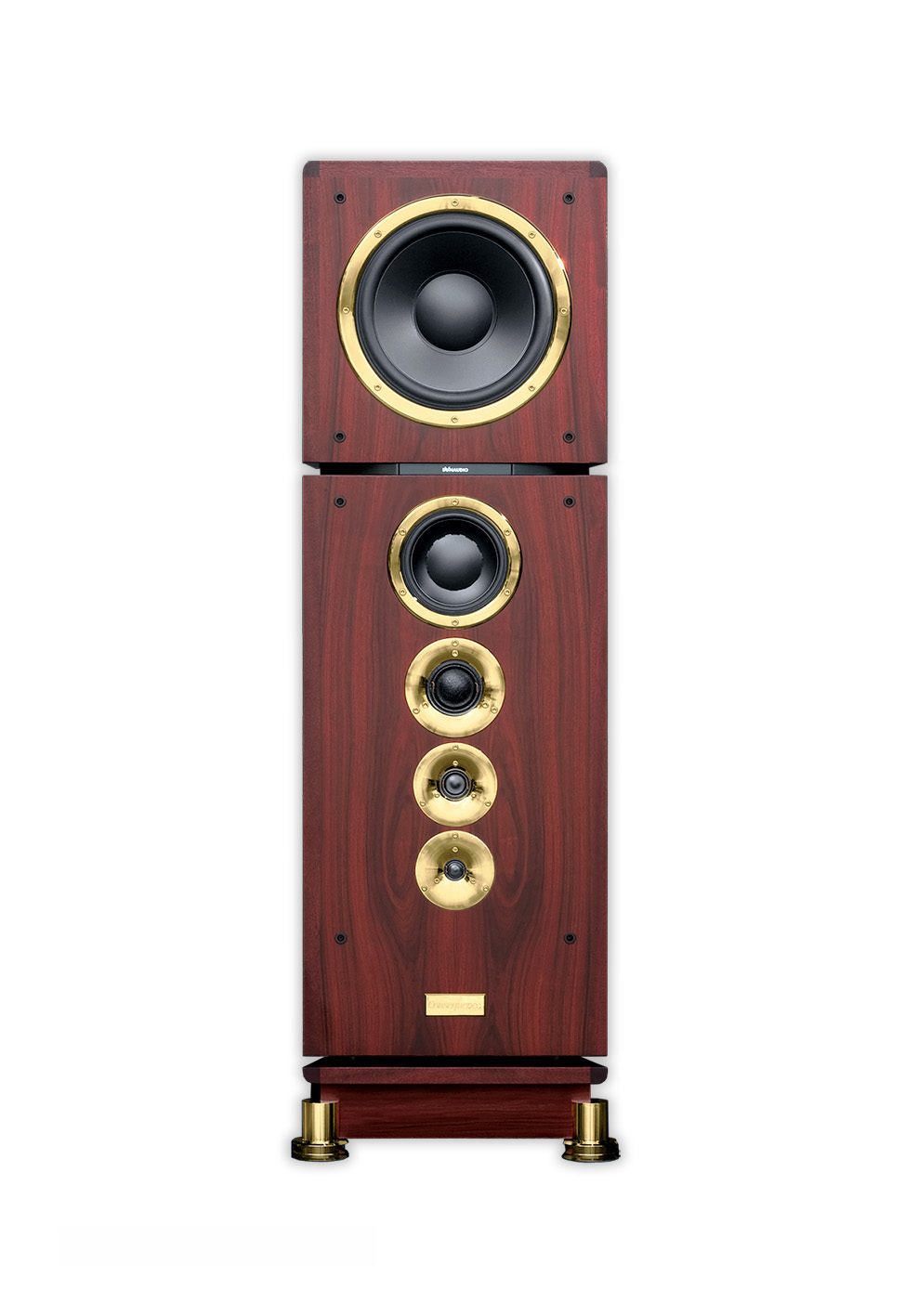
Dynaudio — The Reference Driver (1977 onwards)
Wilfried Ehrenholz founded Dynaudio in Denmark in 1977 with the ambition of manufacturing loudspeaker drivers of a quality that no other company was willing to pursue at commercial scale. The Dynaudio soft-dome tweeter, with its fabric diaphragm, short voice coil, and powerful magnet system, offered a combination of bandwidth, dynamic capability, and low distortion that redefined what a dome tweeter could achieve. The company's long-throw woofers and midrange drivers set comparable standards. Dynaudio's decision to supply its driver technology to other manufacturers, including many of the most respected names in European loudspeaker design, spread its influence far beyond the company's own product catalogue. A generation of fine loudspeakers bear Dynaudio drivers, and the standard those drivers established for controlled bass, smooth high-frequency extension, and reliable power handling continues to inform transducer design globally.
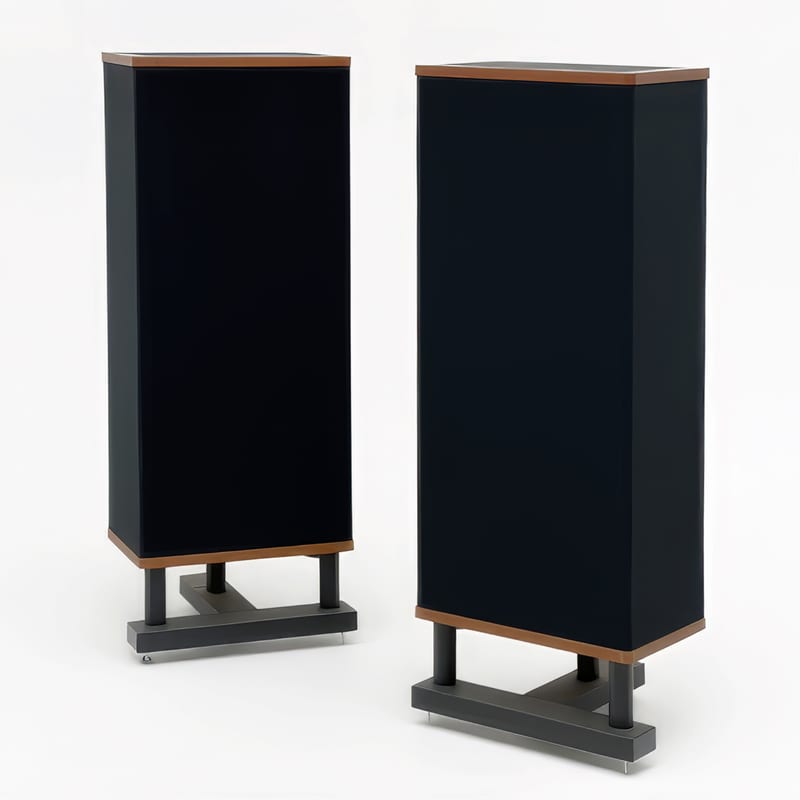
Vandersteen Audio — The Time-Coherent Floorstander (1977 onwards)
Richard Vandersteen introduced the Model 2 in 1977 with a design philosophy that paralleled Thiel's in its insistence on time and phase coherence, but deployed it in a form that was far more commercially accessible. The stepped-baffle arrangement, which places each driver at the acoustic centre of the ones adjacent to it, achieves first-order crossover alignment with a simplicity of visual expression that belied the engineering discipline required to execute it consistently. The Model 2 has been continuously refined and improved since its introduction and remains in production today, a demonstration that the principles that made it relevant in 1977 have not been superseded. Vandersteen's subsequent development of the Model 5 and Model 7, the latter with powered carbon-fibre bass enclosures, continued to develop the time-coherent philosophy into the reference class without abandoning the accessibility that had always characterized the brand.
Harbeth — The BBC Monitor for the Home (1977 onwards)
H.D. Harwood left the BBC's research department to found Harbeth in 1977, taking with him a deep understanding of the principles that had governed the BBC's monitor program and the conviction that those principles could be applied to domestic loudspeakers with results as musically satisfying as anything the studio environment had produced. The HL series and later the Compact 7, Monitor 30, and Monitor 40 brought the BBC's emphasis on midrange accuracy, controlled directivity, and truthful vocal reproduction to a worldwide audience of listeners who valued what music communicated over what measurements demonstrated. Harbeth's use of synthetic polymer diaphragms, developed in direct continuation of the BBC research program, produced a distinctive midrange quality that has been among the most discussed and admired in the loudspeaker world for four decades.
ProAc — The Domestic Monitor (1979 onwards)
Stewart Tyler founded ProAc in 1979 with a design philosophy that drew on the BBC monitoring tradition while prioritizing the musical qualities of domestic listening over the clinical demands of professional broadcast. The Response series established ProAc as a manufacturer whose loudspeakers combined transparency, coherent imaging, and a natural ease with the music that won them devoted followings among both reviewers and long-term owners. The ProAc Tablette and Studio 100 became reference points in the discussion of what a small loudspeaker could achieve in a domestic room, and the company's subsequent reference-class designs have maintained the musical directness that characterized the brand from its earliest products.
SoundLab — The Full-Range Electrostatic at Scale (1978 onwards)
Dr. Roger West founded SoundLab in 1978 with an ambition that most considered technically unrealizable: a full-range electrostatic loudspeaker capable of the dynamic range and bass extension required for a convincing reproduction of large-scale orchestral music. West's solution was to build electrostatic panels of very large physical area, accepting the room-placement challenges this imposed in exchange for the acoustic headroom that scale provides. The SoundLab A-1, and the subsequent Majestic and Ultimate series, achieved a combination of dynamic authority and electrostatic transparency that remains genuinely exceptional. For those willing to accommodate their demands, SoundLab's designs have consistently provided one of the most convincing reproductions of the concert hall that domestic audio has produced.
Focal (JM Lab) — French Driver Technology (1979 onwards)
Jacques Mahul founded Focal in Saint-Étienne in 1979 with the intention of developing loudspeaker drivers of a quality that the French market had never previously produced domestically. The company's early work on inverted-dome tweeters and distinctive cone materials established engineering credentials that its subsequent products would build upon consistently. Focal's development of the W-sandwich composite cone, a ROHACELL foam core between two glass-fibre skins, provided a combination of rigidity and low mass that significantly reduced cone breakup modes and the associated distortion. The later development of pure beryllium tweeters and flax-fibre woofers continued this commitment to material innovation. Focal's Grande Utopia and Scala Utopia have been among the reference-class loudspeakers of the past two decades, and the company has established itself as one of the most commercially and technically significant loudspeaker manufacturers in the world.
MBL — The Omnidirectional Radialstrahler (1979 onwards)
Wolfgang Meletzky's MBL Radialstrahler is one of the most genuinely original transducer concepts in loudspeaker history. Its omnidirectional driver, constructed from aluminum and magnesium petals that flex radially in response to the audio signal, radiates sound equally in all directions, not as an approximation, but as an engineered consequence of the geometry. The MBL 101, and its successive refinements, produce a soundstage of spatial envelopment and scale that no conventional forward-firing loudspeaker can replicate, because they recreate the omnidirectional radiation of acoustic instruments rather than projecting a focused beam towards the listening position. The MBL has attracted a following among listeners who regard the spatial experience of live music as the primary criterion of reproduced sound, and it has maintained its position as the reference omnidirectional loudspeaker for more than forty years.
Meridian — Active Loudspeaker Design (1977 onwards)
Bob Stuart and Allen Boothroyd brought an unusual combination of signal processing expertise and loudspeaker engineering to Meridian, founded in 1977, and one of their most significant contributions was the systematic development of active loudspeaker design. By placing the crossover at line level before dedicated amplifiers drive each individual driver, active loudspeakers eliminate the insertion loss, phase anomalies, and power compression that passive crossovers introduce. Meridian's DSP series demonstrated that the advantages of active design were not theoretical: dynamics were cleaner, the bass was more controlled, and the spatial presentation was more precisely defined. The company's later work on digital room correction and streaming integration extended these principles into the modern era.
Paradigm — The Science of the Affordable Speaker (1982 onwards)
Paradigm's founding in Canada in 1982 was informed by the work of the National Research Council's acoustics laboratory, which provided a rigorous measurement methodology and a commitment to listening-panel validation that the company incorporated into its design process from the outset. The result was a series of loudspeakers that consistently outperformed their price point by margins that competitors found uncomfortable, demonstrating that the application of genuine engineering discipline to cost-controlled manufacturing could produce remarkable results. Paradigm's Signature and Reference series brought studio-grade measurement standards to the domestic market and helped establish the Canadian audio industry as a force in international high fidelity.
The Industry Matures: 1980 to 1995
The 1980s brought digital audio to the living room and, simultaneously, a renewed examination of what analogue loudspeaker design could achieve. Several of the great names of the modern high-end era were established in this period, and the landmark products of the decade continue to define the standards against which contemporary designs are measured.
Wilson Audio — The WATT and the WAMM (1981 onwards)
David Wilson's WAMM, the Wilson Audio Modular Monitor of 1981, was among the most ambitious loudspeaker projects ever undertaken commercially: a multi-enclosure reference system, adjustable in the time domain, that allowed the physical position of each driver module to be calibrated to the listening room. The WAMM weighed hundreds of kilograms and required professional installation, but it demonstrated a commitment to time alignment and acoustic coherence at a scale that no previous domestic loudspeaker had attempted.
The WATT (Wilson Audio Tiny Tot), originally conceived as a portable monitor for Wilson's own recording work, became one of the most successful high-end loudspeakers in history when paired with the Puppy bass module. Wilson's approach combined proprietary phenolic resin cabinet materials of extraordinary rigidity, obsessive driver selection from multiple manufacturers, and a time-alignment methodology that adjusted each module's position relative to the listening seat. The WATT/Puppy defined the modern high-end monitor and continues, in its current Alexandria and ALEXX incarnations, to set the standard for what a dynamically capable, tonally neutral, spatially precise loudspeaker can be.
Sonus Faber — The Cremonese Tradition (1983 onwards)
Franco Serblin founded Sonus Faber in Vicenza in 1983 with a design philosophy as distinctive as any in loudspeaker history: that the cabinet's acoustic contribution is not a flaw to be engineered away but a characteristic to be shaped and refined, as a violin maker shapes the resonance of a soundboard. The Electa, the Extrema, and eventually the Stradivari Homage, with its lute-shaped cabinet in solid wood and its explicit homage to the Cremonese luthiers, demonstrated that aesthetic beauty and acoustic honesty were not mutually exclusive. Sonus Faber's loudspeakers offered a tonal warmth, a spatial generosity, and a naturalness with stringed instruments and the human voice that their technically more clinical competitors often lacked. The brand's subsequent products, developed under Serblin's successors, have maintained the identity he established while extending its technical ambitions to the full reference class.
Apogee Acoustics — The Full-Range Ribbon (1981 to 1998)
Jason Bloom and Leo Spiegel's Apogee Acoustics, founded in 1981, produced what remain the most fully realized full-range ribbon loudspeakers ever offered commercially. The Scintilla, the Diva, and the Full Range used metal-foil ribbon diaphragms of very low mass driven directly by a magnetic field across their entire surface, eliminating the mechanical coupling losses of voice-coil designs and achieving a transient speed and a high-frequency articulation that dynamic drivers could not match. The Apogee's demands on amplification were severe, with the Scintilla's 1-ohm nominal impedance capable of driving some amplifiers to thermal destruction, and the requirement for very large floor area made them impractical for many rooms. But for those who could accommodate them and drive them adequately, the Apogee Full Range in particular offered a reproduction of orchestral music at realistic levels that few loudspeakers of any technology have equalled. The company's closure in 1998 ended a chapter that the audio world has mourned ever since.
Kharma — Dutch High-End Manufacturing (early 1990s onwards)
Charles van Oosterum founded Kharma in the Netherlands in the early 1990s, building loudspeakers at the upper reaches of the market using high-quality Accuton and diamond tweeters technologies, in carefully crafted enclosures. The Exquisite and Enigma series positioned Kharma at the summit of the market in terms of both price and finish, and the company has maintained a following among those who value that level of execution.
DALI — Danish Precision (1983 onwards)
The Danish Audio Loudspeaker Industries, founded in 1983, brought a commitment to research-led driver development and systematic listening evaluation to a market segment that had too often settled for competence over aspiration. DALI's development of proprietary wood-fibre cone materials, its work on hybrid tweeter modules combining dome and ribbon elements, and its consistent investment in driver manufacturing rather than purchasing from external suppliers produced a series of loudspeakers that offered, at their respective price points, a degree of transparency and tonal neutrality that their competitors found difficult to match. The Epicon, Megaline, and Kore represent the company's ambitions at the reference level, and DALI's consistent presence on review shortlists across multiple generations of products speaks to the durability of its engineering approach.
Avantgarde Acoustic — The Modern Horn (1991 onwards)
Holger Fromme and Matthias Ruff founded Avantgarde Acoustic in Germany in 1991 with the ambition of creating horn loudspeakers that combined the sensitivity and dynamic authority of classical horn design with the frequency response, distortion levels, and domestic proportions that the modern listener required. The Trio, the Duo, and the Uno offered horn-loaded reproduction from a spherical midrange horn of carefully calculated geometry, mated with powered bass systems that extended the low-frequency response to levels the horn alone could not achieve. The result was a sensitivity exceeding 100 dB/W/m combined with a dynamic coherence and a midrange directness that opened the horn loudspeaker to a new generation of listeners who had no access to the original Western Electric and Altec systems that had established the principle. Avantgarde demonstrated that the horn was not a museum piece but a living and evolving technology.
Rockport Technologies — The Art of the Cabinet
Andy Payor founded Rockport Technologies in Maine with a commitment to cabinet construction that represented, at the time of the company's first products, the most technically demanding approach in the commercial loudspeaker market. Payor's multi-laminate cabinets, constructed from layers of differing materials selected for their combined acoustic properties, achieved a structural rigidity and freedom from resonance that machined aluminum and conventional MDF could not match. The Antares, the Arrakis, and the more recent Avior and Atria placed Rockport among the small group of American manufacturers whose ambitions extended to the elimination of every significant source of coloration, one by one, until what remained was a loudspeaker that described the recording rather than itself.
The New Generation: 1995 to the Present
The turn of the millennium brought new materials, new manufacturing technologies, and a new generation of designers who had grown up with both the achievements and the limitations of what had come before. The loudspeakers of this era are, in many cases, the finest that have ever been made.
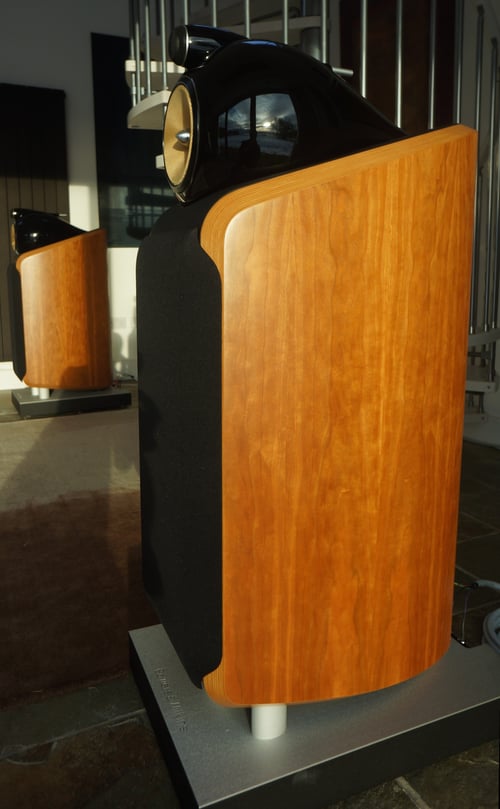
B&W Nautilus (1993) and the 800 Series Diamond
The B&W Nautilus of 1993, with its four drivers mounted in exponentially tapered tubes that absorbed rear-radiated energy progressively, was one of the most technically radical loudspeakers ever brought to commercial production. Its shell-like form, evolved from the principles of acoustic impedance matching, eliminated internal reflections without conventional absorption materials. Commercially limited by its price, its size, and its room requirements, the Nautilus was nonetheless the most important development in B&W's history: the technology it generated, particularly the matrix bracing philosophy and the approach to eliminating cabinet diffraction, found its way into the 800 Series Diamond, which has become one of the most widely used studio monitors in the world and one of the defining reference loudspeakers of the modern era.
Magico — Precision Engineering from the Ground Up (2004 onwards)
Alon Wolf founded Magico in California in 2004 with a design philosophy that applied aerospace manufacturing standards to loudspeaker construction with a thoroughness that no previous commercial manufacturer had attempted at scale. Wolf's sealed-box designs, constructed from machined aircraft-grade aluminum and later from carbon-fibre composites, offered a structural rigidity that eliminated the cabinet resonances and energy storage mechanisms that compromise the transparency of even well-designed loudspeakers. The Magico driver program, pursued with the same commitment to material science, produced woofers, midrange units, and tweeters that set new standards for bandwidth, linearity, and power handling. The Mini II, the S5, the Q7, and the M9 are among the clearest expressions of the proposition that loudspeaker performance is ultimately a materials science problem, and that the commitment of adequate resources to solving it produces results that prior generations of designers could not have achieved.
Revel — The Science of Directivity (1996 onwards)
Revel Loudspeakers, established as part of the Harman group's commitment to rigorous acoustic research, produced a series of designs in which the control of directivity, the way a loudspeaker's off-axis response relates to its on-axis response, was treated as the primary design criterion. Kevin Voecks' work at Harman, informed by the research of Floyd Toole and Sean Olive into the relationship between loudspeaker measurements and listener preference, produced the Salon, the Ultima Studio, and their successors: loudspeakers whose smooth, controlled directivity made them unusually forgiving of room acoustics and unusually consistent in their performance across a range of listening positions. Revel demonstrated that the science of preference was not merely academic, and that loudspeakers designed to its conclusions could compete at the highest levels of both professional and domestic use.
TAD — Technical Audio Devices (2007 onwards)
Pioneer's professional division had been producing high-quality drive units under the TAD brand for decades before Hiroshi Honda led the development of the TAD Reference One, introduced at the 2007 CES and recognized immediately as one of the most technically complete loudspeakers yet produced. The Reference One's concentric beryllium tweeter and midrange driver achieved point-source radiation from a single acoustic origin, while its bass enclosure brought the rigidity and freedom from resonance that high-power, extended-range transduction demands. TAD's subsequent Reference and Evolution series have maintained the technical ambitions of the original, producing loudspeakers that professional mastering engineers and serious domestic listeners regard with equal respect.
Raidho Acoustics — The Ribbon Driver Refined
Michael Børresen and Benno Meldgaard founded Raidho in Denmark with a commitment to ribbon driver technology of a precision that distinguished their designs from all previous commercial applications. Raidho's ribbon tweeters and, later, ribbon midrange drivers offered a transient response, a high-frequency extension, and a resolution of low-level detail that metal-dome and fabric-dome alternatives could not approach. The company's enclosure design, informed by a disciplined approach to lightweight, ultra-rigid structures, complemented the driver's capabilities with a cabinet whose contribution to the sound was minimal. The Raidho C and D series represent the state of the art in ribbon-based domestic loudspeaker design, and the brand's technical achievements have been recognized consistently by the international press and by the ears of those fortunate enough to hear them.
YG Acoustics — Machined Aluminum Precision
Yoav Geva founded YG Acoustics in Colorado with the conviction that a loudspeaker cabinet should be machined from solid aluminum billets with the same precision applied to aerospace components, and that the diaphragms of its drive units should be manufactured in-house to the same standard. The result, introduced in the Anat Reference of 2005, was a loudspeaker of exceptional geometric precision and structural integrity, in which the relationship between the enclosure's acoustic properties and the drive unit's behavior was controlled with a rigor that mass-produced wooden cabinets could not provide. YG's subsequent Sonja, Hailey, and Carmel series have maintained the manufacturing philosophy while refining the acoustic performance, and the company has established a reputation for consistency of execution that its admirers regard as unique in the industry.
Oskar Heil / ESS — The Air Motion Transformer (1964 / 1972)
Dr. Oskar Heil was a German-American physicist whose contributions to electronics extended from pioneering work on microwave generators to early concepts in field-effect transistor design. His invention of the Air Motion Transformer in 1964 added a third chapter to that remarkable biography. The AMT operates on a principle distinct from every other transducer technology: a pleated diaphragm of extremely low mass, suspended in a powerful magnetic field, squeezes and expands its folds rather than pistoning back and forth. The mechanical geometry means that the air it accelerates moves at approximately five times the velocity of the diaphragm itself, a ratio that delivers transient speed, low distortion, and a high-frequency articulation that dome and ribbon tweeters approach but rarely equal.
ESS brought the AMT1 to market in 1972, and for those who heard it the difference was immediate and irreversible. The patents eventually expired, and the principle has since been adopted by ADAM Audio, ELAC, Mundorf, MartinLogan, and dozens of others. The AMT tweeter today is a reference-class transducer technology used across the full range of professional and domestic loudspeaker design. That the idea originated with a physicist who had already helped invent the microwave generator says something about the kind of mind that changes the course of a field.
Philips Research Laboratories — The MFB Studio Monitors (early 1970s)
Among the most technically audacious loudspeaker projects ever undertaken by a major manufacturer, the Philips Motional Feedback series deserves a position in audio history that its commercial fate has not always secured it. Developed at the Philips Research Laboratories in Eindhoven under the direction of Piet Gouw, the MFB system attached a piezoelectric accelerometer to the underside of the woofer's dust cap. This sensor continuously measured the actual movement of the cone and compared it with the amplifier's input signal; any discrepancy generated an error-correction signal that modulated the amplifier output in real time. The result was a reduction in low-frequency distortion of an order that passive loudspeakers could not approach, combined with bass extension from a cabinet of a size that conventional design would have considered wholly inadequate.
The flagship RH545 studio monitor, a three-way active design with separate amplifiers for each driver section and a frequency response specified to within 1.5 dB between 45 Hz and 17 kHz, was a professional instrument in the fullest sense of the phrase. Philips RH544 monitors appeared at Britannia Row Studios during Pink Floyd recording sessions in the early 1980s, including sessions associated with The Final Cut. The technology proved too expensive and too unfamiliar for the mass market and was discontinued by the early 1980s. But the concept was entirely correct, and the engineers at Grimm Audio, Kii Audio, and PSI Audio who apply related error-correction principles to their current designs are working in a tradition that Philips established and that the audio world was not yet ready to recognise.
Backes & Müller — Active Control from First Principles (1972)
Friedrich Müller and Wolfgang Backes founded their company in Saarbrücken in the early 1970s with a conviction they held without compromise for the following five decades: that a passive loudspeaker, in which a single external amplifier drives multiple drivers through a passive crossover network, is a system burdened by losses, phase anomalies, power compression, and coupling inefficiencies that active design eliminates at a stroke. The first market-ready Backes & Müller loudspeaker, the Model 3, appeared in 1972. The company subsequently developed its own driver manufacturing capability and its own sensor-controlled feedback technology, the DMC system, which uses membrane sensors to monitor cone movement continuously and correct deviations from the input signal in real time.
The BM12, BM20, and the monumental BM30 became reference points in the German-speaking audio press over three successive decades, each representing the company's conviction that authentic reproduction required the amplifier and driver to function as a single, tightly coupled system rather than as independent components connected by a passive network. Backes & Müller's long insistence on active topology, and its willingness to develop the engineering required to execute it at the highest level, place it among the small group of European manufacturers whose technical philosophy has proven increasingly vindicated by the direction in which the industry as a whole has moved.
Dahlquist — The Point-Source Concept (1973)
Jon Dahlquist's DQ-10, introduced in 1973, was one of the first commercially available loudspeakers to address the time-domain relationships between drivers with genuine rigor. By mounting its drivers in a staggered, non-planar arrangement that approximated the time arrival of each frequency range at the listening position, the DQ-10 achieved a coherence and three-dimensionality that its contemporaries, most of which placed all drivers in a common flat baffle without regard for their differing acoustic centers, could not match. The DQ-10 was not perfect, but it asked the right questions, and the questions it asked have informed loudspeaker design ever since.
PSB Speakers — Canadian Science at Its Best (1972 onwards)
Paul Barton founded PSB in Canada in 1972 with the benefit of a close working relationship with the National Research Council's acoustics laboratory and Floyd Toole, whose research into the relationship between loudspeaker measurements and listening preference was transforming the scientific understanding of what loudspeakers should do. The result was a series of designs that consistently delivered flat power response, controlled directivity, and low distortion at price points that made serious audio accessible to those without unlimited budgets. PSB's Synchrony and Imagine series brought reference-quality engineering principles to the mainstream market and demonstrated, repeatedly, that the gap between affordable and excellent need not be as wide as the high-end industry sometimes implied.
IMF — The Transmission Line (1965 onwards)
Irving M. Fried introduced the transmission line loudspeaker enclosure to a wide audience through the IMF brand, demonstrating that the acoustic loading of a woofer via a carefully designed internal labyrinth could achieve bass extension and control that sealed and reflex designs found difficult to match. The transmission line's ability to absorb the rearward radiation of the bass driver without the abrupt acoustic discontinuity of a sealed box, while simultaneously loading its forward radiation for maximum efficiency at low frequencies, produced a bass quality, tuneful, articulate, and naturally decaying, that distinguished IMF loudspeakers immediately. The principle, refined and developed by TDL and subsequently by PMC for the professional market, has proven enduringly valuable wherever the reproduction of low-frequency music with accuracy and authority is required.
Vaessen Audiodesign — The Cabinet as Acoustic Sculpture
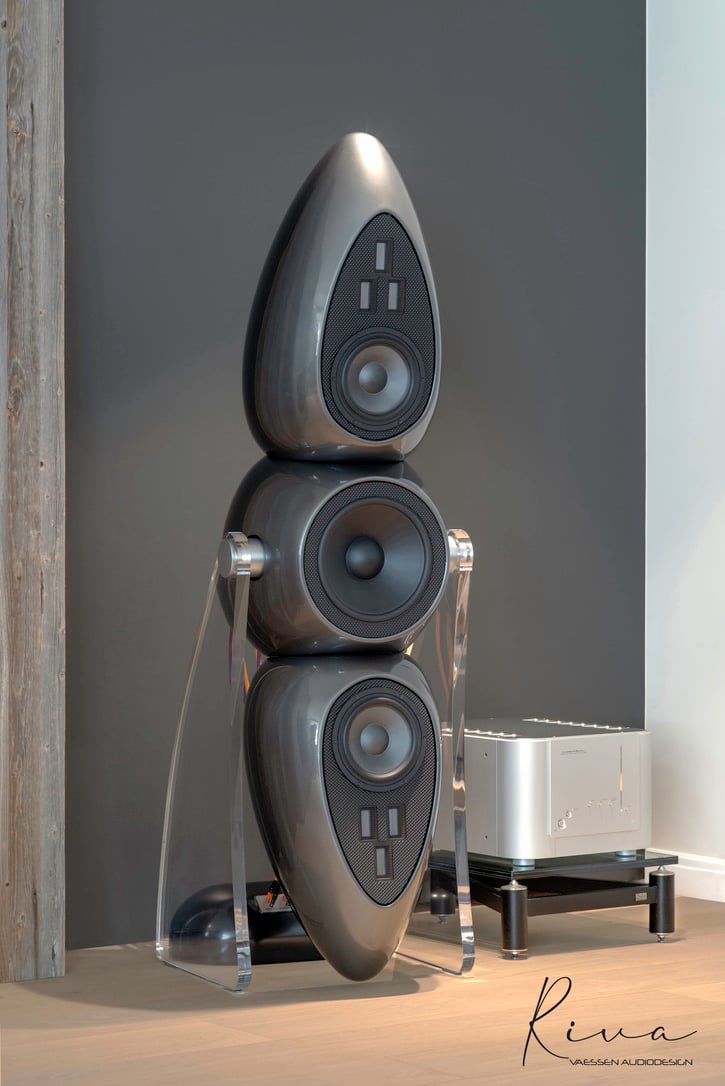
Koen Vaessen's Antwerp-based company represents a tradition of European artisanal loudspeaker design in which the form of the enclosure is determined not by manufacturing convenience but by acoustic necessity. The Aquarius and the subsequent New Aquarius abandoned the right-angled box in favor of shaped, asymmetric enclosures that eliminate parallel internal surfaces, and with them the standing waves and pressure build-up that rectangular cabinets inevitably produce. The philosophy treats the cabinet not as a container to be damped into neutrality but as an acoustic structure whose geometry determines the nature of the resonant field its drivers operate within.
Vaessen's use of carbon-fibre cone drivers, RAAL ribbon tweeters, and Mundorf and Duelund passive components throughout the crossover network reflects the same commitment to material honesty that governs the enclosure design: every element of the chain is chosen because it serves the signal, not because it meets a cost target. In a field that risks forgetting that engineering and craftsmanship are not opposites, Vaessen Audiodesign is a persuasive reminder that they can be the same thing.
Lipinski Sound — Passive Precision and the World's Only Full Class A Active Monitor
Professor Andrew Lipinski's contribution to loudspeaker history unfolds in two distinct yet connected chapters. Understanding them separately helps reveal what makes his life's work so exceptional.
The first chapter centers on the passive monitor. The L-505 and the classic L-707 are conventionally driven loudspeakers of uncompromising engineering integrity: phase-coherent, transient-accurate, and astonishingly revealing of the source. Their directness has earned trust at Mobile Fidelity Sound Lab, Warner Bros., Universal Music Group, NYU, McGill University, and the Moscow Conservatory, among many others. These are institutions where professional demands leave no room for embellishment.
The second chapter is without precedent in loudspeaker manufacturing. The active L-700, to the best of current knowledge, remains the world's only full Class A active loudspeaker. It is not Class A in the conditional sense used by others, but pure Class A throughout its entire operating range. This achievement demands profound mastery of thermal management, power delivery, and circuit precision.
Together, the L-707 and L-700 form a modular system architecture, scalable toward Grand or Signature configurations, preserving full phase integrity and tonal coherence at every stage. Each addition builds naturally upon the last because modularity was woven into the design from the outset, not appended as a marketing feature.
What unites both chapters is the Lipinski Square discrete operational amplifier, a patented topology unique to Lipinski Sound. Built entirely from hand-selected discrete Class A devices, free from integrated circuits, electrolytic capacitors, transformers, or coils in the signal path, the Lipinski Square underpins all Lipinski Sound components, from preamplifiers to the amplifiers driving the passive models. It stands as living proof that Class A amplification remains a vital, evolving discipline rather than a nostalgic relic.
Beyond the designs stands Professor Andrew Lipinski himself: an electronic engineer, recording engineer, and musician who founded the company simply because he needed better tools for his own recordings. Decades later, he still works with the same passion and determination as the early pioneers of the field, shaping technology not for commerce but for the love of music and absolute fidelity.
A Closing Observation
This survey has moved through more than eighty years of loudspeaker development without exhausting the subject, and it would be dishonest to pretend otherwise. What you have read is a selection, not a census. For every name on these pages there are five that are not: Quad's ESL-63 and its concentric ring radiator, the Manger sound transducer with its bending-wave diaphragm, the Gradient loudspeakers of Finland, the Vienna Acoustics tradition, the Electrovoice professional heritage, Cabasse's coaxial spherical enclosures, the electrostatic work of Stax in Japan, the transmission-line engineering of PMC, the ribbon designs of Raidho's predecessors in the Danish driver industry, and the countless custom and bespoke builders across Europe, the United States, and Japan who have pursued the same truth with equal seriousness and without the benefit of distribution networks or press coverage.
Equally outside the main narrative are the time-coherent floorstanders that John Dunlavy refined into the SC series, the Infinite Slope steep-crossover work of JSE, the white-cone Yamaha NS-10M that became the studio nearfield reference of an entire generation, and the bookshelf-form factor that the Cabasse Brigantin and the Vandersteen-adjacent designers carried forward in parallel.
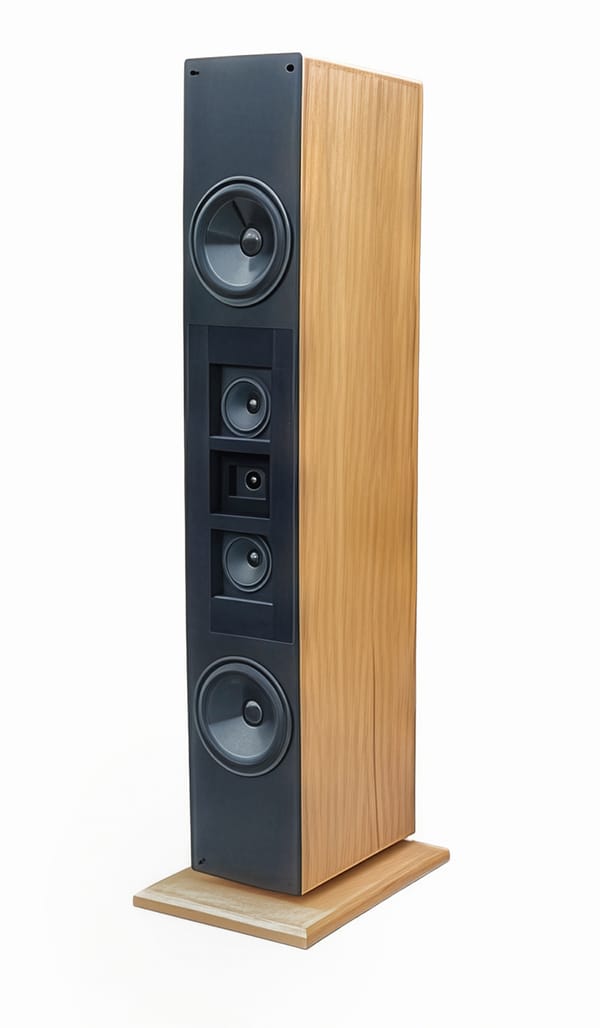
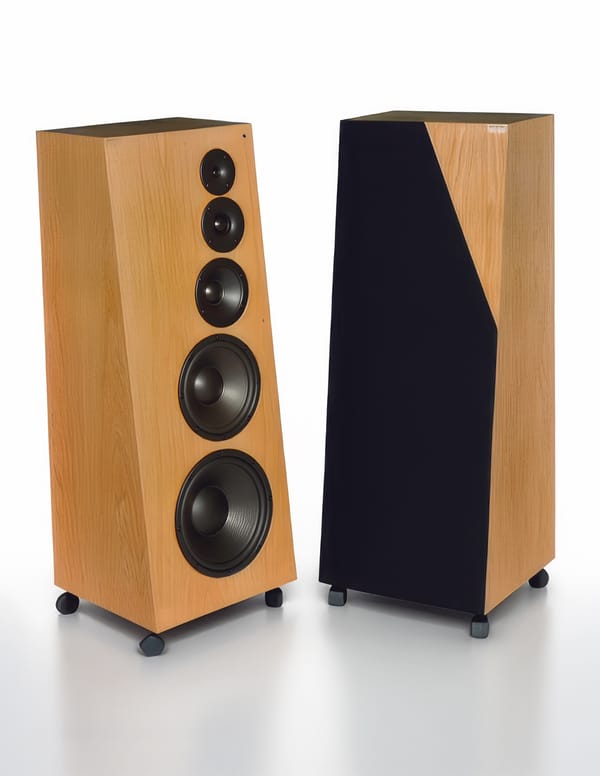

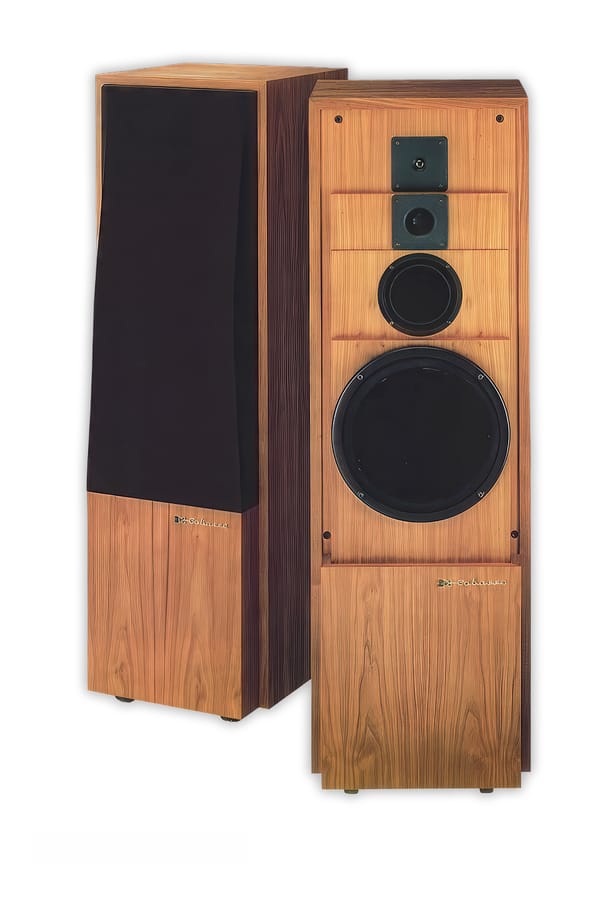
High-fidelity audio is a global discipline, and its history is longer, broader, and more richly populated than any single article can contain. What it has tried to demonstrate is that the history of the loudspeaker is not a history of incremental improvement along a single axis, but a history of competing philosophies, each illuminating a different aspect of the truth, each carrying a legitimate claim to the listener's attention.
Paul Klipsch and Edgar Villchur both wanted accurate sound. They arrived at designs that were in almost every technical respect opposites: one used the room, relied on horn loading, and achieved sensitivity through geometry; the other sealed its driver in a box, trusted the loudspeaker to work in isolation from its environment, and achieved accuracy through restraint. Both were right. The correctness depended on what aspect of the live experience you considered primary.
That tension, between efficiency and linearity, between forward-firing directivity and omnidirectional radiation, between the virtues of the cone and the virtues of the ribbon and the electrostatic panel, between the cabinet as neutral enclosure and the cabinet as tuned instrument, has never been resolved. It cannot be resolved.
The perfect loudspeaker does not exist, because the live acoustic event it attempts to recreate is itself the product of a room, a directional field, a temporal structure, and a set of physical dimensions that no domestic loudspeaker can simultaneously replicate.
What the great designers shared was the refusal to pretend otherwise. They built to the limit of what their chosen approach could achieve, they measured honestly, they listened with patience and skepticism, and they published what they found.
The best loudspeakers in this survey are not the loudest, the most expensive, or the most technically elaborate. They are the ones whose designers understood their own design's limitations as clearly as its virtues, and who nonetheless pursued those virtues to their natural conclusion.
The signal carries the music. The loudspeaker's sole obligation is to let it through.
Capturing every meaningful contribution within the audio industry is neither practical nor necessary; the companies, designers, and products highlighted here are representative rather than exhaustive, standing in for a far broader body of work that collectively shapes the craft and its ongoing evolution.
Questions about Loudspeaker History
What is the difference between acoustic suspension and bass-reflex loudspeakers? +
Acoustic suspension loudspeakers, pioneered by Edgar Villchur in the AR-1 (1954), use a sealed enclosure where trapped air acts as a restoring spring for the driver cone, producing accurate, extended bass from a compact cabinet. Bass-reflex designs use a ported enclosure to extend low-frequency output by tuning the cabinet resonance, trading some transient accuracy for greater efficiency.
The acoustic suspension approach prioritised accuracy over sensitivity and became the first loudspeaker technology that recording engineers trusted as a reference in normal rooms. It democratised serious listening and made high fidelity a domestic rather than purely professional pursuit.
How do electrostatic loudspeakers work and what are their advantages? +
Electrostatic loudspeakers move an ultra-thin, electrically charged diaphragm between two fixed stators using an electrostatic field. The diaphragm's vanishingly low mass allows it to respond to the audio signal with almost zero mechanical distortion, producing a midrange transparency that cone loudspeakers find extraordinarily difficult to match.
Peter Walker's Quad ESL 57 (1957) established the standard, offering freedom from cabinet resonances and crossover-induced coloration. Limitations include restricted bass extension, modest dynamic range, and sensitivity to placement. MartinLogan later addressed the narrow dispersion problem with curved stator panels, while SoundLab tackled dynamic range through sheer panel area. The electrostatic principle remains the benchmark for midrange transparency.
Why did magnet technology matter so much to loudspeaker development? +
The loudspeaker's entire trajectory has been shaped by its magnet. Alnico magnets gave the great JBL and Altec drivers their characteristic warmth and smooth transient response. Ferrite ceramics, from the late 1960s, democratised high-fidelity by making powerful motor systems affordable. Neodymium, arriving commercially in the mid-1980s, offered the same flux density as ferrite at one-tenth the weight, enabling smaller, faster, more transparent drivers.
Field-coil electromagnets, the oldest technology, remain the ultimate reference: adjustable, linear, and effortless, at the cost of complexity and a dedicated power supply. Each magnet material brought a distinct sonic signature and a different set of engineering trade-offs, and every great loudspeaker in history reflects its designer's choice among them.
What makes Lipinski Sound loudspeakers unique in audio history? +
Lipinski Sound operates in two distinct chapters. The passive L-505 and L-707 monitors are phase-coherent, transient-accurate reference tools trusted by Mobile Fidelity Sound Lab, Warner Bros., Universal Music Group, and leading universities worldwide. The active L-700, to the best of current knowledge, remains the world's only full Class A active loudspeaker — pure Class A throughout its entire operating range.
Both chapters are united by the patented Lipinski Square discrete operational amplifier, a topology built entirely from hand-selected discrete devices with no integrated circuits, electrolytic capacitors, transformers, or coils in the signal path. Professor Andrew Lipinski founded the company because he needed better tools for his own recordings, and decades later continues to push the boundaries of what Class A amplification and precision monitoring can achieve.