


"As long as we are concerned with the realistic reproduction of sound, the original sound must stand as the criterion by which the reproduction is judged!"
The audiophile world's discussion of vacuum tubes is too often filled with untested claims and mystical descriptions. This reference approaches them based on measurement, physics, and the pursuit of real performance. Understanding precisely how they work allows us to appreciate their unique qualities rather than attributing them to mystery.
Part 1: Engineering Fundamentals
A vacuum tube is an electronic device that controls the flow of electrons through a vacuum. The basic principle is straightforward: a heated cathode emits electrons through thermionic emission, a control grid modulates that electron flow, and an anode (plate) collects the electrons. By varying the voltage on the control grid, the tube amplifies small signals into larger ones. The vacuum itself serves as the medium through which electrons travel, free from the collisions that occur in gas-filled devices.
Every tube requires a heater (filament) to raise the cathode temperature to the point of electron emission. This is fundamentally different from solid-state devices, where current carriers exist at room temperature. The heater requirement means tubes consume more power, generate more heat, and have a finite lifespan as the cathode material slowly depletes. These are engineering facts, not deficiencies to be argued away.
Triodes
The triode was invented by Lee de Forest in 1906 with the addition of a control grid to Fleming's diode. It contains three electrodes: cathode, control grid, and anode. The control grid, positioned between cathode and plate, acts as a voltage-controlled valve. A small voltage change on the grid produces a proportionally larger change in plate current. This is amplification in its most elemental form.
Triodes are characterised by high linearity and relatively low gain. Their distortion spectrum is dominated by second-harmonic content, which the ear perceives as fullness and warmth rather than harshness. This is not mysticism but psychoacoustics: the second harmonic is exactly one octave above the fundamental, reinforcing the musical tone rather than conflicting with it.
Triodes come in two fundamental types. Directly-heated triodes (DHT) use the filament itself as the cathode. The 2A3, 300B, and 845 are prominent examples. Because the emitting surface is the filament wire, DHTs tend to have higher transconductance and a more immediate, tactile quality. They also require careful power supply design, as any ripple on the heater supply modulates the electron emission directly.
Indirectly-heated triodes use a separate heater element inside a cathode sleeve. The 12AX7, 12AU7, and 6SN7 are common examples. The thermal mass of the cathode sleeve filters out heater supply noise, making these tubes inherently quieter. Nearly all preamp tubes are indirectly heated.
Tetrodes and Pentodes
The tetrode adds a second grid, the screen grid, between the control grid and the plate. This screen grid shields the control grid from the plate, dramatically reducing the Miller capacitance that limits a triode's high-frequency response. The result is higher gain and wider bandwidth. However, tetrodes suffer from secondary emission: electrons knocked from the plate by incoming electrons can be attracted to the positive screen grid, causing a negative resistance region in the operating curve. This makes pure tetrodes unsuitable for audio output stages.
The pentode solves this by adding a third grid, the suppressor grid, between the screen grid and the plate. Connected to the cathode, the suppressor grid repels secondary electrons back to the plate. Pentodes offer the highest gain and power output of any tube type, but their distortion spectrum includes more third-harmonic content. At low levels, this is barely perceptible. At higher levels, third-harmonic distortion can sound harsh and fatiguing, which is why many listeners prefer triodes for critical listening.
Beam tetrodes represent an elegant compromise. Instead of a suppressor grid, beam-forming plates concentrate the electron stream into dense sheets. This beam effect naturally suppresses secondary emission. The 6L6, EL34, KT66, and KT88 are all beam tetrodes (the EL34 is technically a true pentode, though it is often grouped with beam tetrodes due to similar sonic characteristics). Beam tetrodes combine the power of pentodes with a distortion spectrum closer to triodes, which is why they dominate high-fidelity output stages.
The Physics of Harmonic Distortion
All amplifying devices produce harmonic distortion. What distinguishes tube types is not whether they distort, but how. The harmonic spectrum determines whether distortion is perceived as musically pleasant or objectionable.
| Harmonic | Relationship | Character | Dominant In |
|---|---|---|---|
| 2nd | Octave above fundamental | Full, warm | Triodes (SET) |
| 3rd | Twelfth above fundamental | Sharp, harsh at high amplitudes | Pentodes, tetrodes |
| 4th | Two octaves above | Rough, increasingly dissonant | Overdriven circuits |
| 5th+ | Increasingly inharmonic | Fatiguing, unmusical | Clipping, severe overload |
Second-harmonic distortion, at moderate levels, is perceived as richness. A triode producing 1-3% second-harmonic distortion can sound musically engaging without any obvious distortion. Third-harmonic distortion is less forgiving. Even at 0.5%, it can introduce an edge that becomes fatiguing over extended listening. This is measurable and repeatable, not a matter of opinion.
Single-Ended vs Push-Pull
In a single-ended triode (SET) amplifier, one output tube handles the entire signal waveform. The tube operates in class A, conducting current throughout the full cycle. The distortion spectrum is dominated by even-order harmonics, primarily the second. Because SET amplifiers do not cancel even harmonics, they produce a characteristic fullness that many listeners find deeply satisfying with acoustic music, vocals, and small ensembles.
The trade-off is power. A 300B SET produces 8-10 watts. A 2A3 SET produces 3-4 watts. These amplifiers demand high-sensitivity speakers, typically 93 dB/W/m or above. With the right speakers in a moderate room, the result can be extraordinarily transparent and immediate. With low-sensitivity speakers, the amplifier simply runs out of headroom, and the distortion rises sharply.
Push-pull amplifiers use pairs of tubes operating in antiphase. Each tube handles one half of the waveform. This arrangement cancels even-order harmonics in the output transformer, leaving primarily odd-order distortion. The cancellation is never perfect in practice, and a well-designed push-pull amplifier retains enough even-harmonic content to sound musical. The advantage is substantially higher power: a pair of EL34s in push-pull delivers 50-70 watts, enough to drive most speakers with authority.
Neither topology is inherently superior. SET excels at low-level detail, midrange texture, and spatial information. Push-pull excels at dynamic range, bass control, and speaker compatibility. The choice depends on speakers, room size, and musical preferences.
The Transistor Question
The honest comparison between tubes and transistors requires abandoning tribal allegiances. Transistors are quieter, more reliable, more efficient, and offer wider bandwidth. A well-designed solid-state amplifier can achieve distortion figures orders of magnitude below any tube amplifier. On paper, the transistor wins every specification.
Yet specifications do not tell the full story. Transistor distortion characteristics deteriorate sharply near clipping. Where a tube amplifier's distortion rises gradually and predominantly in even harmonics, a transistor amplifier transitions abruptly from very low distortion to harsh, odd-order clipping. In practice, this means a tube amplifier handles momentary overloads more gracefully.
Negative feedback, used heavily in most solid-state designs, reduces measured distortion but can introduce transient intermodulation distortion (TIM). When the feedback loop cannot respond quickly enough to fast transients, the amplifier briefly operates open-loop with much higher distortion. This effect is subtle, frequency-dependent, and difficult to measure with steady-state test signals, but it can affect the perceived naturalness of transient-rich music.
The sound differences between tubes and transistors depend more on design decisions than on the active devices themselves. A tube amplifier with heavy negative feedback and a wide bandwidth output transformer can sound remarkably like a solid-state amplifier. A zero-feedback transistor amplifier in class A can exhibit some characteristics typically associated with tubes. The device is a tool. The designer's intent determines the result.
The Real Advantages of Vacuum Tubes
Stripped of mythology, vacuum tubes offer four genuine engineering advantages in audio applications:
1. Design simplicity. A complete tube amplifier can be built with fewer than twenty components. The signal path is short, the circuit topology is transparent, and every component's contribution is audible and tuneable. This simplicity allows designers to optimise each stage without the complexity of feedback networks, protection circuits, and bias servos that solid-state designs require.
2. Overload characteristics. Tubes clip gradually, with distortion rising smoothly as the signal approaches the rails. This soft clipping preserves the envelope of transients rather than squaring them off. For music with wide dynamic range, this behaviour provides a subjective sense of greater headroom than the measured power suggests.
3. Power supply interaction. In many tube amplifiers, the power supply sags slightly under load. This dynamic compression, while technically a form of distortion, can enhance the perceived body and sustain of musical notes. It is a well-understood effect that skilled designers either exploit or eliminate depending on the intended character of the amplifier.
4. Proven engineering. Tube circuit topologies have been refined over more than a century. The design principles are mature, well-documented, and thoroughly understood. There are no hidden failure modes or undiscovered non-linearities. What you measure is what you hear.
Part 2: The Tube Database
The following reference covers the most important tubes in high-fidelity audio. Each entry includes key electrical specifications, socket type, common equivalents, and practical notes. Specifications are typical values under standard operating conditions as published in manufacturer datasheets.
Preamp Tubes
12AX7 / ECC83
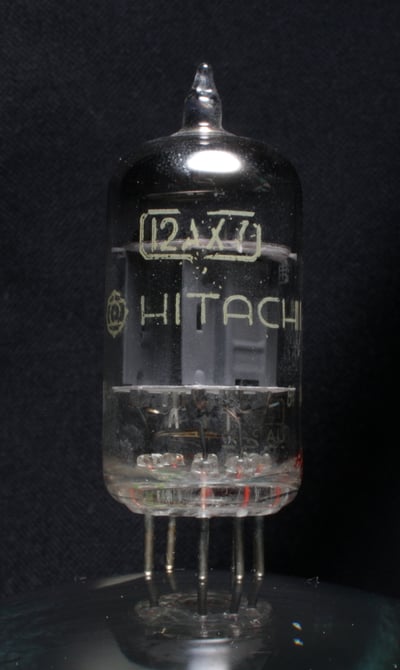
The most widely used preamp tube in audio. A dual triode with high gain, the 12AX7 appears in virtually every tube preamplifier and as the input tube in most tube power amplifiers. Its high amplification factor makes it ideal for phono stages and line-level gain stages. Quality varies significantly between manufacturers, making tube selection critical in this position.
| Parameter | Specification |
|---|---|
| Type | Dual Triode |
| Amplification Factor (μ) | 100 |
| Plate Resistance (Rp) | 62,500 Ω |
| Transconductance (gm) | 1,600 μS |
| Max Plate Voltage | 300 V |
| Max Plate Dissipation | 1.2 W |
| Heater | 12.6 V / 150 mA or 6.3 V / 300 mA |
| Socket | Noval B9A (9-pin miniature) |
| Equivalent | Notes |
|---|---|
| ECC83 | European designation, identical specification |
| 7025 | Low-noise industrial version |
| 5751 | Military grade, μ=70 (lower gain, often preferred in phono stages) |
| CV4004 | British military specification (Mullard, Brimar) |
| ECC803S | Telefunken premium grade, selected for low noise and microphonics |
12AT7 / ECC81
The medium-gain member of the 12A_7 family. Lower amplification factor than the 12AX7 but significantly higher transconductance and lower plate resistance. This makes it faster and more neutral sounding, with excellent transient response. Commonly used as a phase inverter, driver tube, and in reverb circuits. Its lower gain and higher current capability often make it a better choice than the 12AX7 for line stages where voltage gain is less critical than signal handling.
| Parameter | Specification |
|---|---|
| Type | Dual Triode |
| Amplification Factor (μ) | 60 |
| Plate Resistance (Rp) | 10,900 Ω |
| Transconductance (gm) | 5,500 μS |
| Max Plate Voltage | 300 V |
| Max Plate Dissipation | 2.5 W |
| Heater | 12.6 V / 150 mA or 6.3 V / 300 mA |
| Socket | Noval B9A (9-pin miniature) |
| Equivalent | Notes |
|---|---|
| ECC81 | European designation, identical specification |
| 6201 | Premium industrial version, tighter tolerances |
| CV4024 | British military specification |
| ECC801S | Telefunken premium grade, ruggedised |
12AU7 / ECC82
The lowest-gain member of the 12A_7 family, and arguably the most neutral sounding. With an amplification factor of only 17, the 12AU7 provides modest voltage gain but excellent current drive. It is the standard choice for cathode follower stages, headphone amplifiers, and any application where low distortion and high linearity matter more than gain. Many audiophile preamplifiers use the 12AU7 precisely because its low gain forces a simpler signal path with fewer gain stages.
| Parameter | Specification |
|---|---|
| Type | Dual Triode |
| Amplification Factor (μ) | 17 |
| Plate Resistance (Rp) | 7,700 Ω |
| Transconductance (gm) | 2,200 μS |
| Max Plate Voltage | 300 V |
| Max Plate Dissipation | 2.75 W |
| Heater | 12.6 V / 150 mA or 6.3 V / 300 mA |
| Socket | Noval B9A (9-pin miniature) |
| Equivalent | Notes |
|---|---|
| ECC82 | European designation, identical specification |
| 5814A | Military grade, ruggedised, tighter tolerances |
| CV4003 | British military specification (Mullard, Brimar) |
| 6189 | Industrial version, matched sections |
6SN7
An octal-base dual triode that predates the miniature 12AU7 but remains preferred by many designers. The 6SN7 has similar gain to the 12AU7 but significantly higher current capability due to its larger physical structure. This translates to better dynamics and a more authoritative presentation. Many of the finest preamplifiers ever made use the 6SN7, including designs from Cary, Atma-Sphere, and Supratek. The larger glass envelope also means lower operating temperatures and longer life.
| Parameter | Specification |
|---|---|
| Type | Dual Triode |
| Amplification Factor (μ) | 20 |
| Plate Resistance (Rp) | 7,700 Ω |
| Transconductance (gm) | 2,600 μS |
| Max Plate Voltage | 450 V |
| Max Plate Dissipation | 5 W (per section) |
| Heater | 6.3 V / 600 mA |
| Socket | Octal (8-pin) |
| Equivalent | Notes |
|---|---|
| 6CG7 | Noval equivalent, similar characteristics in smaller envelope |
| 6SN7GTA | Higher voltage rating (450V), improved reliability |
| 6SN7GTB | Controlled warm-up version, further improved ratings |
| CV1988 | British military specification |
6SL7
The high-gain counterpart to the 6SN7 in octal format. With an amplification factor of 70, the 6SL7 bridges the gap between the 12AX7's high gain and the 6SN7's low gain. It has a reputation for a smooth, liquid midrange that makes it popular in phono stages and high-gain preamp designs. The higher plate resistance means it is more sensitive to load impedance and cable capacitance than the 6SN7.
| Parameter | Specification |
|---|---|
| Type | Dual Triode |
| Amplification Factor (μ) | 70 |
| Plate Resistance (Rp) | 44,000 Ω |
| Transconductance (gm) | 1,600 μS |
| Max Plate Voltage | 300 V |
| Max Plate Dissipation | 1 W (per section) |
| Heater | 6.3 V / 300 mA |
| Socket | Octal (8-pin) |
| Equivalent | Notes |
|---|---|
| 6SR7 | Single triode + diode variant, partial equivalent |
| 7F7 | Loctal base dual triode, similar characteristics |
| 5691 | Premium red-base RCA version, selected and ruggedised |
6DJ8 / 6922 / ECC88
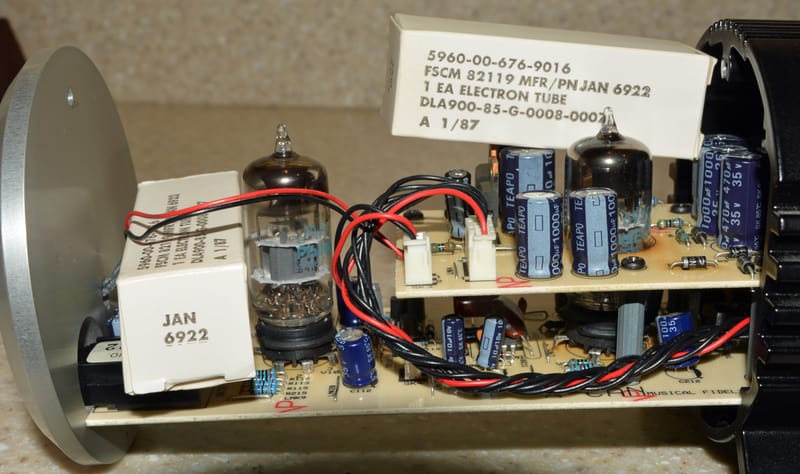
Originally designed for television tuner front ends, the 6DJ8 has become one of the most popular preamp tubes in high-end audio. Its exceptionally high transconductance (12,500 μS) and very low plate resistance (2,600 Ω) give it superb noise performance and excellent driving capability. The 6922/E88CC is the long-life, premium-grade version with tighter tolerances and improved reliability. Many of the finest DACs and phono stages use this tube family.
| Parameter | Specification |
|---|---|
| Type | Dual Triode |
| Amplification Factor (μ) | 33 |
| Plate Resistance (Rp) | 2,600 Ω |
| Transconductance (gm) | 12,500 μS |
| Max Plate Voltage | 130 V (6DJ8) / 220 V (6922) |
| Max Plate Dissipation | 1.8 W (per section) |
| Heater | 6.3 V / 365 mA |
| Socket | Noval B9A (9-pin miniature) |
| Equivalent | Notes |
|---|---|
| 6922 / E88CC | Long-life version, higher max plate voltage (220V) |
| ECC88 | European designation for 6DJ8 |
| PCC88 | Series heater version (7V), not directly interchangeable |
| 7308 / E188CC | Ultra-premium grade, 10,000 hour life, tightest tolerances |
12AY7 / 6072
A lower-gain alternative to the 12AX7 that is often overlooked. With an amplification factor of 40, the 12AY7 provides roughly half the gain of the 12AX7 while offering better signal-to-noise ratio and lower microphonics. Originally the standard first-stage tube in early Fender amplifiers before being replaced by the 12AX7 for higher gain. In phono stages and low-level applications, the 12AY7 can provide a quieter, more transparent result than the 12AX7, particularly with moving magnet cartridges that produce sufficient output voltage.
| Parameter | Specification |
|---|---|
| Type | Dual Triode |
| Amplification Factor (μ) | 40 |
| Plate Resistance (Rp) | 25,000 Ω |
| Transconductance (gm) | 1,600 μS |
| Max Plate Voltage | 330 V |
| Max Plate Dissipation | 2.5 W |
| Heater | 12.6 V / 150 mA or 6.3 V / 300 mA |
| Socket | Noval B9A (9-pin miniature) |
| Equivalent | Notes |
|---|---|
| 6072 / 6072A | Military/industrial grade, selected for low noise |
| 12AX7 (partial) | Pin-compatible but higher gain (μ=100), not a true equivalent |
Power Tubes
300B and 2A3
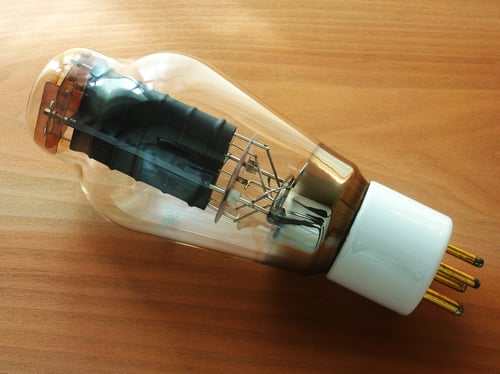
The two most celebrated directly-heated triodes in audio. The 300B, originally developed by Western Electric in the 1930s for telephone repeater amplifiers, has become the icon of single-ended triode amplification. The 2A3, contemporary with the 300B, offers lower power but even greater linearity. Both use the UX4 four-pin socket and require DC heater supplies for lowest noise.
| Parameter | 300B | 2A3 |
|---|---|---|
| Type | Directly-Heated Triode | Directly-Heated Triode |
| Amplification Factor (μ) | 3.85 | 4.2 |
| Plate Resistance (Rp) | 700 Ω | 800 Ω |
| Transconductance (gm) | 5,500 μS | 5,250 μS |
| Max Plate Voltage | 450 V | 300 V |
| Max Plate Dissipation | 40 W | 15 W |
| Typical SE Output | 8–10 W | 3–4 W |
| Heater | 5 V / 1.25 A | 2.5 V / 2.5 A |
| Socket | UX4 (4-pin) | UX4 (4-pin) |
The 300B's 40W plate dissipation allows significantly more output power than the 2A3's 15W, but both require high-sensitivity speakers (93+ dB/W/m) for realistic listening levels. In the right system, the 2A3 can be the more transparent and resolving of the two, with a purity that the 300B cannot quite match. The 300B offers more authority and bass control. Neither should be used with speakers below 90 dB sensitivity.
EL34 / KT77
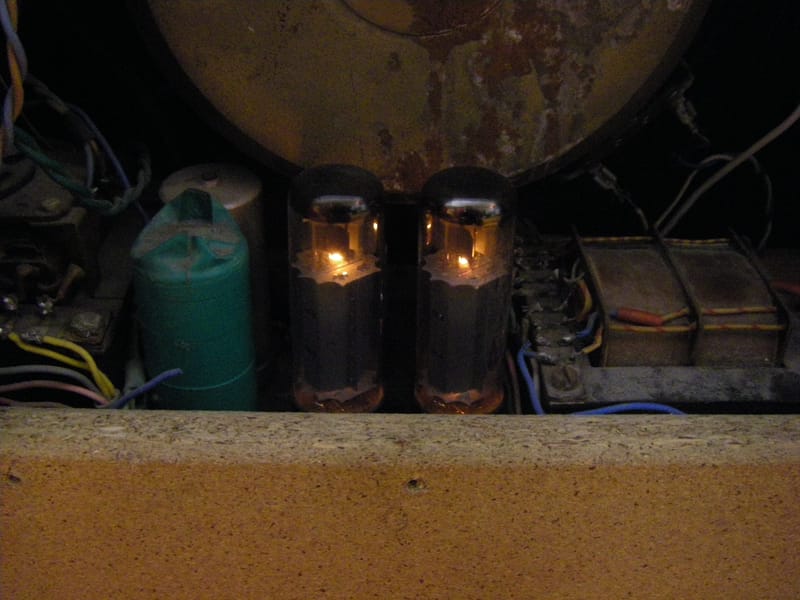
The EL34 is a true pentode, developed by Mullard in 1953, and arguably the most musical power tube ever made. It combines power with a richness in the midrange that beam tetrodes rarely match. The KT77 is the beam tetrode equivalent, pin-compatible, with slightly different characteristics: tighter bass, more extended highs, and a more neutral tonal balance. Both are Octal-based and typically run in push-pull pairs or quads.
| Parameter | EL34 | KT77 |
|---|---|---|
| Type | Pentode | Beam Tetrode |
| Max Plate Voltage | 800 V | 800 V |
| Max Plate Dissipation | 25 W | 25 W |
| Max Screen Voltage | 425 V | 425 V |
| Typical PP Output (pair) | 50–70 W | 50–70 W |
| Typical PP Output (quad) | 80–100 W | 80–100 W |
| Heater | 6.3 V / 1.5 A | 6.3 V / 1.5 A |
| Socket | Octal (8-pin) | Octal (8-pin) |
The EL34 is the tube of British hi-fi: Leak, Quad, and Radford all used it extensively. Its midrange warmth and vocal presence make it particularly suited to acoustic and vocal recordings. The KT77, originally developed by GEC, is rarer but increasingly available from current manufacturers. It is essentially the beam tetrode answer to the EL34, with similar power but a more controlled tonal balance.
6L6GC / 5881
The quintessential American power tube. The original 6L6 was developed by RCA in 1936 and became the foundation of American amplifier design. The 6L6GC is the later, higher-rated version capable of 500V plate operation and 30W dissipation. The 5881 is a ruggedised military version with lower maximum ratings (400V, 23W) but improved reliability. Both are beam tetrodes with an Octal base.
| Parameter | 6L6GC | 5881 |
|---|---|---|
| Type | Beam Tetrode | Beam Tetrode |
| Max Plate Voltage | 500 V | 400 V |
| Max Plate Dissipation | 30 W | 23 W |
| Max Screen Voltage | 450 V | 400 V |
| Typical PP Output (pair) | 50–60 W | 35–45 W |
| Heater | 6.3 V / 900 mA | 6.3 V / 900 mA |
| Socket | Octal (8-pin) | Octal (8-pin) |
The 6L6 is the Fender sound. Its clean headroom, controlled bass, and clear midrange define the American amplifier tradition. In hi-fi, it appears in amplifiers from McIntosh, Fisher, and many contemporary boutique builders. The 5881 can substitute for the 6L6GC in circuits that do not exceed its lower voltage and dissipation ratings, but the reverse substitution is always safe.
KT88 / 6550
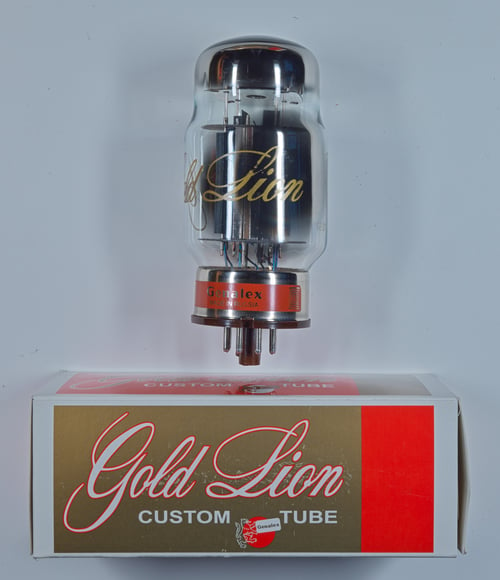
The heavyweight beam tetrodes of the tube world. The KT88, developed by GEC/MOV, and the 6550, developed by Tung-Sol, are the standard choices for high-power tube amplifiers. Both are Octal-based and produce prodigious power: a quad of KT88s in push-pull can deliver 100-200 watts depending on circuit topology. These are the tubes of choice for driving difficult, low-sensitivity speakers with full dynamic authority.
| Parameter | KT88 | 6550 |
|---|---|---|
| Type | Beam Tetrode | Beam Tetrode |
| Max Plate Voltage | 800 V | 600 V |
| Max Plate Dissipation | 40 W | 35 W |
| Max Screen Voltage | 600 V | 400 V |
| Typical PP Output (pair) | 80–100 W | 70–90 W |
| Typical PP Output (quad) | 150–200 W | 130–180 W |
| Heater | 6.3 V / 1.6 A | 6.3 V / 1.6 A |
| Socket | Octal (8-pin) | Octal (8-pin) |
The KT88 has the higher maximum ratings across the board: 800V plate voltage versus 600V, 40W dissipation versus 35W. When substituting KT88 for 6550, reduce bias slightly to account for the KT88's higher emission. The reverse substitution requires verifying that the circuit does not exceed the 6550's lower plate and screen voltage limits. Sonically, the KT88 tends toward a fuller, warmer presentation while the 6550 is leaner and more analytical.
EL84 / 6BQ5
A compact Noval-based pentode that punches well above its size. The EL84 produces only 12 watts of plate dissipation but delivers a surprisingly dynamic and musically engaging performance. Famous as the output tube of the Vox AC30 and numerous compact hi-fi amplifiers, the EL84 has a lively, expressive character with excellent midrange presence. A quad in push-pull can produce 20-30 watts, more than sufficient for sensitive speakers.
| Parameter | Specification |
|---|---|
| Type | Pentode |
| Max Plate Voltage | 300 V |
| Max Plate Dissipation | 12 W |
| Max Screen Voltage | 300 V |
| Typical PP Output (pair) | 15–17 W |
| Typical PP Output (quad) | 20–30 W |
| Heater | 6.3 V / 760 mA |
| Socket | Noval B9A (9-pin miniature) |
845 / 211
Transmitter triodes repurposed for high-power single-ended amplification. These are the largest tubes commonly used in audio, with anode voltages exceeding 1,000 volts. The 845, originally manufactured by RCA and United Electronics, produces 15-25 watts in single-ended class A, enough to drive moderately sensitive speakers with full dynamic range. The 211 offers lower power but similar sonic character. Both use the G17 socket and require extremely careful power supply design due to the lethal voltages involved.
| Parameter | 845 | 211 |
|---|---|---|
| Type | Directly-Heated Triode | Directly-Heated Triode |
| Max Plate Voltage | 1,500 V | 1,250 V |
| Max Plate Dissipation | 75 W | 40 W |
| Typical SE Output | 15–25 W | 10–15 W |
| Amplification Factor (μ) | 5.3 | 12 |
| Heater | 10 V / 3.25 A | 10 V / 3.25 A |
| Socket | G17 (4-pin, top cap anode) | G17 (4-pin, top cap anode) |
The 845 amplifier represents perhaps the ultimate expression of the single-ended philosophy: enough power for real-world use, triode linearity, and a directness that push-pull amplifiers rarely match. The cost and complexity of the power supply, the heat generated, and the safety considerations make these amplifiers a serious commitment. They reward that commitment with sound quality that can be genuinely extraordinary.
Rectifier Tubes
Rectifier tubes convert AC to DC in the power supply. While solid-state rectification is more efficient, tube rectifiers introduce a soft-start characteristic and a slight voltage sag under load that many designers and listeners prefer. The choice of rectifier tube affects the amplifier's dynamic character, particularly its recovery from transients and its subjective sense of power and flow.
| Parameter | 5U4G | 5Z3 | GZ34 / 5AR4 | 274B |
|---|---|---|---|---|
| Type | Full-wave | Full-wave | Full-wave | Full-wave |
| Max DC Current | 275 mA | 125 mA | 250 mA | 150 mA |
| Voltage Drop | High (soft) | High (soft) | Low (stiff) | Medium |
| Heater | 5 V / 3 A | 5 V / 2 A | 5 V / 1.9 A | 5 V / 2 A |
| Socket | Octal | UX4 | Octal | UX4 |
| Character | Warm, rich, classic SET sound | Smooth, organic, vintage | Tight, controlled, authoritative | WE heritage, refined midrange |
The GZ34/5AR4 is the most popular audiophile rectifier due to its low voltage drop and high current capacity. It provides the stiffest regulation of any common rectifier tube, yielding tight bass and controlled dynamics. The 5U4G, with its higher voltage drop, produces more power supply sag and a warmer, softer presentation that many SET enthusiasts prefer. The 274B is the Western Electric companion to the 300B and completes the classic WE signal chain.
Part 3: Equivalents, Selection, and Procurement
Tube equivalency is frequently misunderstood. A true equivalent has identical pinout, similar electrical characteristics, and can be substituted without circuit modification. A near-equivalent may share a socket but differ in gain, bias requirements, or maximum ratings. The tables below clarify these distinctions.
Quick Equivalency Reference: Preamp Tubes
| American | European | Military | Premium | Socket |
|---|---|---|---|---|
| 12AX7 | ECC83 | CV4004, 5751 | ECC803S, 7025 | Noval B9A |
| 12AT7 | ECC81 | CV4024, 6201 | ECC801S | Noval B9A |
| 12AU7 | ECC82 | CV4003, 5814A | 6189 | Noval B9A |
| 6DJ8 | ECC88 | 6922/E88CC | 7308/E188CC | Noval B9A |
| 6SN7 | — | CV1988 | 6SN7GTA/GTB | Octal |
| 6SL7 | — | 5691 | — | Octal |
Quick Equivalency Reference: Power Tubes
| Type | Equivalents | Caution | Socket |
|---|---|---|---|
| EL34 | KT77, 6CA7 | KT77 is beam tetrode, check bias | Octal |
| 6L6GC | 5881, KT66 | 5881 has lower max ratings | Octal |
| KT88 | 6550 | 6550 has lower max voltage and dissipation | Octal |
| EL84 | 6BQ5, 7189 | 7189 has higher max plate voltage | Noval B9A |
| 300B | None (unique) | No direct substitute exists | UX4 |
Cross-Family Substitution Notes
The 12AX7, 12AT7, and 12AU7 share the same Noval B9A pinout and heater configuration, making them physically interchangeable. However, their electrical characteristics differ significantly, and substituting one for another will change gain, frequency response, and bias conditions. The following table summarises the implications.
| Substitution | Effect | Safe? |
|---|---|---|
| 12AX7 → 12AT7 | Lower gain (μ 100→60), faster transients, more neutral | Generally safe, verify sufficient gain |
| 12AX7 → 12AU7 | Much lower gain (μ 100→17), significant level drop | Often insufficient gain, circuit-dependent |
| 12AX7 → 5751 | Slightly lower gain (μ 100→70), lower noise, tighter bass | Safe, often an improvement |
| 6SN7 → 6SL7 | Higher gain (μ 20→70), higher plate resistance | Not recommended, bias shift likely |
Socket Reference
| Socket Type | Pins | Common Tubes |
|---|---|---|
| Noval B9A | 9-pin miniature | 12AX7, 12AT7, 12AU7, 6DJ8, EL84 |
| Octal | 8-pin | 6SN7, 6SL7, EL34, KT88, 6550, 6L6, GZ34 |
| UX4 | 4-pin | 300B, 2A3, 274B, 5Z3 |
| G17 | 4-pin + top cap | 845, 211 |
NOS vs Current Production
NOS (New Old Stock) tubes are unused tubes from factories that have since closed. They represent the peak of industrial tube manufacturing, when automated production lines produced millions of units under strict quality control. The question of whether NOS tubes are genuinely better than current production is one of the most debated topics in audio.
Notable NOS Manufacturers
| Manufacturer | Country | Known For | Sought-After Types |
|---|---|---|---|
| Western Electric | USA | Unmatched build quality, legendary 300B | 300B, 274B, 310A |
| Mullard | UK | Rich, warm midrange, superb build | EL34, ECC83, GZ34, CV4004 |
| Telefunken | Germany | Precision, clarity, diamond-bottom | ECC83, ECC801S, ECC803S, EL34 |
| RCA | USA | Reliable, musical, wide range | 6L6GC, 6SN7, 5691, 5U4G |
| Sylvania | USA | Detailed, extended highs, open sound | 6SN7W, 6L6, 12AX7 |
| Amperex | NL / USA | Bugle Boy series, musical and transparent | 6DJ8, 6922, ECC83, EL84 |
| GEC / MOV | UK | Authoritative bass, dynamic, rare | KT88, KT66, KT77 |
Current Production Manufacturers
| Manufacturer | Country | Strengths | Notable Types |
|---|---|---|---|
| JJ Electronic | Slovakia | Consistent quality, good value, wide range | ECC83S, EL34, KT88, 300B |
| Psvane | China | Premium builds, NOS-like performance | 300B, KT88, 12AX7, 845 |
| Sovtek / EH | Russia | Affordable, reliable, industry standard OEM | 12AX7, EL34, 6L6, 6922 |
| Shuguang | China | Large range, Treasure series competitive | 300B, KT88, EL34, 845 |
| Western Electric (new) | USA | Restarted production, original tooling | 300B |
Recommendation Matrix
| Scenario | Recommendation | Rationale |
|---|---|---|
| Daily use, replaceable | Current production (JJ, Psvane) | Affordable, available, consistent |
| Critical preamp position | Tested NOS or premium current | Preamp tubes have greatest sonic impact |
| Power tubes, matched quad | Current production, factory matched | Matching NOS quads is expensive and unreliable |
| Collector / reference system | Verified NOS from reputable dealer | Buy from dealers who test and guarantee |
Tube Testing and Matching
Proper tube testing goes beyond the simple "good/bad" indication of vintage emission testers. Modern tube testing measures multiple parameters that determine both performance and longevity.
Key Test Parameters
| Parameter | What It Measures | Why It Matters |
|---|---|---|
| Transconductance (Gm) | Gain capability at operating point | Primary indicator of tube health and performance |
| Plate Current (Ip) | Current draw at set bias | Must match within pairs/quads for balanced operation |
| Grid Leakage | Unwanted current on control grid | Indicates contamination or end of life |
| Gas Content | Loss of vacuum integrity | Gassy tubes are unstable and can damage circuits |
| Microphonics | Sensitivity to mechanical vibration | Critical in preamp positions, less so in power stages |
| Noise Floor | Residual hiss and hum | Essential for phono stages and low-level circuits |
Matching Requirements
Push-pull pairs: Plate current matching within 5-10% is essential for balanced operation and low distortion. Transconductance matching is desirable but less critical.
Quad sets: All four tubes should be matched for plate current. In practice, two matched pairs (one for each phase) is acceptable and often more practical than a perfect quad.
Preamp dual triodes: Section-to-section balance within the same tube is important for phase splitter and differential applications. For simple gain stages, overall quality matters more than internal matching.
Single-ended output: No matching required since only one tube per channel is used. Select for lowest noise and desired tonal character.
Application Guide
Selecting tubes for a specific system depends on the amplifier topology, speaker sensitivity, room size, and musical preferences. The following table provides starting points for common system configurations.
| System Type | Recommended Output | Speaker Sensitivity | Notes |
|---|---|---|---|
| Near-field / desktop | EL84 PP or 2A3 SE | 85+ dB/W/m | Small room, low to moderate levels |
| High-sensitivity horns | 300B SE or 2A3 SE | 96+ dB/W/m | Ultimate transparency, low power sufficient |
| Medium speakers | EL34 PP or 845 SE | 89–93 dB/W/m | Most common audiophile scenario |
| Low-sensitivity floorstanders | KT88/6550 PP quad | 84–88 dB/W/m | Current and voltage to control difficult loads |
| Full-range electrostatics | KT88 PP or OTL (6AS7) | Varies | High voltage swing, stable into capacitive load |
For preamp tube selection: in phono stages, prioritise low noise and low microphonics. The 12AX7 is standard, but the 5751 and 12AY7 can offer better signal-to-noise ratio with sufficient gain. In line stages, the 6SN7 and 12AU7 offer the best linearity. In DAC output stages, the 6DJ8/6922 family excels due to its high transconductance and low output impedance.
Vacuum tubes are not magic. They are electronic devices with specific, measurable, and well-understood physical properties. Those properties produce sonic effects that many listeners find deeply satisfying. Understanding those effects allows us to use these devices more consciously, matching tube characteristics to circuit requirements and musical goals rather than relying on reputation or mythology. Music itself is the ultimate criterion.
Questions about Vacuum Tubes
What is the difference between a triode and a pentode? +
Triodes have three elements: cathode, control grid, and anode (plate). They produce primarily second-harmonic distortion, which is perceived as warmth and fullness because the second harmonic is exactly one octave above the fundamental. Triodes offer the highest linearity of any tube type and are the basis for single-ended triode (SET) amplifiers.
Pentodes add two more grids: a screen grid for higher gain and a suppressor grid to prevent secondary emission. This gives them higher gain and power output, but their distortion spectrum includes more third-harmonic content, which can sound sharper at higher levels. Triodes offer highest linearity; pentodes offer highest power at reasonable cost.
Can I substitute a KT88 for a 6550? +
With caution. Both share the Octal socket and similar pinout, but their maximum ratings differ significantly. The KT88 has higher plate dissipation (40W vs 35W) and higher maximum plate voltage (800V vs 600V). When substituting KT88 for 6550, bias reduction is typically required to avoid exceeding the amplifier's design parameters.
The reverse substitution (6550 in place of KT88) is more risky. You must verify the circuit does not exceed the 6550's lower ratings. In amplifiers designed specifically for KT88 with high plate voltages, the 6550 may not be safe. Always consult the amplifier manufacturer before substituting.
Are NOS tubes really better than current production? +
NOS tubes often represent the peak of industrial tube manufacturing, when factories like Mullard, Telefunken, and RCA produced millions of units under strict quality control. The best NOS specimens can offer superior sonics: lower noise, better microphonic rejection, and more refined tonal character. Some audiophiles consider certain NOS tubes irreplaceable.
However, supply is finite and declining. Prices are heavily inflated, storage history is usually unknown, and counterfeits are increasingly common. Modern tubes from JJ, Psvane, and restarted Western Electric now rival NOS in many applications and represent better value for most users. For power tubes especially, current production matched sets are often the more practical choice.
What tubes does a 300B SET amplifier use? +
A typical 300B SET amplifier uses one 300B directly-heated triode per channel as the output tube, producing 8-10 watts in single-ended class A. The 300B uses a 4-pin UX4 socket and requires a 5V heater supply at 1.25A, ideally DC-regulated for lowest noise.
It also requires a driver tube to provide voltage gain before the output stage. Common choices include the 6SN7 or 12AU7, though some designs use the 12AT7 or 6SL7. A rectifier tube, commonly the 5U4G or GZ34/5AR4, converts AC to DC in the power supply. The rectifier choice affects the amplifier's dynamic character: the GZ34 provides tighter bass, while the 5U4G gives a warmer, more relaxed presentation.