


"The reel-to-reel tape recorder represents the central instrument of recorded music as we know it."
The Magnetic Tape Machine: A Foundation of Professional Audio
The reel-to-reel tape recorder represents the central instrument of recorded music as we know it. For more than five decades, every significant recording – whether a symphony, a rock album, a radio broadcast, or a film soundtrack – passed through the record and playback heads of a magnetic tape machine before reaching any listener. The tape recorder did not merely capture sound; it shaped it, and in doing so shaped the entire culture of recorded music.
Understanding the tape recorder requires understanding its three inseparable dimensions: the mechanical transport that moves tape with precision, the electronic circuitry that encodes and decodes magnetic signals, and the tape itself, a chemical and physical medium that determines the ultimate boundary of what any machine can achieve. Each dimension has its own history, its own engineering tradition, and its own cast of manufacturers who devoted careers to its perfection.
The persistence of reel-to-reel tape in an era of digital recording reflects something beyond nostalgia. Mastering engineers, recording studios, and serious listeners continue to regard well-maintained tape machines running high-quality tape as reference-grade sources, capable of communicating musical truth in ways that digital formats, for all their measured precision, have not fully replicated.
Origins and Early Development
The Magnetophon and Its Legacy
Magnetic recording predates the tape recorder as most audiophiles know it. Valdemar Poulsen, a Danish engineer, demonstrated magnetic wire recording with his Telegraphone in 1898, establishing the fundamental principle that varying magnetic fields impressed upon a moving medium could store and reproduce sound. However, wire recording suffered from limited frequency response, high noise, and the practical inconvenience of metal wire that could snap, tangle, and injure operators.
The transformation came from Germany. AEG and BASF collaborated through the 1930s to develop the Magnetophon, a machine that replaced wire with a coated plastic tape. The Magnetophon K4, demonstrated publicly in 1935, achieved performance that wire recorders could not approach. The critical breakthrough came in 1940 when engineer Walter Weber, working at the Reich Broadcasting Corporation, discovered AC bias recording. By adding a high-frequency ultrasonic signal to the audio signal during recording, Weber found that the tape's magnetic particles aligned with dramatically greater linearity, reducing distortion and extending frequency response far beyond what DC bias recording allowed. This discovery, concealed from Allied engineers until after the war, became the foundation upon which all subsequent tape recording was built.
American Signal Corps engineers who encountered Magnetophons in captured German radio stations in 1945 recognized immediately that the machines operated at a quality level beyond anything available in the United States. The recordings they found – of full orchestras, broadcast at any hour of the night – were indistinguishable from live performances in their smoothness and bandwidth. Jack Mullin, an American Army officer and audio engineer, brought two Magnetophon machines and fifty reels of tape back to the United States, demonstrating them to the Institute of Radio Engineers in Hollywood in 1946. That demonstration changed the American recording industry permanently.
Ampex and the American Industry
Bing Crosby, unwilling to perform his radio programs live, heard Mullin's demonstrations and immediately grasped their implications. Pre-recorded programs of broadcast quality could be made at any time and aired whenever required. Crosby invested in Mullin's work and subsequently contracted with a small California company called Ampex to manufacture professional tape recorders based on the Magnetophon principles.
The Ampex Model 200, delivered in 1948, established the company's reputation instantly. Operating at 30 inches per second on half-inch tape, it achieved frequency response and dynamic range that no disc recording could match. Recording studios throughout Hollywood adopted Ampex machines within a year of their introduction. The Model 300 and Model 350 extended the product line, while the Model 351 became the standard professional mono machine of the 1950s. The Ampex 350 and 351 established the physical conventions – reel size, transport layout, head configuration – that subsequent professional machines followed for decades.
Ampex continued innovating with determination. The Ampex 300 series gave way to the pioneering Ampex 600, a portable machine that brought professional-quality recording outside the studio. The Ampex ATR-100 series, introduced in the 1970s, refined the transport and electronics to levels that many engineers considered definitive, and the ATR-102 in particular became one of the most respected mastering machines ever built. The Ampex ATR-104 extended the design to multitrack formats. Later, the Ampex ATR-700 brought similar engineering to a more compact format.
The company's most historically significant achievement may have been the development of multitrack recording. The Ampex Model 300-8, an eight-track machine developed for Les Paul in the early 1950s, enabled overdubbing and the layered recording techniques that transformed popular music. Les Paul's experiments with Ampex machines, creating recordings through multiple generations of layered performances, demonstrated possibilities that the recording industry would spend subsequent decades fully exploring.
Studer of Switzerland: The Complete Model History
No manufacturer contributed more comprehensively to professional tape recording than Studer, and a complete survey of their machines reveals an engineering progression of remarkable consistency and ambition. Willi Studer's insistence on building every component to the highest possible standard, rather than to a price point, produced machines whose longevity in professional service exceeded that of any competitor.
The Studer C37, introduced in 1957, established the company's professional credentials with a machine whose transport and electronics both exceeded the standards of its era. The C37's distinctive appearance – a combination of Swiss industrial precision and functional clarity that would characterize all subsequent Studer products – reflected Willi Studer's belief that aesthetic quality and engineering quality were inseparable expressions of the same discipline. The C37 found immediate acceptance in European broadcasting, where its reliability and sonic performance distinguished it from competing products.
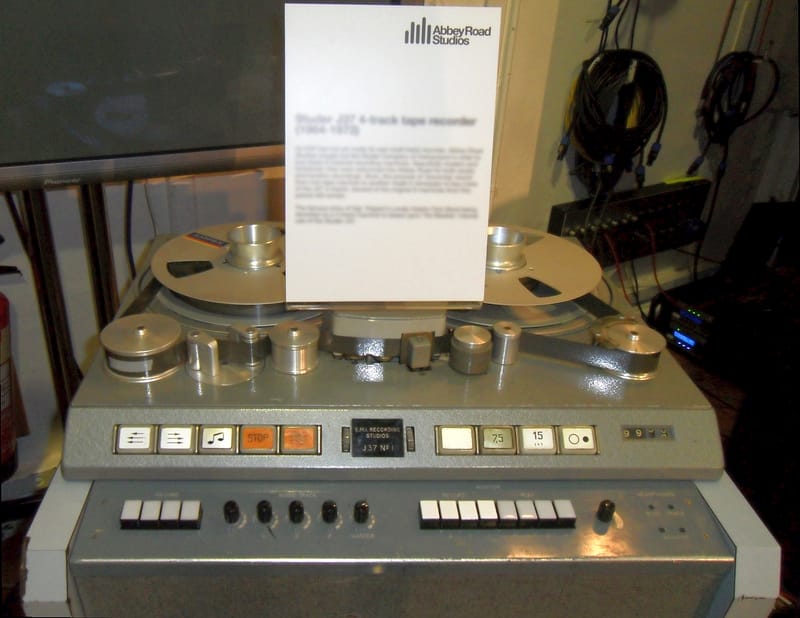
The Studer J37, a four-track machine introduced in 1964, achieved historical significance beyond its technical merits. The Beatles recorded the majority of their most significant work, including Sergeant Pepper's Lonely Hearts Club Band and Abbey Road, on Studer J37 machines at EMI's Abbey Road Studios. The J37's particular combination of transport characteristics, head design, and electronic character contributed to the sonic qualities of those recordings in ways that engineers who have attempted to replicate them on other machines consistently note. The machine's four-track configuration allowed the production techniques that George Martin and the Beatles developed, and its technical limitations – the restricted dynamic range and the particular distortion characteristics of its electronics – became creative tools rather than mere constraints.
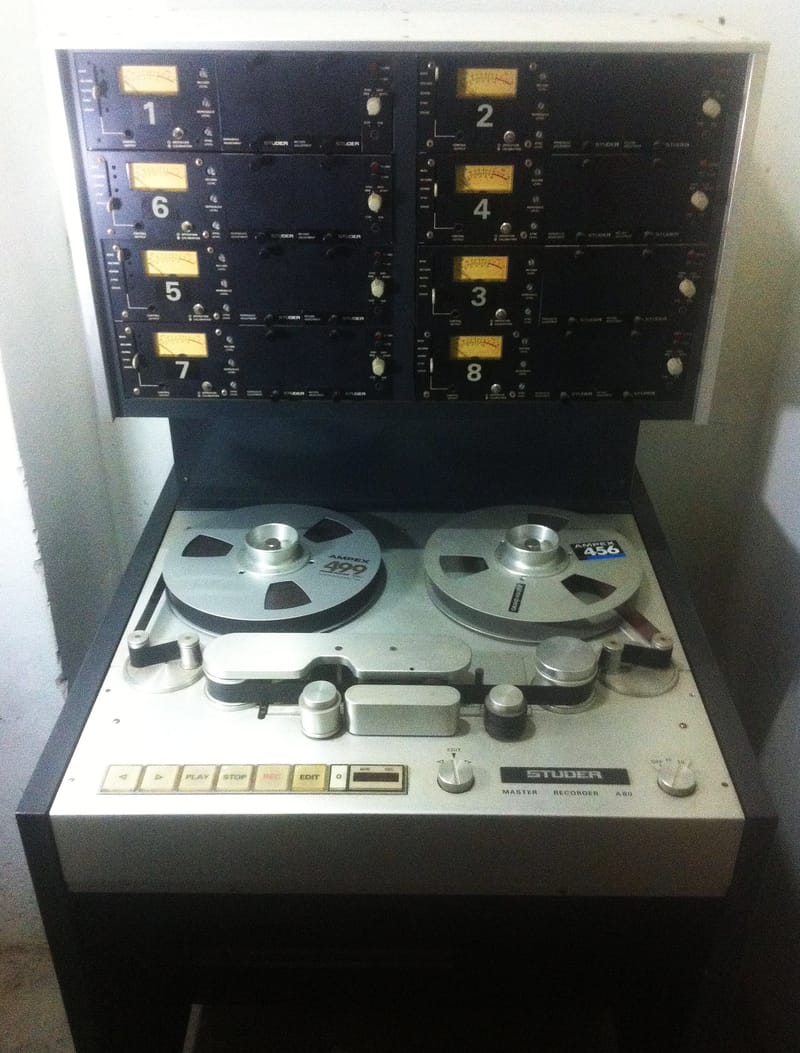
The Studer A80, the company's dominant product through the 1970s, was available in an extensive range of configurations. The A80 RC provided sophisticated automation capability for studio applications. The A80 VU addressed the requirements of facilities preferring VU metering to the A80's standard peak-reading meters. The A80 MK II incorporated revised electronics that addressed limitations identified through field experience with the original design. Special versions of the A80 were produced for specific broadcast applications, with custom track configurations and specialized remote control interfaces that reflected the particular requirements of individual customers.
The Studer A820 multitrack represented the company's final statement in analog multitrack recording. Its transport, with a closed-loop dual-capstan drive system whose servo electronics achieved speed stability measured in parts per million, set a standard that no subsequent machine has exceeded. The A820's modular electronics allowed individual channels to be removed and replaced without disturbing adjacent channels, a practical advantage of enormous value in working studio environments where a machine failure during a session requires rapid diagnosis and repair. The A820's automation interface, compatible with the major automation systems of its era, allowed the machine to participate in the computerized mixing and overdubbing workflows that had become standard in major studios by the mid-1980s.
The Studer A827, the final Studer multitrack machine, refined the A820 concept with improved transport mechanics and updated electronics while maintaining full compatibility with existing A820 operating procedures. The A827's production run was limited by the declining market for analog multitrack recording as digital formats captured the professional market, but the machines produced during its relatively brief production life are now among the most sought-after by studios maintaining analog recording capability.
The Studer A810, the company's stereo mastering machine of the 1980s, achieved near-universal acceptance in mastering studios. Its transport quality, derived from the A820 development program, combined with electronics specifically optimized for the two-track mastering application to produce a machine whose performance in that specific role exceeded even the A80's considerable capabilities. The A810's head-block, which combined record, sync, and playback heads in a precision assembly, could be replaced as a complete unit when head wear required it, a practical advantage that mastering studios, which operated their machines for extended hours daily, valued considerably.
The Studer A807 addressed the stereo mastering market with a two-track machine whose transport and electronics were specifically optimized for the requirements of mastering from multitrack sources. Its precision and reliability made it a standard fixture of mastering studios throughout its production run. The A810 extended this approach, offering enhanced electronic performance and flexibility in a machine that many mastering engineers preferred to its successor.
Studer's consumer and semi-professional division, operating under the Revox name, brought the company's engineering philosophy to a wider market. The Revox A77, introduced in 1967, achieved remarkable success as a high-quality home and semi-professional machine. Its direct-drive capstan motor, a genuine technical innovation at its price point, provided speed stability that belt-drive competitors could not match. The Revox B77 refined the A77 concept with improved electronics and ergonomics, becoming one of the best-selling quality tape recorders ever made. The Revox PR99 extended the design further into semi-professional territory, and the Revox B790 demonstrated Studer's ability to apply their engineering to the turntable market as well.
EMT and Telefunken: The German Broadcast Tradition
EMT of Germany
Elektromesstechnik, known universally as EMT, established its reputation through broadcast equipment of extraordinary quality. The company's 948 and 950 tape machines achieved recognition in European broadcast facilities as machines built to standards that exceeded any conceivable operational requirement. The EMT 948, a stereo machine designed specifically for broadcast, combined a transport of remarkable smoothness with electronics whose signal-to-noise ratio and frequency response set reference standards for their era.
EMT's contribution extended beyond the machines themselves. The company developed tape heads of exceptional quality, and their understanding of the relationship between head geometry, tape formulation, and playback equalization influenced subsequent manufacturers throughout the industry. EMT's broadcast machines remained in service at major European radio stations decades after their production ended, a testament to the quality of their engineering and construction.
Telefunken and the M-Series
Telefunken of Germany occupied a central position in the development of professional tape recording, their machines forming the backbone of German broadcasting from the postwar period through the 1980s. The Telefunken M-series tape recorders represent German engineering at its most uncompromising, their development reflecting the requirements of German public broadcasting, whose technical standards, enforced by the IRT (Institute for Broadcast Technology), specified performance that exceeded any commercial requirement.
The Telefunken M5, the earliest of the series, established the transport architecture that subsequent models refined. Its massive, precisely machined capstan assembly, driven through a sophisticated gear reduction from a synchronous motor, achieved speed stability that competing transport designs of the same era could not match. The M5's electronics, while more straightforward than later designs, achieved noise and frequency response performance that satisfied the IRT's demanding specifications.
The Telefunken M10 extended the M5's approach with a more refined transport and electronics that addressed the limitations the M5's operational experience had revealed. Available in configurations for both studio recording and broadcast, the M10 achieved wide deployment in German and European broadcast facilities. Its combination of reliable transport mechanics and maintainable electronics made it a practical choice for facilities where engineering staff needed to service machines with minimal downtime. Many M10 machines remain in service today, operated by engineers who value their particular sonic character.
The Telefunken M15 represented a fundamental rethinking of the transport design. The M15's capstan assembly, machined from solid steel to tolerances approaching those of precision instrumentation, moved tape with a smoothness that engineers who worked with it consistently described as qualitatively different from any other machine they had operated. The capstan's bearing design, which eliminated the axial and radial play that introduced noise in conventional bearing configurations, contributed to a wow and flutter performance that remained a reference standard for decades.
The Telefunken M15A, the final development of the M-series concept, refined the M15's already exceptional transport with a revised capstan bearing assembly and improved tension servo system. The M15A's electronics incorporated improvements derived from the M15's operational experience, addressing the areas where field use had revealed limitations. The combination of the M15A's transport and electronics produced a machine whose measured and audible performance many experienced engineers consider the highest expression of professional tape recording. The machine's weight – over 100 kilograms in its standard console mounting – reflected the mass of precision-machined components that its performance required.
Nagra of Switzerland
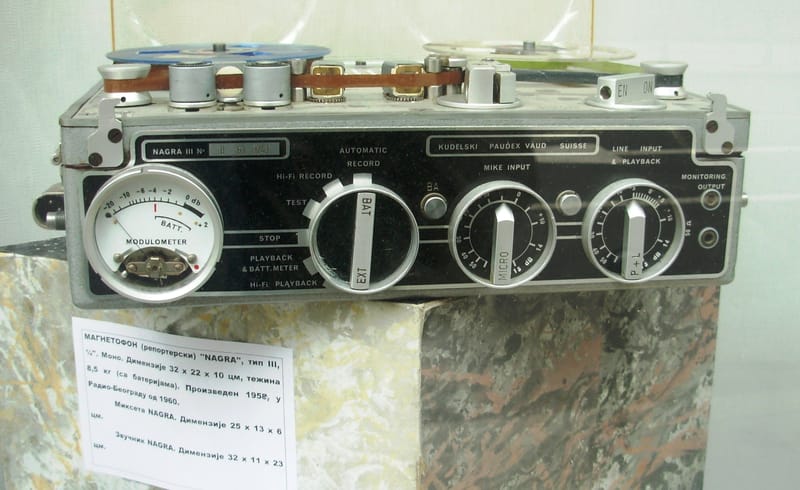
Nagra, founded by Polish-born engineer Stefan Kudelski in Lausanne in 1951, approached the tape recorder from a direction that no other manufacturer shared: the requirements of field recording, news gathering, and film sound. The Nagra III, introduced in 1958, established the company's defining characteristic – a portable machine of professional quality, capable of operating in conditions that would defeat studio equipment, yet achieving performance that studio engineers respected.
The Nagra 4.2 became the standard film sound recorder of the 1960s and 1970s, used on virtually every significant film production worldwide. Its combination of portability, reliability, and sonic performance made it irreplaceable for location recording. The machine's pilotone synchronization system allowed its recordings to be synchronized with film cameras, solving the fundamental challenge of location film sound. A generation of sound recordists built their careers around the Nagra 4.2, and their affection for the machine reflects both its technical excellence and its exceptional reliability in difficult conditions.
The Nagra 4-S and Nagra T, larger studio-oriented machines, extended the company's engineering to applications where portability was secondary to ultimate performance. The Nagra T in particular achieved recognition as a mastering machine of exceptional quality, its transport combining Swiss precision with electronics of genuine sophistication. Nagra's later digital machines, including the Nagra V and subsequent models, carried the company's reputation for portable recording excellence into the digital era while their analog machines remained in active use.
Nagra's approach to electronics reflected Stefan Kudelski's background in precision instrumentation. Each circuit was designed to the minimum component count consistent with required performance, with each component chosen for long-term stability rather than initial performance. The result was electronics that maintained their alignment over years of field use without the drift that affects more complex circuits, and that could be serviced with minimal test equipment in field conditions.
Otari, MCI, and the Ampex Professional Range
Otari of Japan
Otari Electric, founded in Tokyo in 1961, became Japan's most significant manufacturer of professional tape recording equipment, with machines that achieved genuine international recognition rather than merely serving the domestic market.
The Otari MX-5050 family achieved extraordinary commercial success through a combination of genuine performance and practical reliability that made it the most widely installed professional stereo machine outside Europe. Available in half-track stereo, quarter-track stereo, and full-track mono configurations, the MX-5050 provided transport quality and electronic performance that satisfied broadcast, post-production, and music recording applications equally. The MX-5050 BII and BIII variants incorporated progressive improvements to the transport servo system and electronics that addressed limitations identified through field experience with earlier versions.
The Otari MTR-90 multitrack machine, available in sixteen and twenty-four track configurations on two-inch tape, competed directly with the Studer A820 and MCI JH-24 in the studio market. The MTR-90 Mark II incorporated a significantly revised transport that addressed the Mark I's tendency toward capstan bearing wear in high-use studio environments. The machine's electronics, whose modular design facilitated rapid channel replacement during sessions, achieved noise and frequency response performance that working engineers found genuinely competitive with European alternatives at a substantially lower acquisition cost.
The Otari MTR-12 and MTR-15 addressed the stereo and half-track mastering market with machines whose transport quality reflected the company's understanding that mastering applications demanded the highest transport stability. Otari's engineering team paid particular attention to the relationship between transport mechanics and head-to-tape contact, recognizing that uniform contact across the tape width determined both frequency response consistency and long-term head wear.
The Otari MTR-100, the company's reference multitrack machine, represented their most ambitious engineering achievement. Its transport, a dual-capstan closed-loop design with servo electronics derived from their mastering machine development program, achieved speed stability that the MTR-90 could not match. The MTR-100's twenty-four tracks on two-inch tape delivered performance that Otari's engineers considered fully competitive with the Studer A820, and independent evaluations by recording engineers who used both machines generally supported this assessment.
MCI and American Studio Equipment
MCI's machines equipped more American independent recording studios during the 1970s than any other manufacturer, a market dominance achieved through a combination of practical engineering, competitive pricing, and dealer support that Studer and Ampex could not match in the rapidly expanding independent studio market.
The MCI JH-110 stereo machine provided a reliable, well-performing two-track recorder whose electronics could be aligned by any competent technician using standard test equipment. Its transport, while not approaching the precision of Studer or Telefunken designs, achieved performance adequate for the majority of professional applications and demonstrated long-term reliability in continuous studio use.
The MCI JH-114 four-track, JH-116 sixteen-track, and JH-124 twenty-four-track multitrack machines formed the backbone of American studio recording through the 1970s. The JH-24, as the twenty-four-track version was universally known, combined adequate transport performance with electronics whose sonic character suited the requirements of popular music recording. Many of the most commercially successful recordings of the late 1970s and early 1980s were made on JH-24 machines. Sony's acquisition of MCI in 1980 produced the Sony-MCI JH-24 and subsequent variants, which continued the original design with incremental improvements. The Sony APR-5003V stereo mastering machine, developed from MCI engineering combined with Sony's own transport research, achieved mastering performance that competed credibly with the Studer A810 and Ampex ATR-102.
Ampex: The Complete Professional Range
The Ampex 440 series, introduced in the mid-1960s, replaced the 300 series with a more compact design that maintained professional performance standards while reducing the physical size that had made the earlier machines impractical for some applications. The 440-1 mono, 440-2 stereo, 440-4 four-track, and 440-8 eight-track machines established a family of compatible transports whose shared components simplified maintenance and spares holding. The 440's transport used a closed-loop tension servo system more sophisticated than the 300 series, producing improved tape handling and reduced scrape flutter.
The Ampex MM-1000, introduced in 1967, brought sixteen-track recording to professional studios for the first time in a practical, reliable form. The MM-1000's two-inch transport established the physical format that subsequent multitrack recording standardized upon, and its sixteen tracks on two-inch tape defined the configuration that recording engineers worked with through the late 1960s. The MM-1100 extended the concept to twenty-four tracks on the same two-inch format, a development that required the track width reduction and head engineering advances that made Dolby noise reduction not merely useful but practically necessary for competitive noise performance.
The Ampex ATR-100 series represented the company's most refined engineering achievement in professional tape recording. The ATR-102 stereo mastering machine combined a transport whose dual-capstan, closed-loop design achieved speed stability approaching that of the Telefunken M15A with electronics whose noise and frequency response performance satisfied the most demanding mastering applications. The transport's flutter filter, a mechanical low-pass filter interposed between the capstan and the tape path, attenuated high-frequency flutter components that the servo system alone could not fully suppress. The ATR-102 became the standard mastering machine in American mastering studios through the late 1970s and 1980s, used to prepare the master tapes from which virtually every significant American recording of that era was cut to disc.
The Ampex ATR-104 extended the ATR-100 transport to multitrack configurations, available in four, eight, and sixteen-track variants. The ATR-700 brought a more compact implementation of the ATR transport design to applications where the full ATR-100's size was impractical, maintaining the essential transport characteristics in a smaller package.
Sony Professional Audio
Sony's professional audio division produced tape machines across a wider range of applications than any competitor, from the smallest portable field recorders through reference studio multitrack systems.
The Sony TC-800 series portable machines achieved wide acceptance in broadcast and field recording applications. Their combination of compact size, battery operation, and performance adequate for broadcast use made them practical tools for news gathering and documentary production. The TC-800GL, with its built-in level meters and professional XLR connections, achieved particular recognition as a practical field machine.
The Sony APR-5000 stereo mastering machine combined a transport of genuine professional quality with electronics designed specifically for mastering applications. The APR-5003V variant, which incorporated video synchronization capability, found application in post-production facilities where audio and picture synchronization was required.
The Sony PCM series, while nominally digital, used analog tape transports to store digital audio encoded on standard video tape, an approach that brought near-digital noise performance to recording facilities before purpose-built digital recorders became available. The Sony PCM-3348 digital multitrack effectively ended the market for new analog multitrack machines in major studios when its combination of forty-eight tracks, silent operation, and random access made its advantages over two-inch analog irresistible for most applications.
Semi-Professional and High-End Consumer Machines
The Japanese Masters
Japan's consumer electronics industry approached the tape recorder with the same combination of engineering ambition and manufacturing precision that characterized their contribution to other audio fields. Teac, Akai, Sony, Pioneer, Denon, and Tascam produced machines whose performance, at their best, approached professional standards while remaining accessible to serious home users.
Teac established themselves as the dominant force in Japanese consumer tape recording with a product range that extended from entry-level machines to the A-6300 and A-6600 series, whose engineering reflected genuine professional aspirations. The Teac X-2000R, X-1000R, and the remarkable X-10R achieved recognition as among the finest consumer machines ever produced, their transport mechanisms and electronics combining to deliver performance that competing machines at similar prices could not match. The Teac A-7300 and A-7400 series brought similar performance to more accessible price points.
The Teac A-7300 and A-7400 series combined direct-drive capstan motors with sophisticated tension servo systems in machines whose physical robustness reflected the company's understanding that consumer machines required greater mechanical tolerance than professional machines whose operators maintained them professionally. The A-7300's transport achieved speed stability that belt-drive competitors could not match, and its three-motor configuration, with separate motors for supply reel, take-up reel, and capstan, provided the tension control that single and dual-motor designs compromised.
The Teac X-1000R and X-2000R represented the company's highest expressions of consumer reel-to-reel engineering. The X-2000R's transport, incorporating a direct-drive capstan motor of the precision normally reserved for semi-professional machines, achieved speed stability measured in parts per million rather than the percentages that characterized less ambitious consumer designs. The machine's auto-reverse mechanism maintained speed stability through the reversal process with a smoothness that competing auto-reverse designs could not achieve. The X-10R, Teac's absolute reference consumer machine, combined the X-2000R's transport precision with electronics designed without the cost constraints that limited the production machines.
Akai, another Japanese manufacturer with deep roots in tape recording, produced the GX series machines whose glass-and-crystal ferrite heads achieved exceptional longevity. The Akai GX-636, GX-747, and the flagship GX-77 combined impressive transport engineering with the company's proprietary head technology, which used a glass bonding technique that significantly extended head life compared to conventional ferrite construction. The GX-400D-SS, GX-635D, and GX-650D extended the range to various price points while maintaining the head technology that distinguished Akai's approach.
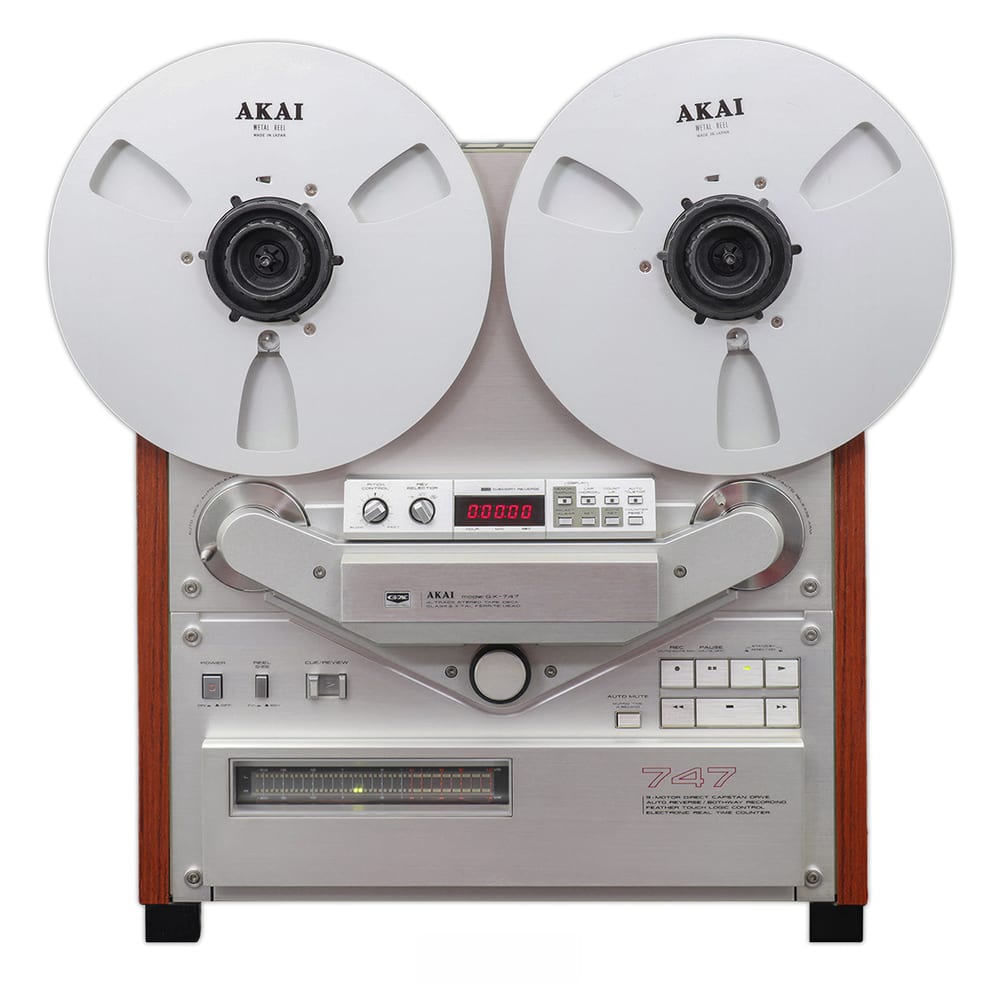
Akai's professional ambitions extended beyond their consumer GX series. The Akai PRO-24 and PRO-24s multitrack machines used standard half-inch tape for twelve tracks, a configuration that achieved per-track performance between the Tascam 38's eight tracks on half-inch and the full professional sixteen-track format. The machine's GX glass-ferrite heads, derived from the consumer GX series but enlarged for the professional application, achieved the longevity that working studios required.
Sony's consumer reel-to-reel machines reached their highest expression in the TC-880 and TC-756 series. The Sony TC-880-2 used a direct-drive capstan motor derived from Sony's professional product development rather than a purpose-designed consumer motor. The motor's tachometer feedback system achieved speed stability comparable to semi-professional machines, and the TC-880-2's overall transport precision exceeded that of competing consumer machines substantially. The Sony TC-756, TC-788, TC-580, and TC-377 extended the range to various price points while maintaining the transport architecture that distinguished Sony's machines from competitors using simpler designs.
Pioneer produced the RT-909, whose transport used a dual-capstan closed-loop drive system unusual in consumer machines of its era, providing tape tension stability across the head assembly that single-capstan designs could not achieve. The RT-909's auto-reverse mechanism maintained capstan speed through the reversal process with a precision that competing designs of the same period could not fully match. The Pioneer RT-2044 extended the broadcast-derived transport concept to a larger reel size, accommodating ten-and-a-half-inch reels. The Pioneer RT-701 and RT-707 occupied more accessible price points in the range.
Denon's professional heritage, rooted in their long history of supplying broadcast equipment to NHK and other Japanese broadcast organizations, informed their consumer machines with engineering discipline that purely consumer-oriented manufacturers rarely matched. The DH-710 and subsequent models reflected the understanding of transport mechanics and head design that Denon's professional work had developed.
Tascam: The Semi-Professional Revolution
Tascam, Teac's professional division established in 1971, addressed the market between genuine professional machines and consumer equipment with a range of products that democratized multitrack recording.
The Tascam Series 70 machines, including the 80-8 eight-track and 85-16 sixteen-track, brought multitrack recording to studios that could not justify the cost of MCI or Studer equipment. The Tascam MSR-16 and MSR-24 machines, introduced in the late 1980s, represented the company's most sophisticated analog multitrack designs. The MSR-16 used half-inch tape for sixteen tracks, while the MSR-24's twenty-four tracks on one-inch tape combined practical tape economy with performance approaching two-inch standards in the mid-frequency range.
The Tascam 38, a half-inch eight-track machine, became one of the most successful semi-professional machines ever produced. Its combination of adequate transport performance, maintainable electronics, and competitive pricing made it the standard machine in home studios and project studios throughout the 1980s. The Tascam 32, 34, and 36 stereo machines addressed the semi-professional two-track market with machines whose performance approached professional standards at prices accessible to serious home recordists.
Tandberg of Norway
Tandberg Radio, founded in Oslo in 1933, produced tape recorders whose sonic reputation exceeded their market presence, attracting devoted followers among audiophiles who valued musical communication above specifications. The company's engineering team consistently prioritized the musical quality of reproduced sound over the measured specifications that competitors emphasized, producing machines whose sonic character many audiophiles found uniquely satisfying.
The Tandberg 9000X, the company's reference machine, combined a transport of genuine quality with electronics whose design reflected decades of accumulated understanding of what made tape recordings musically convincing. The 9000X's particular head design, developed in-house rather than sourced from standard Japanese head manufacturers, produced a frequency response and transient characteristic that contributed to the machine's distinctive sonic signature. Audiophiles who compared the 9000X to competing machines of superior measured performance consistently reported that the Tandberg communicated musical events with a naturalness that technically superior machines did not always match.
The Tandberg 10X extended the 9000X philosophy with a revised transport that addressed the 9000X's tendency toward capstan bearing wear during extended operation. The 10X's electronics incorporated improvements derived from the 9000X's operational experience, refining the record amplifier's bias stability and the playback equalizer's frequency response accuracy. The Tandberg Series 15, available in both open-reel and cassette configurations, extended the company's philosophy to more accessible price points. The TD-20A SE, produced late in the company's history, represented Tandberg's most ambitious attempt to combine professional transport performance with their distinctive electronic philosophy.
Revox: The Complete Model History
The Revox brand produced a succession of machines that brought genuine engineering quality to the home and semi-professional market. Each generation incorporated advances from Studer's professional development program, ensuring that Revox machines benefited from engineering resources beyond those any purely consumer-oriented manufacturer could justify.
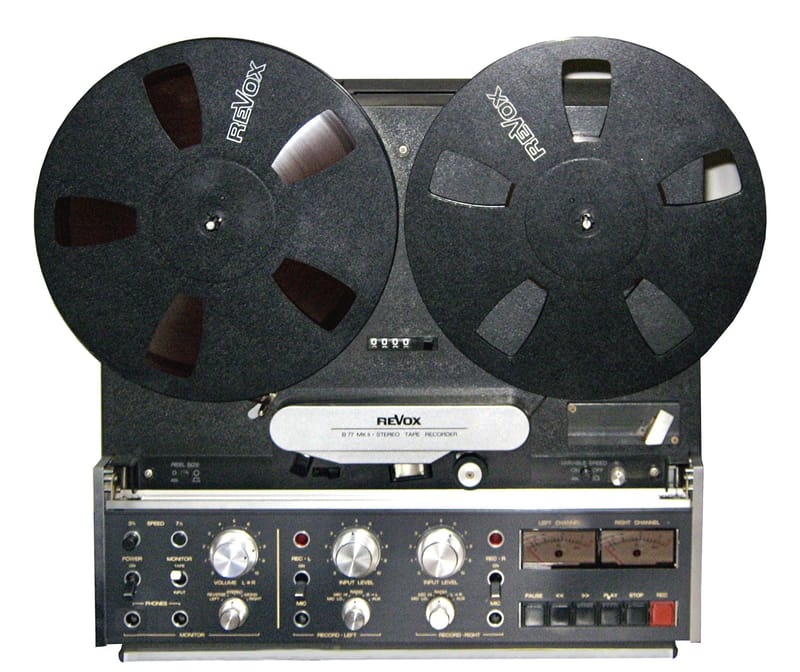
The Revox A36 and F36 established the brand's reputation for quality construction and reliable performance, with progressive improvements demonstrating Studer's commitment to evolution rather than cost reduction.
The Revox A77 represented a fundamental advance in consumer machine design. Its direct-drive capstan, driven by a purpose-designed DC motor with tachometer feedback, achieved speed stability that belt-drive competitors at similar and higher prices could not match. Available in a remarkable range of configurations including mono, stereo, half-track, quarter-track, and various speed combinations, the A77 addressed virtually every home recording application with the same transport and electronics architecture.
The Revox B77, introduced in 1977, refined the A77 with revised electronics that further reduced noise and improved the record amplifier's bias adjustment stability. The B77 MK II extended the design with electronically balanced inputs and outputs that improved compatibility with professional equipment. The B77 HS variant operated at 15 and 30 inches per second rather than the standard 7.5 and 15 inches per second, achieving professional mastering performance in a consumer machine format.
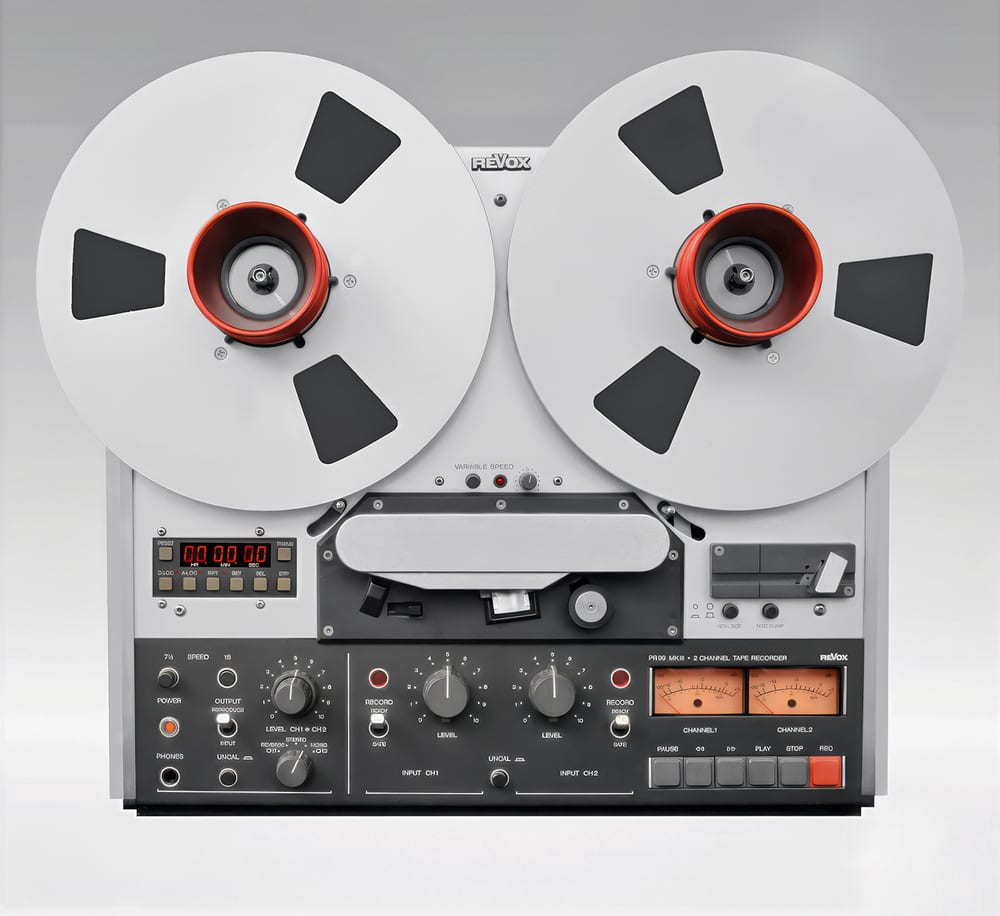
The Revox PR99 addressed the semi-professional market with a machine whose transport incorporated elements of the Studer professional design program. The PR99's direct-drive capstan used a motor derived from professional machine development rather than the consumer-oriented motor of the B77, achieving speed stability measurably superior to its predecessor. The PR99 MK II and MK III variants refined the electronics progressively, with the MK III achieving noise performance approaching that of professional machines in the same format.
Nakamichi: The Pursuit of Tape Perfection
Nakamichi's contribution to tape recording extended beyond the cassette machines for which the company is most widely known. Their reel-to-reel machines reflected the same engineering philosophy that produced their reference cassette decks: the relentless pursuit of mechanical precision as the foundation of sonic performance.
The Nakamichi 700 open-reel machine should not be confused with the later cassette deck of the same name. It was an early consumer reel-to-reel unit with a relatively conventional layout and performance. The Nakamichi 1000 open-reel model, likewise unrelated to the well-known cassette deck that followed, occupied a slightly higher position in the lineup and reflected the company's early engineering ambitions, though it did not introduce any genuinely disruptive concepts.
During this period, Nakamichi was also deeply involved in OEM manufacturing. Some reel-to-reel machines were produced for other brands, while certain Nakamichi-branded units are believed to have shared platforms or transport designs with other Japanese manufacturers. Documentation remains incomplete, making precise attribution difficult. In contrast to companies such as Revox, TEAC, or Akai, Nakamichi never established a significant technical or commercial presence in the open-reel domain. There are no direct counterparts in their catalog to widely recognized benchmarks like the Revox A77 or the TEAC A-series. By the early 1970s, the company redirected its engineering focus almost entirely toward the compact cassette, a format in which it could innovate far more decisively, leaving its brief involvement with reel-to-reel as a minor and largely transitional chapter.
The Nakamichi 1000 reel-to-reel machine achieved recognition among audiophiles for its transport precision and the particular sonic character of its electronics. The machine's heads, manufactured to Nakamichi's own specifications, combined frequency response extending well beyond the audible range with physical construction whose precision exceeded that of standard Japanese head manufacturers. The 1000's azimuth adjustment mechanism, which allowed continuous azimuth correction while the machine was operating, addressed the variation in recorded azimuth between different tapes that reduced playback high-frequency performance on machines with fixed head alignment. The Nakamichi 550 brought the company's engineering philosophy to a wider market while maintaining the head quality and transport precision that distinguished Nakamichi's approach.
Ferrograph of England
Ferrograph, a British manufacturer producing machines from the 1950s through the 1970s, occupied a distinctive position in the professional and semi-professional market. Their machines, built to standards that emphasized long-term reliability and ease of maintenance, achieved wide use in British broadcasting, education, and semi-professional recording. The Ferrograph Series 7 represented their most refined achievement, combining a transport of solid engineering with electronics whose performance satisfied demanding users. The company's attention to head alignment and replacement procedures reflected an understanding that long-term ownership required accessible maintenance.
Magnetic Tape: The Medium Itself
Formulations and Their Development
The magnetic tape is not a passive medium. Its formulation – the choice of magnetic particles, binder chemistry, base film, and coating process – determines the ultimate performance boundary of any recording system, regardless of the quality of the machine running it.
Early recording tape used iron oxide particles, gamma ferric oxide, suspended in a binder and coated onto a base of cellulose acetate, later replaced by polyester. Iron oxide tape established the fundamental characteristics of magnetic recording: a noise floor determined by particle size and coating uniformity, a high-frequency response limited by the relationship between particle size and head gap, and a dynamic range bounded by the tape's saturation characteristics.
BASF of Germany and Agfa developed the tape formulations that equipped the original Magnetophons and subsequent professional machines. Their understanding of coating technology, derived from decades of photographic film manufacturing, gave German tape manufacturers advantages that competitors spent years overcoming.
BASF and the German Tradition
The BASF LPR35, a low-print-through formulation designed for archive and broadcast applications, achieved recognition in European broadcasting facilities as the standard for recordings intended for long-term storage. Its particular oxide formulation combined adequate sensitivity with print-through characteristics significantly below those of high-output formulations, reflecting the priority that archive facilities placed on long-term signal stability over maximum dynamic range.
The BASF PER528, a professional high-output formulation, became the standard tape in many European recording studios during the late 1970s and early 1980s. Its combination of high maximum output level, low noise, and reliable coating adhesion made it a practical choice for facilities that recorded at the elevated operating levels that maximized signal-to-noise ratio. The PER528's frequency response, optimized for standard IEC equalization, produced recordings that translated consistently between machines aligned to European standards.
The BASF SM900, continuing the BASF formulation tradition through the Recording The Masters brand that now produces it, represents the contemporary expression of European professional tape formulation. Its low-noise oxide coating achieves a noise floor that approaches the theoretical limit for standard-width professional tape formats, while its high-output capability allows recording at levels that maximize dynamic range without saturation-related distortion.
The BASF SM468, the other principal formulation in the current Recording The Masters range, provides characteristics optimized for different operating conditions than the SM900. The SM468's formulation achieves its best performance at operating levels slightly below those of the SM900, making it the preferred choice for facilities that align their machines to standard operating levels rather than the elevated levels that high-output formulations support.
Scotch and 3M: The American Standard
3M's Scotch brand recording tape established the standard against which American professional recording was measured through five decades of tape recording history.
The Scotch 111 and 115 formulations were standard in American studios through the 1950s. The Scotch 202 and 206 formulations, introduced in the late 1950s and early 1960s, reflected improvements in oxide particle manufacturing that produced smaller, more uniformly sized particles. The reduced particle size improved high-frequency response by allowing shorter recorded wavelengths to be stored with adequate signal strength, while the improved uniformity reduced the noise that irregularly sized particles contributed.
The Scotch 250, introduced in the early 1970s, represented a qualitative advance in American professional tape formulation. Its high-coercivity oxide achieved a maximum output level significantly higher than the formulations it replaced, allowing engineers to record at levels that improved signal-to-noise ratio by 3 to 4 dB over what the Scotch 206 permitted.
The Scotch 996, 3M 226, and 3M 227 formulations represented the company's professional tape range through the late 1970s and 1980s. The 227 achieved recognition as a standard professional formulation whose consistency from batch to batch provided the predictability that professional facilities required. The 3M 996's low-noise characteristics made it the preferred choice for noise-critical applications where the additional headroom of high-output formulations was less important than minimum recorded noise.
Ampex Grand Master Series
The Ampex Grand Master 406, the first of the series to achieve wide professional acceptance, combined adequate high-output characteristics with a coating quality that exceeded the consistency of competing formulations.
The Ampex Grand Master 456 became the standard professional tape in American studios through the late 1970s and remained in widespread use through the 1980s. Its high-output oxide, combined with a binder formulation that achieved reliable coating adhesion at elevated operating temperatures, made it the practical choice for studios working at higher recording levels.
The 456's consistency from batch to batch, maintained through Ampex's manufacturing quality control, provided the predictability required when biasing machines to specific formulations.
The Ampex Grand Master 499, the highest-output formulation in the series, achieved maximum output levels exceeding those of the 456 by approximately 3 dB. Its use was generally limited to applications where the additional headroom justified the higher cost and the more precise machine alignment it required. Mastering facilities using 499 typically maintained dedicated machines aligned specifically for the formulation rather than recalibrating between 499 and standard-output tape.
The later continuation of these formulations under Ampex Recording Media Corporation maintained the 456 and 499 designations while progressively refining oxide and binder formulations within the constraints of available raw materials.
The 456 "Quantegy" formulation retained the established operating characteristics of its Ampex predecessor while incorporating manufacturing refinements that improved coating consistency in later production batches.
ATR Magnetics
ATR Magnetics, established in the United States specifically to serve the professional tape community following Quantegy's closure, produces formulations optimized for high-speed mastering applications. The ATR Master Tape formulation, available in standard and high-output variants, achieves characteristics specifically suited to the requirements of half-track stereo mastering at 15 and 30 inches per second. ATR's formulation development reflected extensive consultation with mastering engineers whose understanding of what tape characteristics produced the most musically satisfying recordings informed the technical specifications more directly than laboratory measurements alone could have.
Agfa and the European Alternative
Agfa's professional tape range occupied an important position in European professional recording, particularly in continental European facilities outside Germany. The Agfa PEM 469 and PEM 568 formulations achieved recognition as high-quality alternatives to BASF's professional range, their oxide formulations optimized for European IEC equalization standards.
The Agfa PE 31, PE 36, and PE 39 formulations addressed different segments of the professional market with characteristics optimized for specific applications. The PE 39, Agfa's high-output professional formulation, achieved maximum output levels comparable to Ampex 456 while maintaining the coating consistency and reliability that professional facilities required. European mastering studios that maintained both BASF and Agfa formulations in their tape libraries reported that the two companies' tapes, while meeting similar measured specifications, produced recordings with detectably different sonic characters that some engineers preferred for specific musical material.
TDK, Maxell, Fuji, and Japanese Formulations
The Japanese tape manufacturers approached formulation development with the manufacturing precision and quality control that characterized their consumer electronics production.
TDK's professional formulations, developed from their consumer tape manufacturing expertise, achieved recognition in Japanese broadcast and recording facilities as reliable, consistently performing materials. The TDK SA and SA-X consumer formulations demonstrated the company's ability to develop high-output chromium-dioxide-type oxide formulations whose performance in cassette applications challenged the professional reel-to-reel formulations on a per-unit-width basis.
Maxell's UD and MR professional formulations achieved acceptance in facilities throughout Asia and some penetration in international markets where their combination of performance and competitive pricing made them practical alternatives. The Maxell MR formulation's high-output characteristics and consistent coating quality provided performance adequate for professional recording applications in facilities that aligned their machines specifically for the formulation's characteristics.
Fuji's professional tape range, standard in Japanese broadcast facilities, reflected the company's photographic film manufacturing heritage in the coating consistency and substrate quality that distinguished their products. Sony's professional tape range, produced at the same manufacturing facilities as the company's video and data recording media, achieved the consistency and reliability that professional applications required.
Tape Types and Track Configurations
Professional tape recording employs several distinct configurations of track layout on the tape width, each representing a trade-off between recording time, signal-to-noise ratio, and compatibility with other machines.
Full-track mono recording, which magnetizes the entire tape width as a single channel, achieves the highest signal-to-noise ratio of any tape format by using all available magnetic material for a single signal. Professional broadcast mono machines typically used full-track configuration for the highest quality. Half-track mono divides the tape into two sequential passes, each occupying approximately half the tape width, doubling recording time at a modest cost in signal-to-noise performance.
Stereo recording introduced the two-track half-track configuration, where two channels occupy the full tape width simultaneously. This configuration, standard in professional mastering applications, provides excellent crosstalk separation between channels and full use of the tape's oxide coating for signal storage. Two-track quarter-track stereo, which uses a narrower track on each of two passes, allows four-track recording on standard tape at reduced performance, and was the standard consumer stereo format.
Professional multitrack recording expanded from four tracks in the early 1960s through eight, sixteen, and finally twenty-four tracks, all on two-inch wide tape. Accommodating twenty-four tracks in two inches of width required track widths so narrow that individual track signal-to-noise ratios were significantly lower than in two-track configurations, which was a primary motivation for the development of Dolby noise reduction.
Tape Base Materials
Cellulose acetate, the earliest base material, provided adequate performance but was vulnerable to moisture absorption. Its relative brittleness meant that acetate tape broke rather than stretching when subjected to transport stress, a property that minimized damage to recordings but required frequent splicing in heavily used archives.
Polyester base, introduced in the 1950s, offered superior dimensional stability and strength. However, polyester tape stretches rather than breaking under stress, which can create a permanent speed error at the stretched point. Tensilized polyester, a base material processed to reduce its stretch characteristics, attempted to combine polyester's durability with reduced susceptibility to permanent stretching.
Tape Degradation and the Sticky Shed Syndrome
Sticky shed syndrome, a condition affecting primarily tapes manufactured between approximately 1970 and 1990 using certain binder formulations, causes the tape's oxide coating to shed onto transport components during playback. The underlying mechanism involves hydrolysis of the polyurethane binder that holds oxide particles to the base film. As moisture penetrates the binder over decades, the urethane bonds break, releasing oxide particles that adhere to transport components, clogging heads and guides while simultaneously removing coating from the tape surface.
The standard treatment for affected tapes involves baking at low temperatures, typically 54 degrees Celsius for eight to twelve hours in a convection oven with controlled humidity. This process temporarily reverses the hydrolysis by driving off absorbed moisture, restoring the binder's cohesion sufficiently for one or more complete plays. Engineers managing archives of affected tape routinely bake tapes immediately before transfer, working quickly to capture the recording before degradation resumes.
Print-through, another form of tape degradation, occurs when strong magnetic fields from one layer of tape on a reel transfer to adjacent layers over time. Low-frequency signals are most susceptible, as their longer wavelengths more effectively magnetize adjacent layers. Storing tapes tails-out ensures that print-through echoes follow rather than precede musical events, which is perceptually less objectionable.
Transport Mechanics: The Engineering of Tape Motion
Capstan Drive Systems
The capstan and pinch roller represent the primary speed control mechanism of any tape transport. The capstan, a precision-machined rotating shaft, moves the tape at a controlled velocity when the pinch roller presses the tape against it. The accuracy of the capstan's rotational speed directly determines the accuracy of the recorded or reproduced pitch, making capstan design central to transport engineering.
Early tape recorders used capstans driven through belt or gear reduction from AC synchronous motors, which provided inherent speed stability as long as the power line frequency remained constant. However, load variations, belt wear, and power line frequency fluctuations all introduced speed errors that manifested as wow and flutter in the reproduced signal.
Direct-drive capstan motors, in which the capstan is the rotor shaft of a purpose-designed motor, eliminate the transmission elements that introduced errors in belt-drive systems. The Revox A77's direct-drive capstan represented a genuine innovation in consumer machines, while professional machines including the Studer A80 used sophisticated servo-controlled DC motors that maintained capstan speed with precision exceeding AC synchronous motor designs. Closed-loop servo systems measured the actual capstan speed through a tachometer and compared it to a reference frequency, correcting any deviation within microseconds.
Dual-capstan transports, which use two capstans spaced on either side of the heads, maintain constant tape tension across the head assembly regardless of supply and take-up reel tension variations. This approach, used in machines including the Ampex ATR series and the Studer A820, ensures consistent head-to-tape contact and reduces the tape tension variations that affect high-frequency response.
Reel Drive and Tension Servo Systems
Professional machines use tension servo systems that continuously measure tape tension and adjust reel motor torque to maintain the target value. The Studer A80's tension servo maintained constant tension despite the widely varying reel diameters encountered as tape transfers from full supply reel to empty take-up reel. The servo system's ability to respond quickly to tension variations produced by tape splices, thickness variations, and transport acceleration contributed substantially to the A80's sonic performance.
Head Design and Materials
The recording and playback heads are the most critical components of any tape machine, converting between electrical signals and magnetic fields with characteristics that determine the recorder's frequency response, noise floor, and crosstalk performance.
Ferrite heads, introduced in the 1970s, offered hardness advantages over the permalloy and laminated metal heads they replaced. Ferrite's extreme hardness extended head life dramatically in high-use environments, but early ferrite formulations suffered from brittleness that caused chipping at the head gap edges. Improved ferrite formulations and bonding techniques overcame these limitations, and ferrite heads became standard in professional machines by the late 1970s.
Akai's glass-bonded ferrite heads, used throughout their GX series consumer machines, achieved exceptional longevity by bonding ferrite elements with glass rather than epoxy. The glass bond's hardness matched the ferrite material's own hardness, eliminating the differential wear that caused epoxy-bonded heads to develop raised edges as the softer bonding material wore away. Akai claimed head life of 2,000 hours or more for their glass-ferrite construction, a figure that independent testing generally confirmed.
Amorphous metal heads, developed in the 1980s, used metallic glass alloys whose magnetic properties combined high permeability with sufficient hardness for acceptable tape contact durability. These heads, used in machines including late Sony and Nakamichi models, achieved frequency response and noise characteristics that exceeded both conventional ferrite and permalloy designs.
Noise Reduction: Extending Tape's Dynamic Range
Dolby A and Professional Systems
Ray Dolby founded Dolby Laboratories in London in 1965 with the specific goal of extending the dynamic range of professional tape recording. The Dolby A system, introduced in 1966 and immediately adopted by recording studios worldwide, addressed the fundamental limitation of tape noise through a sophisticated encode-decode process.
Dolby A divided the audio spectrum into four frequency bands and applied complementary compression and expansion to each band independently. During recording, the encode stage compressed low-level signals in each band, raising them above the tape's noise floor. During playback, the decode stage applied the inverse expansion, restoring the original dynamics while simultaneously suppressing the tape noise that had been added during recording. The adoption of Dolby A throughout professional recording from the late 1960s onward changed what was sonically possible on tape, providing approximately 10 dB of improvement in the critical high-frequency range where tape hiss was most audible.
Dolby SR, introduced in 1986, extended the noise reduction approach to achieve approximately 25 dB of noise reduction across the audio spectrum while maintaining the complementary encode-decode architecture. SR's more sophisticated processing, operating across a greater number of frequency bands with adaptive characteristics, produced a noise-reduced tape recording that approached digital noise performance while retaining the sonic character of analog tape. Many engineers who preferred the sound of analog tape adopted Dolby SR specifically because it allowed tape to compete with digital on noise performance grounds while preserving the saturation and harmonic characteristics they valued.
Dolby B, C, and S for Cassette Applications
Dolby B, developed specifically for the cassette format, achieved approximately 10 dB of noise reduction in the frequency range where cassette hiss was most audible. Its simpler architecture compared to the professional Dolby A system made it practical for implementation in consumer electronics at modest cost, and its adoption throughout the cassette industry created a standard that allowed encoded recordings to be decoded on any Dolby B equipped deck.
Dolby C, introduced in 1980, extended the noise reduction approach to achieve approximately 20 dB of noise reduction across a wider frequency range. Its two-stage complementary system applied separate high-level and low-level processing in the treble region, achieving noise reduction depth that the simpler Dolby B could not match.
Dolby S, introduced in 1989, brought elements of the professional Dolby SR system's multi-band processing to the consumer cassette market, achieving noise reduction of approximately 24 dB across the audio spectrum. The combination of Dolby S with metal particle tape and a high-quality transport produced cassette recordings whose noise performance approached that of professional reel-to-reel recordings.
dbx Noise Reduction
dbx, founded by David Blackmer, developed a noise reduction approach based on wideband compression and expansion rather than the multi-band processing of Dolby A. The dbx system applied 2:1 compression during recording and complementary 2:1 expansion during playback, achieving noise reduction of approximately 30 dB across the full audio spectrum. dbx achieved particular acceptance in the semi-professional and consumer market, where its greater noise reduction depth suited the higher noise floors of narrower-track consumer configurations. The dbx Type I format, used with professional and semi-professional reel-to-reel machines, provided noise reduction depth that made consumer-format recordings competitive with professional two-track performance.
Tape Machine Alignment and Maintenance
The Critical Importance of Proper Alignment
A tape machine operating without correct alignment does not merely perform below its potential – it may actively damage recordings and degrade tapes. The relationship between head geometry, bias current, equalization, and record level represents an interdependent system where an error in any element degrades the combined performance in ways that simple measurements may not reveal.
Azimuth Alignment
The recording head gap must be precisely perpendicular to the tape's direction of travel. Any angular deviation, measured in minutes of arc, reduces high-frequency response in a manner analogous to the effect of head gap length. At 15 inches per second, a one-minute azimuth error reduces the response at 15 kHz by several decibels. At 30 inches per second, where the recorded wavelengths are half the length, the same angular error doubles its effect.
Azimuth alignment is performed using a test tape recorded with a high-frequency tone at precisely correct azimuth. The playback machine's head is adjusted while monitoring the playback level of the high-frequency tone. Maximum output at the alignment frequency indicates correct azimuth. Professional facilities aligned all their machines to the same azimuth reference to ensure that recordings could be transferred between machines without audible degradation.
Bias Optimization
The AC bias current applied to the recording head during recording must be precisely optimized for the specific tape formulation in use. The bias frequency, typically 50 to 150 kHz depending on the machine's design, must be significantly higher than the highest audio frequency recorded to avoid intermodulation with audio signals.
Increasing bias from below optimum initially improves low-frequency sensitivity and reduces high-frequency distortion. As bias increases through the optimum range for a given tape, high-frequency sensitivity reaches a maximum and begins to decline. The final optimum represents a compromise between maximum high-frequency sensitivity and the distortion characteristics of the tape at the chosen operating level.
Different tape formulations require different optimal bias levels, reflecting their different coercivity and saturation characteristics. A machine optimized for Scotch 250 will produce inferior results with Ampex 456 without rebiasing, even though both are high-output formulations. Professional facilities maintained detailed alignment procedures for each formulation they used.
Record Level Calibration and Equalization
The IEC and NAB equalization standards specify different frequency responses for the playback electronics, reflecting different approaches to the trade-off between noise and distortion in the recording process. IEC equalization, standard in European facilities, applies more low-frequency playback boost, compensating for recording that reduces low-frequency levels to avoid saturation. NAB equalization, standard in American facilities, applies less low-frequency boost and extends the low-frequency recording range higher in frequency. Professional facilities using both American and European tapes required playback electronics capable of switching between both equalization standards.
Head Cleaning and Demagnetization
Tape oxide deposits accumulate on head surfaces, guides, and capstan components during normal operation, degrading head-to-tape contact and reducing high-frequency response. Professional facilities cleaned heads after each tape change using isopropyl alcohol and lint-free applicators. Consumer machine owners who neglect head cleaning gradually experience the high-frequency loss and occasional dropout problems that result from oxide contamination.
Demagnetization of heads and metal transport components prevents the accumulation of residual magnetization that would add noise to recordings. Professional facilities demagnetized heads and transport components at regular intervals, typically before each recording session, using a hand-held demagnetizer that applies a gradually diminishing AC magnetic field.
Lubrication and Mechanical Maintenance
The mechanical components of tape transports require periodic lubrication to maintain their design performance over decades of operation. The lubricants used must be compatible with the plastic and rubber components in proximity, as petroleum-based lubricants attack many synthetic rubber formulations and can contaminate pinch rollers and tape guides.
Pinch rollers harden with age and accumulate oxide contamination that reduces their friction characteristics. Hardened pinch rollers allow tape slippage against the capstan, increasing wow and flutter and potentially damaging tapes through uneven tension. Replacement pinch rollers are available from specialist suppliers for most professional and semi-professional machines, and their renewal typically produces the most dramatic improvement in transport performance of any maintenance operation.
Brake pads and felt components associated with reel braking systems wear with use and require periodic inspection and replacement. Inadequate braking allows tape to spill from reels during fast wind operations; excessive braking stress tape during normal play and increases head wear.
Electronics: Preamplifiers and Signal Processing
The playback preamplifier must amplify the small signal from the playback head while applying the correct equalization curve for the tape speed and format in use. The head presents an inductive source impedance that varies with frequency, requiring careful input stage design to maintain consistent loading across the audio bandwidth.
Transformer-coupled input stages, used in many professional machines, provide balanced operation and inherently low noise. The transformer's turns ratio provides voltage gain before the active stage, improving the signal-to-noise ratio of the combined system.
All-electronic input stages, using either bipolar junction transistors or field-effect transistors, avoid the transformer's potential for saturation, frequency response anomalies, and the interaction with head inductance that can produce resonances in the playback frequency response. Carefully designed FET input stages achieve noise performance comparable to transformer-coupled designs while offering greater bandwidth and reduced susceptibility to external magnetic interference.
The record amplifier must combine the audio signal with the bias oscillator signal while maintaining the precise levels and equalization required for correct recording. The record current in the head determines both the recorded level and the bias level simultaneously, requiring the amplifier to maintain their ratio with precision across the audio bandwidth. Variations in the ratio between audio and bias currents produce variations in the recording characteristic that appear as frequency response and distortion anomalies in the playback signal.
The Cassette Format: Engineering Excellence in a Compact Medium
The Compact Cassette's Professional Evolution
The compact cassette, introduced by Philips in 1963 as a dictation medium, achieved sonic performance through subsequent decades of development that its original design parameters never anticipated. The format's fundamental limitations – narrow track width, slow tape speed, and the consequent noise and frequency response constraints – were progressively overcome through advances in tape formulation, transport engineering, and noise reduction electronics that converted a dictation medium into a high-fidelity format.
Philips' original compact cassette specification defined a tape width of 3.81 millimeters, a tape speed of 4.76 centimeters per second, and a maximum reel diameter of 48 millimeters. These parameters, chosen for compatibility with the format's intended dictation application, severely constrained the audio performance available from the format.
The development of chromium dioxide tape formulations by DuPont and their adoption by major tape manufacturers through the early 1970s substantially extended the cassette format's high-frequency performance. Chromium dioxide oxide particles, smaller and more uniformly sized than the gamma ferric oxide particles used in Type I formulations, achieved recorded wavelength capabilities that pushed the cassette format's frequency response ceiling significantly higher.
The development of metal particle tape formulations in the late 1970s represented the most significant single advance in cassette tape technology. Metal particles, whose coercivity significantly exceeded that of both ferric and chromium dioxide formulations, achieved maximum output levels that allowed the cassette format to approach the dynamic range of professional reel-to-reel recordings on narrow track widths.
The Reference Cassette Decks
Nakamichi's cassette machines represent the highest expression of the cassette format's engineering potential. The Nakamichi Dragon, introduced in 1982, incorporated an automatic azimuth correction system that continuously optimized the playback head's angular position for each individual tape, addressing the fundamental limitation of the cassette format through real-time mechanical compensation. The Dragon's transport, with its dual-capstan closed-loop drive and sophisticated tension servo, achieved speed stability that professional reel-to-reel machines of modest quality could not exceed.
The Nakamichi 1000ZXL, the company's absolute reference cassette machine, combined the Dragon's automatic azimuth correction with a bias and equalization optimization system that measured each tape's magnetic characteristics and set the record electronics accordingly. The 1000ZXL's transport used a direct-drive capstan motor of exceptional precision, and the machine's electronics achieved noise and frequency response performance that stretched the cassette format to its absolute mechanical limits.
The Nakamichi CR-7, TX-1000, and 700ZXL represented other points in the company's cassette machine range, each reflecting the engineering philosophy that azimuth accuracy and transport precision determined the cassette format's sonic ceiling.
Beyond Nakamichi's legendary machines, a number of manufacturers produced cassette decks of reference quality that demonstrated the format's full potential when approached with engineering ambition uncompromised by cost constraints.
Sony's Walkman Professional series incorporated transport engineering that exceeded many home cassette decks. The WM-D6C used a direct-drive capstan motor and sophisticated tension servo in a portable package that achieved speed stability comparable to semi-professional home machines. The Sony TC-K9, TC-K8B, and TC-KA7ES represented the company's reference home cassette deck development. The TC-K9's three-motor transport, direct-drive capstan, and dual-capstan closed-loop drive achieved speed stability that competing single-capstan designs could not approach.
Aiwa's XK-S9000 and AD-F990 achieved recognition among cassette enthusiasts for combining transport quality with electronic sophistication. The XK-S9000's automatic azimuth adjustment system addressed the fundamental cassette format limitation with effectiveness that working engineers found genuinely impressive.
Pioneer's CT-A9 and Kenwood's KX-9050 represented their respective companies' reference cassette deck achievements. The CT-A9's three-motor transport and dual-capstan drive reflected Pioneer's broadcast equipment heritage. The KX-9050's direct-drive transport and sophisticated electronics demonstrated Kenwood's ability to produce reference-quality products when engineering ambition was unconstrained by cost.
Technics' RS-AZ7 and RS-1500 series machines reflected Matsushita's engineering resources, with transport designs derived from the company's professional recording equipment experience. The RS-1500's transport, one of the most mechanically sophisticated three-head cassette deck designs ever produced, achieved head-to-tape contact geometry whose precision improved both frequency response consistency and channel separation compared to common dual-head cassette deck configurations.
Tape Maintenance Equipment and Accessories
The removal of residual magnetism from heads, guides, and capstan assemblies requires a demagnetizer capable of producing a magnetic field strong enough to align all residual magnetic domains and then diminishing it gradually enough that the domains return to a random orientation rather than aligning in any preferred direction.
The Nortronics demagnetizer achieved particular professional recognition for its effectiveness and ergonomic design. Its balanced field geometry produced a demagnetizing pattern that addressed all orientations of residual magnetism rather than merely those aligned with the primary field axis. Professional facilities used Nortronics demagnetizers as standard equipment.
The correct demagnetization procedure requires withdrawing the demagnetizer from proximity to the machine while the device remains energized. Switching the demagnetizer off while in proximity to a head deposits a residual field proportional to the device's remaining field at the moment of switch-off, defeating the purpose of the procedure.
Splicing Equipment
Tape editing requires clean, accurate splices that maintain the tape's physical integrity while creating transitions that reproduce correctly on playback. The equipment required includes a splicing block that holds the tape in a precise channel while a cutting blade creates the edit point, splicing tape of appropriate width and adhesive characteristics, and a leader tape for head and tail sections.
The RCA splicing block used a precise channel geometry that held the tape at exactly 45 degrees or 90 degrees to the tape axis for different splice configurations. The 45-degree splice, standard for music editing, produces a transition that crosses the tape diagonally, ensuring that the splice passes through the head gap gradually rather than abruptly. Editall splicing blocks achieved wide acceptance as the practical professional standard, their anodized aluminum construction maintaining the channel geometry necessary for consistent splice quality through years of heavy use.
Splicing tape for audio applications must be thin enough not to create a bump at the splice point that would disturb head contact, non-magnetic to avoid signal contamination, and adhesive enough to maintain the splice under the tension of normal transport operation. The Scotch 41 and 42 splicing tapes achieved wide professional acceptance for combining these characteristics in proportions that working engineers found practically optimal.
Tape Storage and Handling
Long-term storage of magnetic tape requires conditions that minimize the chemical degradation of the binder and oxide coating while maintaining the physical integrity of the tape pack. Professional archive facilities maintain tape storage at approximately 60 degrees Fahrenheit and 40 percent relative humidity, conditions that substantially extend the chemical stability of binder formulations vulnerable to hydrolysis.
Tape storage orientation affects the long-term dimensional stability of the tape pack. Vertical storage, with the reel axis horizontal, distributes gravity uniformly across the tape pack's width and is the preferred orientation for long-term archive storage. Leader tape, attached to the beginning and end of recorded tape, protects the recorded content from the physical damage that occurs when the machine threads and tensions the tape at the beginning of a play cycle.
Building a Reference Tape Playback System
Selecting Machines for Different Applications
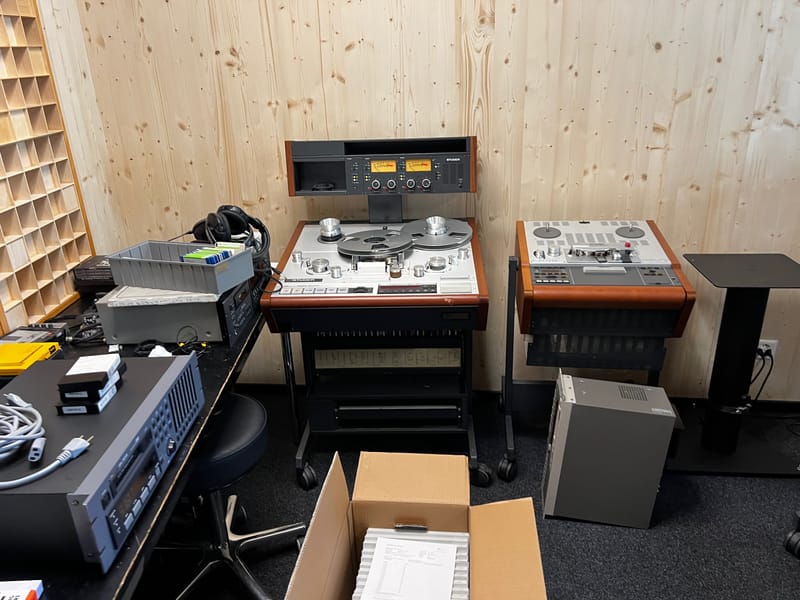
For two-track playback of pre-recorded tapes at the highest quality, the Studer A810 and A807, Ampex ATR-102, and Telefunken M15A represent the reference standard. Their combination of transport precision, head quality, and electronic performance allows pre-recorded tapes to be reproduced at a quality that reveals the full information content of the recording.
For reference-quality recording and playback at a more practical scale, the Revox PR99 MK III, Otari MX-5050 BII, and Tandberg 10X provide transport quality and electronic performance adequate for the most demanding audiophile applications. Their combination of practical operating simplicity and genuine performance capability makes them the practical choices for listeners who value tape's sonic qualities without requiring the absolute performance of full professional machines.
For cassette format playback at reference quality, the Nakamichi Dragon, 1000ZXL, and CR-7 remain the standard, their automatic azimuth correction addressing the fundamental limitation that degrades cassette playback on lesser machines. Supporting these with appropriate tape formulations – Maxell MX, TDK MA, Sony Metal Master, or the contemporary Mulann and RTM formulations – achieves cassette performance that converts skeptics unfamiliar with the format's potential.
The Complete Signal Chain
The tape machine's output connects to a preamplifier or integrated amplifier whose input sensitivity and impedance must match the machine's output characteristics. Professional machines typically output at standard operating level – plus 4 dBu in American standard, 0 dBu in European standard – which requires a preamplifier input of appropriate sensitivity. Consumer machines output at levels suited to consumer equipment's high-level inputs, typically around minus 10 dBV.
The quality of the connection between machine and preamplifier affects the final playback quality in ways that parallel the considerations of phono cartridge and phono stage connection. Cable quality, connection integrity, and the elimination of ground loops that introduce hum all require attention. Professional facilities used balanced connections throughout their signal chains specifically to eliminate the ground loop problems that plagued unbalanced consumer installations.
Power supply quality for the tape machine itself affects transport servo performance and electronic noise in ways that become audible in reference systems. The use of power conditioning equipment that eliminates line noise and voltage variations can produce audible improvements in transport stability and electronic noise performance that experienced listeners consistently identify.
Conclusion
The reel-to-reel tape recorder, in all its forms, represents one of the most complex and rewarding technologies in the history of recorded sound. Its story spans continents and decades, from Walter Weber's laboratory discovery of AC bias in wartime Berlin through the Swiss precision of Studer's A820 and A827, the German engineering authority of Telefunken's M15A and EMT's broadcast machines, the American ingenuity of Ampex's ATR series and MCI's studio workhorses, the Japanese manufacturing excellence of Otari, Teac, Akai, and Sony, the Norwegian musical philosophy of Tandberg, and the portable mastery of Nagra's field recorders.
The tapes themselves constitute an equally complex history, from BASF's foundational formulations and Scotch's American professional standards through Ampex's high-output ceramic oxides, the Japanese manufacturers' precision-engineered alternatives, and the contemporary production of Recording The Masters, ATR Magnetics, and the specialist suppliers who ensure that professional tape formulations remain available to the engineers and enthusiasts who require them.
The disciplines of alignment, maintenance, and careful operation that professional facilities maintained represent a genuine understanding that the tape recorder is not a self-maintaining device but a precision instrument whose performance reflects the care invested in it. Azimuth precision measured in minutes of arc, bias optimization specific to individual tape formulations, head demagnetization before each session, and the controlled storage conditions that extend tape's chemical stability all contribute to a system whose full performance potential is available only to those willing to engage with its requirements.
The tape recorder's persistence as a reference source component – in mastering studios where its recordings serve as the master from which all subsequent reproductions derive, in audiophile listening rooms where its sonic qualities continue to satisfy listeners whose experience of digital formats has not displaced their preference for the analog medium, and in archive facilities where its recordings constitute irreplaceable cultural documents – reflects an achievement whose depth rewards the attention it demands.
For those who pursue recorded music to its highest expression, the reel-to-reel tape recorder offers a path whose combination of mechanical sophistication, chemical complexity, and sonic reward remains unique among source components. From the first threading of a fresh reel of ATR Master Tape onto a restored Studer A810 to the careful storage of an archive reel whose recordings may be a century old before they are next played, the engagement with tape recording is an engagement with the full depth of what human ingenuity has achieved in the pursuit of capturing and reproducing musical truth.
Capturing every meaningful contribution within the audio industry is neither practical nor necessary; the companies, designers, and products highlighted here are representative rather than exhaustive, standing in for a far broader body of work that collectively shapes the craft and its ongoing evolution.
This is part of a continuing series. See also: Milestones in High-Fidelity Audio | Tube Reference Guide
Questions about Reel-to-Reel Tape
What are the best reel-to-reel tape machines for audiophile playback? +
For two-track playback at the highest quality, the Studer A810, Studer A807, Ampex ATR-102, and Telefunken M15A represent the reference standard. Their combination of transport precision, head quality, and electronic performance reveals the full information content of master tapes.
For more practical audiophile use, the Revox PR99 MK III, Otari MX-5050 BII, and Tandberg 10X provide excellent performance with simpler operation. These machines offer genuine tape quality without requiring the full professional maintenance infrastructure that the reference machines demand.
What is sticky shed syndrome and how do you fix it? +
Sticky shed syndrome affects tapes manufactured between approximately 1970 and 1990 using certain binder formulations. Moisture causes hydrolysis of the polyurethane binder that holds oxide particles to the base film, releasing particles that clog heads and guides while removing coating from the tape surface.
The standard treatment involves baking at 54 degrees Celsius for eight to twelve hours in a convection oven with controlled humidity. This temporarily reverses the hydrolysis, restoring the binder's cohesion sufficiently for one or more complete plays. Engineers managing archives routinely bake tapes immediately before transfer, working quickly to capture the recording before degradation resumes.
What is the difference between 15 ips and 30 ips tape speed? +
At 15 inches per second, recorded wavelengths are twice as long as at 7.5 ips, improving high-frequency response and signal-to-noise ratio. At 30 ips, wavelengths double again, achieving the highest frequency response and lowest flutter. This is why 30 ips became the standard for professional mastering.
However, 30 ips uses twice as much tape per minute and requires more precise azimuth alignment, as any angular error has twice the effect on high-frequency response compared to 15 ips. The choice between speeds depends on whether maximum quality or tape economy is the priority for a given application.
Why do mastering engineers still use reel-to-reel tape? +
Mastering engineers and serious listeners continue to regard well-maintained tape machines running high-quality tape as reference-grade sources. Tape's particular saturation and harmonic characteristics, combined with its dynamic behavior, communicate musical truth in ways that digital formats have not fully replicated.
The persistence of reel-to-reel in professional settings reflects not nostalgia but genuine sonic preference. When a machine like the Studer A810 or Ampex ATR-102 is properly aligned with quality tape such as ATR Master Tape or BASF SM900, the result is a source whose musical engagement continues to satisfy even engineers with extensive experience of the finest digital converters.