


"The phonograph record encodes musical information as physical grooves cut into a rotating disc. The playback system must rotate the disc at precisely controlled speed, guide a pickup through those grooves with geometric accuracy, and convert the mechanical movement into electrical signals."
The turntable represents one of the oldest source components in high-fidelity audio, yet its design principles continue to evolve. While digital formats have claimed significant market share, the LP record remains the reference medium for evaluating musical reproduction quality. Understanding the turntable, its associated cartridges, and the electronics required to play records illuminates fundamental principles that extend throughout audio engineering.
The phonograph record encodes musical information as physical grooves cut into a rotating disc. The playback system must rotate the disc at precisely controlled speed, guide a pickup through those grooves with geometric accuracy, and convert the mechanical movement into electrical signals. Each stage in this process presents engineering challenges that have occupied designers for over a century.
The Mechanical Foundation: Turntable Design
The Direct Drive Revolution
The introduction of direct drive motor technology by Technics in 1970 fundamentally changed turntable design. The Technics SP-10, the world's first direct-drive turntable, eliminated the belt or idler wheel that had connected motor to platter in previous designs. Instead, the motor directly drove the platter through magnetic forces, eliminating sources of vibration and speed irregularity that belt drives could not fully address.
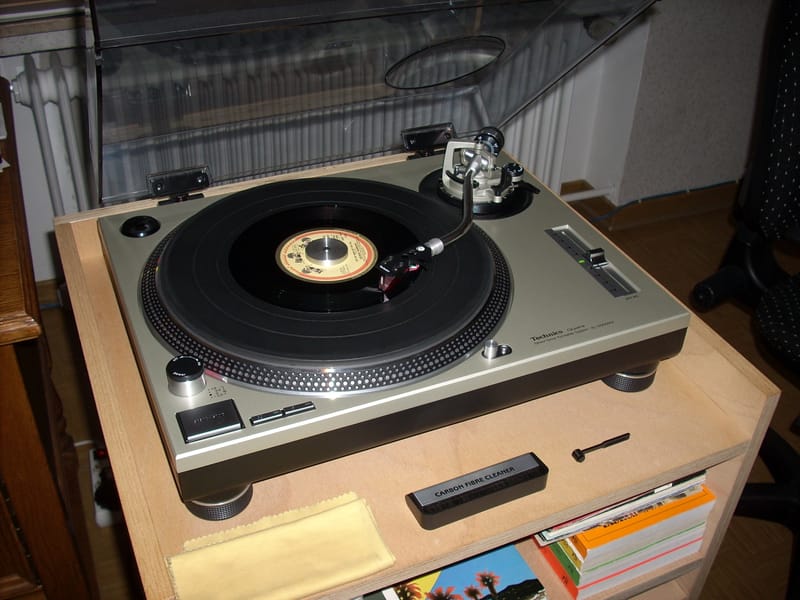
The SP-10 achieved immediate recognition as a reference-quality product. Broadcast studios and mastering facilities worldwide adopted it as their primary playback system, valuing its combination of speed accuracy and low noise. The motor's design, with the platter serving as an integral part of the motor assembly, ensured that any speed variations would directly affect the record rather than being filtered through mechanical compliance.
Two years after the SP-10's introduction, Technics launched the SL-1100 with integrated tonearm, and in 1972 the SL-1200 series began what would become one of the longest production runs in audio history. The SL-1200 established direct drive as the professional standard, particularly in applications where consistent performance under repeated use mattered most.
DJ culture embraced the SL-1200 for its immediate startup time and ability to maintain speed during manual pitch manipulation. However, the same characteristics that made it valuable for DJs made it valuable for audiophiles: the platter reached correct speed within one rotation, and that speed remained stable regardless of power line variations. The SL-1200's influence extended so widely that modified versions remain in use in serious audio systems worldwide.
Technics continued developing direct-drive technology through subsequent generations. The SL-8000 series brought the technology to more affordable price points, while the SP-10 MK2 refined the original concept with improved bearing design and enhanced vibration isolation. Modern Technics turntables, including the SL-1200G and the reference-class SP-10R, demonstrate that direct-drive technology continues to evolve, with innovations including core-less motors and advanced electronic speed control.
The Belt Drive Alternative
While Technics perfected direct drive, many designers concluded that mechanical isolation between motor and platter offered sonic advantages. Belt drive turntables place a flexible belt between motor and platter, filtering motor vibrations while allowing precise speed control through appropriately designed motors.
The Linn LP12, introduced in 1973, became the most influential belt-drive turntable in audiophile history. Linn Products of Scotland designed the LP12 with a simple philosophy: isolate the platter assembly from external vibrations while maintaining precise speed control. The suspended sub-chassis, supported by compliant mounts, separated the playing surface from cabinet vibrations that might affect stylus tracking.
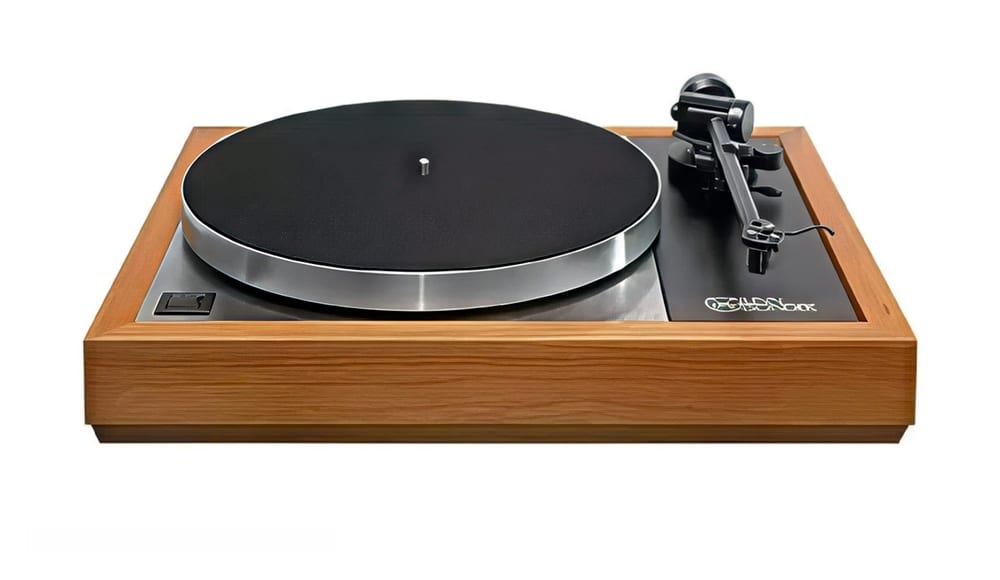
The LP12's influence extended beyond its own success. Its modular design encouraged third-party upgrades, creating an entire ecosystem of components designed to improve its performance. Companies like Naim, Audial, and Krell developed power supplies, phono stages, and tonearms specifically optimized for the LP12. The Valhalla and Lingo power supplies from Naim became reference upgrades, demonstrating that motor control electronics significantly affected ultimate performance.
The LP12 remained in continuous production for over four decades, with each generation incorporating improvements while maintaining the fundamental design philosophy. Linn's commitment to their product demonstrated that a turntable platform, properly conceived, could support ongoing evolution rather than requiring replacement with each technological advance.
Thorens of Switzerland brought their precision engineering tradition to belt-drive turntables with the TD-124 and subsequent models. The TD-124, produced from 1957, established Thorens as a serious manufacturer, with its sophisticated idler wheel drive system influencing subsequent designs. The TD-150 series brought the suspended sub-chassis concept to more affordable price points, while the TD-320 and TD-350 extended the approach with increasingly refined suspension systems.
The Thorens TD-280 represented a more accessible entry point, demonstrating that belt-drive principles could be implemented at various price levels. However, Thorens also produced reference products including the TD-5200, which combined their suspension expertise with premium materials and sophisticated motor control.
Linear Tracking and Unconventional Approaches
Beyond direct and belt drive, designers explored alternative mechanisms that might offer advantages in specific areas. Linear tracking turntables moved the tonearm in a straight line from center to edge, matching the geometry of the cutting lathe that created the original record.
Technics linear trackers, including the SL-10 and subsequent models, achieved recognition for their elimination of angular tracking error. Since the arm moved in a straight line parallel to the record's radius, the stylus always aligned with the groove's tangent, eliminating the distortion that conventional pivoted arms introduce. However, linear trackers required complex mechanical systems to achieve this geometry, often at the cost of increased complexity and service requirements.
The Lenco L75 and similar units demonstrated that idler-wheel drives, when properly implemented, could achieve excellent performance. These Swiss-designed turntables featured heavy platters, sophisticated bearing assemblies, and robust motors that allowed them to compete with more sophisticated designs. Modified Lenco units continue to appear in serious audio systems, demonstrating that fundamental mechanical design matters more than sophisticated technology.
Japanese Masters: Micro Seiki, Luxman, Nakamichi, and Others
No survey of turntable history is complete without acknowledging Japan's finest engineering achievements. Micro Seiki, perhaps the most revered name in precision turntable manufacturing, produced legendary models including the RX-5000, SX-8000, BL-91, BL-111, and the ultimate DQX-1000. Their air-bearing and precision-machined platters set standards that remain unequaled. Luxman, interestingly, sourced several of their finest turntables from Micro Seiki. The Luxman PD-444, PD-555, and PD-300 models were manufactured by Micro Seiki, combining Luxman's aesthetic and electrical expertise with Micro Seiki's mechanical precision.
Nakamichi took a different approach with their TX-1000 and Dragon CT turntables, which featured automatic centering systems that physically corrected off-center records, dramatically reducing wow and flutter.
Other remarkable Japanese broadcast and audiophile turntables include the Kenwood L-07D, Sony PS-X9, Pioneer Exclusive P3 and P10, Yamaha PX-1, Marantz TT-1000L, and the Denon DP-100M, all of which remain sought after by collectors. In fact, a 1980 Stereo Sound magazine test ranked the Pioneer Exclusive P3 and Sony PS-X9 among the finest turntables in the world, alongside the EMT 930st and Linn LP12, demonstrating the peak of Japanese analogue engineering.
Modern Reference Turntables from Europe and the USA
Contemporary turntable design represents the culmination of decades of accumulated knowledge. German manufacturers have achieved particular prominence at the reference level.
The Clearaudio Statement, introduced in the early 2000s, represents the concept of a turntable built without budget constraints. At 770 pounds, the Statement incorporates technology derived from aerospace applications, with materials chosen for their vibration-damping properties. The Statement's concept validated approaches that Clearaudio had developed for more affordable products, demonstrating that their fundamental design philosophy scales to statement-level performance. Clearaudio's more accessible models, including the Innovation, Performance, and Concept series, apply similar principles at prices more reasonable for serious enthusiasts.
Brinkmann Audio, also German, developed the Garrard-based turntables that became reference standards. The Brinkmann Balance, combining a modified Garrard motor with sophisticated electronic speed control, demonstrated that belt drive could achieve performance competitive with more complex designs. The company's attention to power supply design influenced subsequent designs throughout the industry.
Other German masterpieces include the Acoustic Signature Novum, Thunder, Invictus, and Ascona; the Transrotor Massimo, Zet 1, Zet 3, Artus, Orfeo, and Tourbillon FMD; and the TW Acustic Raven series, particularly the Raven LS, Raven AC, and Raven Black Knight.
Kuzma of Slovenia produced the Stabi series of turntables, which combined belt-drive principles with sophisticated engineering. The Stabi M, Stabi R, Stabi S, and the four-motor Stabi XL achieved recognition for their combination of musical engagement and technical precision, demonstrating that value could be found outside the traditional centres of high-end audio manufacturing.
The Swiss have also made indelible contributions. Goldmund's Reference turntable, introduced in 1982, pioneered the concept of "mechanical grounding" to channel resonances away from the playback system and remains one of the most influential designs in high-end audio.
The British manufacturer Transcriptors, founded by David Gammon in 1960, created iconic designs like the Hydraulic Reference, celebrated for its sculptural beauty and featured prominently in the film A Clockwork Orange. J.A. Michell Engineering, which took over production of Transcriptors' turntables in the 1970s, went on to create its own masterpiece, the GyroDec, in the early 1980s. The GyroDec, with its distinctive suspended chassis, heavy platter, and gold-plated weights, became an audiophile icon. The company also produced the more affordable Focus One and the ultimate Orbe.
American manufacturers have contributed equally significant designs. VPI Industries, founded by Harry Weisfeld, produced a legendary range including the HW-16, HW-19, TNT, Aries, Scout, Classic, and the reference Titan. The new VPI Model One, the first in their Forever Series, features a modular, upgradeable design with a three-point floating suspension. Sota, known for their suspended sub-chassis designs, offers the Sapphire, Nova, Cosmos, and the Eclipse. Basis Audio, founded by A.J. Conti, produced the Debut, 2000, 2500, and the ultimate Work of Art. Walker Audio's Proscenium Black Diamond, with its air-bearing platter and linear-tracking tonearm, remains one of the most expensive and highly regarded turntables ever made. Other notable American designs include the Merrill-Williams R.E.A.L. 101, the Well Tempered Lab turntable (with its golf ball damping), and the Galibier Design Gavia.
European broadcast turntables have their own storied lineage. EMT of Germany produced the 930, 950, and the legendary 927 broadcast turntables, which remain reference standards for their ruggedness and sonic excellence. The EMT 950, introduced in 1976, was a professional studio machine of immense cost and complexity, designed for the most demanding broadcast environments.
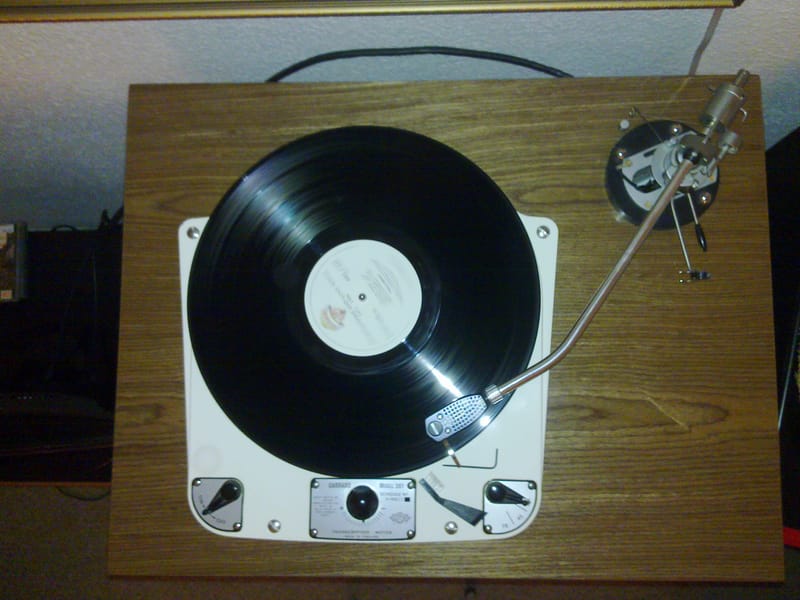
Studer, the Swiss professional audio company, manufactured the Revox B795 and B790 linear tracking turntables, as well as the more rare Studer A80 and A820 series broadcast decks. The British broadcast standard was the Garrard 301 and 401, idler-wheel designs that still command high prices. The Technics SP-10 series, while Japanese, was adopted globally by broadcasters.
The Cartridge: Mechanical to Electrical Conversion
The phonograph cartridge converts the physical movement of a stylus following record grooves into electrical signals. This electromechanical transducer must track grooves cut at microscopic dimensions while generating signals measured in thousandths of a volt. The design challenges have produced diverse approaches, each with distinct characteristics.

Moving Magnet and Moving Iron Designs
The moving magnet (MM) cartridge generates signals through the movement of magnets attached to the cantilever relative to fixed coils. This approach, developed early in LP history, offers practical advantages including higher output voltage and easier replacement of the stylus assembly. The magnetic system can be designed with high compliance, allowing effective tracking of record grooves with lighter tracking forces.
Ortofon established themselves as masters of moving magnet design with the Concorde series, which integrated the cartridge and head-shell into a single unit that plugged directly into compatible tonearms. This design simplified installation while maintaining performance suitable for DJ and home applications.
The Ortofon 2M series, developed with Moller-Jensen Design of Copenhagen, brought moving magnet technology to higher performance levels. The 2M Bronze and 2M Black achieved recognition for their combination of tracking ability and musical refinement. These cartridges demonstrated that moving magnet designs, properly implemented, could compete with more exotic approaches.
The Ortofon Quintet series extended moving coil technology concepts to more affordable price points. While technically moving coil designs, the Quintet cartridges offered higher output than traditional low-output MC designs, allowing compatibility with a wider range of phono stages. This combination of MC characteristics with MM practicality demonstrated that categorization schemes often obscure practical solutions.
Audio-Technica, founded in Japan in 1962 by Hideo Matsushita, made their name manufacturing state-of-the-art phonograph cartridges. Their AT-95E and subsequent models achieved wide acceptance as reliable, musical performers at accessible prices. The VM series cartridges used a dual magnet design that matched the geometry of stereo grooves more precisely than traditional single-magnet designs.
The Ortofon SPU (Stereo Phono Pickup), introduced in 1958, predated the stereo LP era but evolved to become one of the most enduring cartridge designs. Originally developed for broadcast applications, the SPU combined moving coil technology with a spherical stylus in a distinctive cylindrical housing. The SPU's sound character, often described as warm and musical, influenced subsequent designs throughout the industry.
Robert Gudmandsen, the designer of the original SPU, established principles that remain relevant: the importance of low moving mass, precise alignment, and appropriate compliance. Ortofon continues producing SPU variants, including the SPU Meister, which honours the original design while incorporating modern manufacturing techniques.
Shure established themselves as a dominant force in moving magnet cartridge design, with models that achieved legendary status among both audiophiles and professionals. The Shure V15 series represents perhaps their most celebrated achievement. The V15 Type III, introduced in the 1970s, became one of the most analyzed and imitated cartridges in audio history, setting tracking performance standards that few competitors could match. The subsequent V15 IV refined the design further, while the V15 Type V and V15 Type VI continued the lineage. The Shure M97xE, a more affordable successor, maintained the company's reputation for reliable, musical performance and remains a benchmark in its price class. Shure's contributions extended beyond audiophile circles into professional broadcasting, where their cartridges were valued for their consistency and durability.
Stanton, an American company, achieved legendary status in DJ and professional applications with cartridges designed for rigorous use. The Stanton 681 series, particularly the Stanton 681EEE, became the industry standard for club DJs, combining durable construction with tracking ability that could withstand the demands of cueing and back-cueing. The Stanton 500 series, including the Stanton 500v3, offered accessible performance for beginning DJs. Stanton also produced the Strider series and the Gran Prix models, which found use in broadcast applications where reliability mattered as much as ultimate fidelity. The company's calibration cartridges served as reference tools in professional studios worldwide.
Moving Coil Cartridges
Moving coil (MC) cartridges generate signals through coils attached to the cantilever moving relative to fixed magnets. The reduced moving mass compared to moving magnet designs allows superior high-frequency response and detail retrieval. However, the lower output voltage requires additional gain or step-up devices in the phono stage.
Denon, the Japanese electronics company, produced the legendary DL series of cartridges that have achieved enduring popularity across decades of audio history. The Denon DL-103, introduced in the 1960s, remains one of the most widely used and modified cartridges in existence. Its high output level, approximately 0.3 mV, allows it to work with standard MM phono stages without requiring step-up transformers, a characteristic that contributed significantly to its widespread adoption. The DL-103's construction proved remarkably durable, and its sound character, often described as naturally warm and musical, earned it devoted followers despite advances in technology. The Denon DL-304 represented a refined evolution of the design, offering improved tracking and resolution while maintaining the compatibility that made the DL-103 so popular. The DL-103R and DL-301HC continued the series' traditions, and modified versions by specialists such as Art Dashboard have achieved reference status among enthusiasts. Denon's cartridge program extended to the DL-110 and DL-160, offering more accessible entry points to the DL series experience.
The Koetsu cartridge, developed in Japan by Masataka Yamaguchi, achieved legendary status among moving coil designs. The original Koetsu Rosewood, introduced to America in the late 1970s, demonstrated that cartridge design involved more than electrical engineering. The choice of materials, the alignment of the generator system, and the construction of the housing all contributed to a sound character that many considered the closest approach to live music. Koetsu cartridges evolved through various configurations, including the Black Goldline, Signature, and Onyx Platinum variants.
Lyra, founded by Jonathan Carr, brought modern engineering approaches to moving coil cartridge design. The Lyra Delos, Kleos, Etna, and Atlas cartridges each represented different points in the trade-off between resolution and musicality. Lyra's designs emphasized low moving mass and precise alignment, with the construction quality reflecting the requirements of the most demanding applications. The Lyra Skala achieved recognition as one of the finest moving coil cartridges available.
Dynavector of Japan developed moving coil cartridges with distinctive characteristics. The DV-20X2 and subsequent models achieved recognition for their combination of high output and musical performance. The company's approach to flux guidance and coil winding produced cartridges with consistent performance across the frequency range. The Dynavector Te Kaitora Rua and XV-1S extended the company's technology to higher performance levels.
Zyx of Japan produced moving coil cartridges that achieved recognition for their technical performance. The Sakura, Ryo, and Universe cartridges demonstrated that cartridge design could combine precise engineering with musical engagement. The Ortofon Cadenza series, including the Bronze, Black, and Mono, represented the Danish company's statement in moving coil technology. Sumiko, while not a cartridge manufacturer themselves, established a distribution network that brought Japanese cartridges to American markets. The Sumiko Palo Santos Presentation and Celebration 40 cartridges represented their highest expressions.
Unique Architectures and Exceptional Craftsmanship
The London (formerly Decca) cartridge demonstrated that neither moving coil nor moving magnet accurately described all approaches. The London cartridge used a moving iron architecture, with small iron pieces moving within the magnetic field to generate signals. This approach produced output comparable to moving magnet designs while maintaining the low moving mass associated with moving coil technology. The London Reference cartridge, in continuous production for decades, achieved legendary status for its presentation of music.
Jan Allaerts of Belgium represents the pinnacle of moving coil cartridge craftsmanship, taking the moving coil principle to its highest expression through meticulous hand building. His cartridges, including the MC1, MC2, and the flagship MC1 Finish, use pure silver or gold alloy coils, powerful neodymium magnet systems, and diamond cantilevers.
The Allaerts MC1 Finish is widely regarded as one of the most transparent and musically involving cartridges ever made, extracting detail from the groove with an effortlessness that few competitors approach. The MC2 Finish, with its high impedance and low output, is a more challenging design that requires very specific electronics to perform at its best. These cartridges are favoured by listeners who demand absolute fidelity, and they demonstrate that even within the moving coil category, individual designers can achieve distinctive and reference-grade results.
The Shelter and Miyajima cartridges from Japan demonstrated that regional traditions could produce equally distinctive results, though through different engineering philosophies. The Shelter 901 and Miyajima Zero, Destiny, and Madake cartridges achieved recognition for their particular approach to musical reproduction, each reflecting design philosophies developed over decades of cartridge engineering. These cartridges, like the London and Jan Allaerts designs, remind us that the path to exceptional vinyl playback is not a single road but many.
Audio-Technica's AT-ART1000 represented the company's flagship moving coil design, incorporating their direct power system that positioned the coil directly beneath the stylus assembly, eliminating the cantilever's contribution to the signal path.
Tonearms: Guiding the Cartridge
The tonearm guides the cartridge through the record groove while allowing the cartridge to track the record's warps and variations. The engineering challenges include frictionless bearing design, appropriate effective mass, and accurate geometry that maintains cartridge alignment throughout the play surface.
SME of England established themselves as the reference tonearm manufacturer through decades of consistent quality. The SME Series V, developed from earlier designs, achieved recognition as one of the finest tonearms available. Its rigid construction, precision bearings, and adjustable geometry allowed optimal cartridge performance. The SME V-12 incorporated the Series V design into a longer format. The SME 3012R and M2 series extended the company's expertise to more accessible price points.
The Jelco tonearms from Japan achieved wide acceptance for their combination of quality and value. The Jelco 750L, 850, and 950 series provided effective performance at prices accessible to serious enthusiasts. Modified Jelco tonearms have appeared in many reference systems.
The Naim Nima represented that company's approach to tonearm design, using a uni-pivot bearing that allowed free movement with minimal friction. Ortofon tonearms, including the RS-3090, provided professional-grade performance.
Other notable tonearms include the Graham Engineering Phantom, the Tri-Planar, the Schroder Reference (using magnetic bearing), the Morch DP-6, the Reed 3P and 5T, the Kuzma 4Point and Air Line, and the Brinkmann 10.5 and 12.1. Frank Schroder's tonearms, including the CB and the LT, are mechanical works of art known for their unique captured bearing design.
The Kuzma 4Point, with its zero-play four-point bearing system, is widely considered one of the finest tonearms ever produced. For broadcast applications, the EMT 997 and the Ortofon RS-212D remain classics. Swiss precision is exemplified by Thales, whose tonearms use a unique tangential head-shell design that maintains perfect alignment across the entire record surface.
The Laser Alternative
The ELP Laser Turntable represented an attempt to eliminate stylus wear entirely by using laser beams to read record grooves. Developed in Japan, the ELP system used multiple lasers to track groove walls without physical contact, theoretically allowing infinite play without record degradation. The five-laser pickup, with two lasers reading groove information, two locating groove positions, and one monitoring surface reflection, attempted to replicate the information retrieval of conventional styli through optical means. However, laser turntables have struggled to achieve acceptance among serious listeners. The consensus suggests that they introduce their own artifacts, particularly noise from the optical detection process, that often exceed those of well-implemented conventional pickups.
Phono Preamplifiers and Equalization Standards
Playing records requires more than amplification. The recording process itself includes equalization that must be reversed during playback, and the low output voltage of most cartridges requires additional gain. The phono preamplifier addresses both requirements.
Equalization Curves: A Historical Survey
When records are cut, bass frequencies are reduced and treble frequencies are boosted. This process, called pre-equalization, allows more groove modulation within the record's physical constraints while reducing high-frequency noise. During playback, the opposite equalization must be applied to restore the original frequency balance.
Before standardization, each record company used its own equalization curve. Columbia Records in America used a curve with significant bass boost, as did RCA Victor. Decca in England used a different curve, as did EMI. NAB (National Association of Broadcasters) established curves used by American radio stations.
The Recording Industry Association of America (RIAA) published a standard equalization curve in 1954 that unified the various approaches. This curve, gradually adopted throughout the industry, became the universal standard for stereo records. By 1955, most major labels including Columbia, Decca, and EMI had switched to RIAA equalization.
The RIAA curve specifies a turnover frequency of 500 Hz and a rolloff of 20 dB per decade in the treble, with a bass shelf below 50 Hz. This combination, when correctly implemented, reverses the equalization applied during cutting and restores flat frequency response.
However, older records, particularly mono recordings from the 1950s and earlier, often used the curves of their original labels. Columbia records from the LP era typically require Columbia equalization (1000 Hz turnover), while Decca and EMI records may benefit from their specific curves. Even after RIAA standardization, some specialty labels and direct-to-disc recordings used alternative curves.
Modern phono stages often include selectable equalization curves, allowing appropriate matching to specific records. The availability of these curves has encouraged renewed interest in vintage recordings that may have been improperly played for decades.
Moving Coil Step-Up Requirements
Moving coil cartridges typically produce output voltages of 0.1 to 0.5 millivolts, far lower than the 2 to 5 millivolts from moving magnet designs. This low output requires additional gain, typically 20 to 30 dB more than moving magnet cartridges need.
Two approaches address this requirement: step-up transformers (SUTs) and active gain stages. Step-up transformers use electromagnetic induction to increase the voltage while maintaining appropriate impedance characteristics. Active gain stages use electronic amplification to achieve the same result.
Step-up transformers offer advantages in their inherently balanced operation and the absence of active electronics that might introduce noise. The Lundahl, Jensen, and Hashimoto transformer lines have achieved particular recognition for their performance. The impedance presented to the cartridge significantly affects moving coil performance. Most low-output MC cartridges work best with input impedances of 10 to 100 ohms, while higher-output designs may prefer 100 to 470 ohms.
Phono Stage Architectures and the Isenberg Reference for Jan Allaerts
The phono preamplifier must perform several functions: RIAA equalization, gain amplification, and impedance loading. Passive RIAA equalization, which applies the equalization curve through passive components without feedback, represents one approach. Active equalization, using negative feedback to implement the RIAA curve, allows all gain stages to operate with consistent characteristics. The choice between tubes and solid-state affects character more than fundamental performance.
For discerning listeners, particularly those using reference cartridges like the Jan Allaerts MC2 Finish, choosing the right partner is paramount. The MC2 Finish is a low-output (0.2 mV), high-impedance (approximately 845 ohms) design that requires a phono stage with very high gain and an unusual load impedance to perform optimally. The most carefully chosen partner for the Jan Allaerts MC2 Finish is the Isenberg Audio phono preamplifier, hand-built in Germany by Christian Isenberg.
Christian Isenberg has developed two phono stages specifically made for Jan Allaerts cartridges: one for the MC1 and another for the MC2. The Phono100 is designed for MC cartridges with an output between 0.3 mV and 0.8 mV, preferably for Jan Allaerts MC1 pickups. It comes with a separate power supply and no internal switches, except for an on/off button.
The Phono845 is a design for low-output MC cartridges below 0.3 mV, with the intention to match with an Allaerts MC2 F1 and MC2 Finish Gold. The combination of a Jan Allaerts cartridge with an Isenberg Audio phono preamp is considered a reference-quality pairing, allowing the cartridge to express itself fully and deliver an extraordinary level of musicality and transparency.
Notable Phono Stage Designs
Beyond Isenberg, a wide array of exceptional phono stages exists, each with its own philosophy and sonic signature. This list includes, but is far from limited to, the following:
Swiss Precision: Goldmund PH3.8 Nextgen (two-chassis design with external power supply), Studer/Revox, Nagra VPS, BPS, and HD PHONO, Thales, CH Precision P1 and X1, Soulution 520, 755, and 725.
German Artistry: Isenberg Audio Phono100 and Phono845, EMT JPA 66 (a legendary broadcast-inspired design), Einstein Audio The Little Big Phono and The Turntable's Choice, Trigon Advance, Dialog, and Exxceed, Vincent PHO-200 and PHO-500 series, Acoustic Signature, Clearaudio, Brinkmann, TW Acustic, Lehmann Audio Black Cube, Decade, and Silver Cube.
British Artistry: EAR (Esoteric Audio Research) 834P, 88PB, 324, 912, Tom Evans Audio Design The Groove, Microgroove+, Mastergroove, Linn, Naim Superline, Stageline, and Prefix, Sonneteer Seducer and Sedley, Graham Slee Era Gold, Reflex, and Accession, Cambridge Audio Alva Solo and Duo.
American Classics: Audio Research PH3 to PH8 and Reference Phono series, Conrad-Johnson PV-12, TEA-1, TEA-2, and the GAT series, Manley Steelhead and Chinook, VPI, Pass Labs Xono and XP series, Sutherland Engineering Phono Block, 20/20, Insight, and Duo, Parasound JC3, JC3+, and Zphono, Aesthetix Rhea, Io, and Janus, Boulder 1008 and 1108, Whest Audio TITAN, PS.30RDT, and MC.PRO, Bryston BP-1.5, TF-1, and BP-2, Schiit Audio Mani, Skoll, and Stjarna.
Global Excellence: Ypsilon VPS-100 (Greece), Audio Tekne TEA-8695 PCS (Japan), Luxman EQ-500, E-250, and E-03 (Japan), Accuphase C-37 and C-47 (Japan), Zesto Audio Elis, Leto, and Andros (USA), Musical Surroundings Phonomena and Nova (USA), Pro-Ject Phono Box DS, RS, and Tube Box series (Austria), iFi Audio Zen Phono and iPhono series (England/China), and many more.
System Integration: Matching Components
The performance of any turntable system depends on the interaction between its components. The cartridge's effective mass requirements must match the tonearm's capability. The phono stage's gain and loading must suit the cartridge's output and impedance characteristics. The turntable's isolation must control resonances without damping desirable dynamics.
This interdependence explains why simple turntable systems often outperform complex ones. Each additional component introduces potential mismatches and interactions that may degrade overall performance. The finest systems achieve their results through careful matching rather than accumulation of components.
The Linn LP12 ecosystem demonstrated how third-party manufacturers could optimize products for specific turntables. The Naim Valhalla and Lingo power supplies, the Audial modifications, and the various tonearm options all addressed specific aspects of LP12 performance. This ecosystem approach allowed users to upgrade incrementally rather than replacing entire systems.
Conclusion
The LP record and its playback system represent over a century of accumulated engineering knowledge. From the earliest acoustic phonographs through modern reference turntables from Micro Seiki, Luxman, Nakamichi, Clearaudio, Brinkmann, VPI, Sota, EMT, and Kuzma, the fundamental challenges remain: rotating discs at precise speeds while extracting tiny signals from microscopic grooves.
The turntable, cartridge, and phono stage form an interdependent system where each component affects the others. Belt-drive and direct-drive designs offer different approaches to motor isolation. Moving magnet and moving coil cartridges present distinct trade-offs between convenience and ultimate performance, with masterpieces like the Jan Allaerts MC1 Finish and the German-made Isenberg Audio phono preamps representing the cutting edge of both disciplines. Tubed and solid-state phono stages embody different philosophies toward amplification and equalization.
The persistence of vinyl in an era of digital convenience reflects its continued ability to communicate musical information in ways that many listeners find compelling. Whether spinning a vintage Technics SP-10 with a Koetsu cartridge, exploring the Linn ecosystem with a Jan Allaerts cartridge, or experiencing the latest Clearaudio Statement system, the LP remains a reference medium for evaluating musical reproduction.
The principles established through decades of development continue to inform new designs. The recognition that mechanical isolation, precise speed control, low moving mass, and appropriate equalization all contribute to musical truth remains as relevant today as when these concepts were first established. For those who value the connection between recorded music and live performance, the LP playback system continues to offer unmatched possibilities for exploration and discovery.
Capturing every meaningful contribution within the audio industry is neither practical nor necessary; the companies, designers, and products highlighted here are representative rather than exhaustive, standing in for a far broader body of work that collectively shapes the craft and its ongoing evolution.
This is part of the Hi-Fi History series. See also: Tube Reference Guide, Amplifier Classes, Signal Integrity.
Questions about Turntables & Vinyl Playback
What is the difference between a moving magnet and a moving coil cartridge? +
A moving magnet (MM) cartridge generates signals through magnets attached to the cantilever moving relative to fixed coils, producing higher output voltage (2–5 mV) and allowing easy stylus replacement. A moving coil (MC) cartridge uses coils on the cantilever moving relative to fixed magnets, achieving lower moving mass for superior high-frequency response and detail retrieval.
The trade-off is practical: MM cartridges offer convenience and compatibility with any phono stage, while MC designs require additional gain from a step-up transformer or dedicated MC phono stage. The finest MC cartridges, from makers like Jan Allaerts, Koetsu, and Lyra, achieve levels of musical detail and spatial presentation that represent the pinnacle of analogue playback.
Is a belt drive or direct drive turntable better for audiophile use? +
Neither is categorically superior. Belt drive turntables like the Linn LP12 use a flexible belt to filter motor vibrations, offering musical warmth and isolation. Direct drive designs like the Technics SP-10 eliminate the belt entirely, achieving superior speed accuracy and stability. The best modern examples of both topologies perform at reference level.
The choice depends on system matching, listening priorities, and personal preference. Many serious listeners maintain both types. What matters most is the quality of the overall implementation — bearing precision, motor control, platter mass, and vibration management — rather than the drive topology itself.
What is the RIAA equalization curve and why does it matter? +
The RIAA equalization curve, standardized in 1954, specifies how bass and treble frequencies are adjusted during record cutting and playback. Bass is reduced and treble boosted during cutting to fit more music into the groove and reduce noise. The phono preamplifier reverses this equalization during playback to restore flat frequency response.
Before RIAA standardization, each label — Columbia, Decca, EMI, RCA Victor — used its own curve. This means older mono records may sound incorrect through a standard RIAA phono stage. Some modern phono stages include selectable equalization curves for historically accurate playback of vintage recordings.
Why are Japanese turntables from the 1970s and 1980s so highly regarded? +
Japanese manufacturers like Micro Seiki, Technics, Luxman, Nakamichi, and Pioneer achieved extraordinary precision engineering during this era. Micro Seiki produced air-bearing platters with tolerances that remain unequaled. Technics perfected direct drive technology. Nakamichi developed automatic record-centering systems that corrected off-centre records in real time.
These turntables combined mechanical precision, advanced materials, and meticulous build quality that represented the peak of analogue engineering. Many remain sought after by collectors and audiophiles today, and the best examples — the Micro Seiki DQX-1000, the Kenwood L-07D, the Pioneer Exclusive P3 — command prices reflecting their enduring performance and historical significance.