


"Great recordings are rarely the result of a single decision. They are the result of many correct decisions."
This is a four-part piece on the history of recorded sound: how the legendary recordings were really made, how microphones actually work, how formats evolved from mono to immersive audio, and why the room is the one component that every recording and every playback system must confront. The thread running through all four parts is the same: there are no magic components, only well-executed systems.
Part 1 - The Myth of the Magic Microphone
How Legendary Recordings Were Really Made
Introduction
For as long as recorded music has existed, listeners have searched for the secret behind great sound. Was it the microphone? The recording console? The tape machine? The studio? The engineer? Or perhaps a single piece of equipment so exceptional that it transformed ordinary performances into timeless recordings?
Audio history is filled with such myths. Mention Frank Sinatra and somebody will inevitably mention the Neumann U47. Discuss Michael Jackson and the conversation quickly turns toward the Shure SM7. Speak about great opera recordings and before long someone will be praising the Decca Tree, the Neumann M50, or Kingsway Hall. The implication is always the same: the equipment created the magic.
The reality is far more interesting. And far more educational.
The greatest recordings in history were never created by a single component. Not one. Instead, they emerged from complete systems in which every element contributed to the final result: the performer, the room, the microphone, the engineer, the recording medium, the producer, the arrangement, the acoustics. The microphone mattered, but it was never the entire story.
This is perhaps the most important lesson the history of recording can teach us. Today, many discussions within high-end audio revolve around individual products. A loudspeaker becomes legendary. An amplifier acquires mythical status. A cartridge becomes the subject of endless debate. Yet when we examine the recordings that shaped musical history, a different pattern emerges. The engineers responsible for those recordings were rarely searching for magic.
They were searching for balance, reliability, simplicity, and transparency. Their objective was not to create sound. Their objective was to preserve it. And nowhere is this lesson more clearly demonstrated than in the voices that defined recorded music.
Frank Sinatra and the Capitol Years
Few artists are more closely associated with recording excellence than Frank Sinatra. More than seventy years after many of his most celebrated recordings were made, they continue to impress listeners with their natural tonal balance, realistic dynamics, and extraordinary vocal presence. Many enthusiasts attribute this achievement to a single microphone: the Neumann U47.
The U47 certainly deserves its reputation. It remains one of the most important microphones ever produced and appears throughout recording history. But the U47 alone did not create the Capitol sound.
Sinatra recorded in Capitol's Studio A, one of the finest recording spaces ever built. The room itself contributed significantly to the final result. Engineers such as John Palladino developed microphone techniques that balanced intimacy with realism, allowing Sinatra's voice to remain present without sounding artificially detached from the orchestra. Capitol's famous underground echo chambers became another essential part of the chain. These chambers were not effects in the modern sense. They were carefully designed acoustic spaces used as musical instruments.
The spaciousness heard on recordings such as I've Got You Under My Skin emerged from the interaction of performer, room, microphone, engineer, and acoustic environment. Remove any one of these elements and the recording changes dramatically. Remove Sinatra and there is no recording at all. The microphone mattered. But it was only one part of a much larger story.

Tony Bennett and the Church on 30th Street
If Capitol Studios represented one approach to recording excellence, Columbia's legendary 30th Street Studio represented another. Originally a church, the building possessed acoustics that engineers still discuss with admiration decades after its closure. The immense volume of the room created a natural ambience unlike anything that could be generated electronically.
When Tony Bennett recorded I Left My Heart in San Francisco, listeners were not merely hearing a microphone and a singer. They were hearing a voice interacting with a remarkable acoustic space. The room became part of the instrument. This is an important distinction, because it reminds us that recordings begin before electricity enters the picture. A microphone does not record a voice: a microphone records a voice interacting with an environment. That environment often contributes far more to the final sound than many listeners realise.
The Dave Brubeck Quartet and "Take Five"
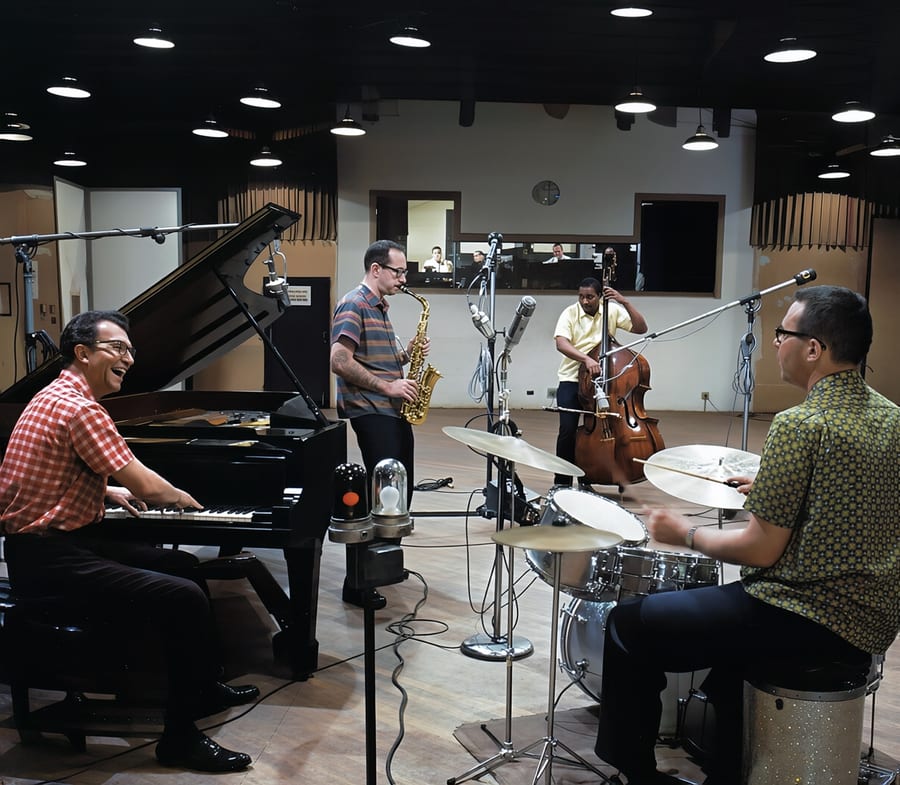
The 1959 recording of Take Five at Columbia's 30th Street Studio offers one of the most instructive case studies in the history of recorded sound. Engineer Fred Plaut worked with a console built around Altec modules, Altec amplifiers and monitors, and just four microphones: a Neumann U47 and a Neumann M49, one assigned per player, tracked to an Ampex 300 three-channel tape recorder. Nothing more.
The drum sound on that recording, with its distinctive natural weight and definition, has influenced engineers for generations. It did not come from elaborate close-miking or sophisticated processing. It came from a U47 positioned a few feet in front of Joe Morello's kit, in a room whose reverberation was itself an instrument. A single small echo chamber with a speaker and a second U47 provided the spatial depth that listeners still find arresting today.
What the session demonstrates is the power of disciplined simplicity. Four musicians. Four microphones. One exceptional room. Every decision served the performance rather than compensating for anything the room could not provide.
Ella Fitzgerald and the Art of Effortless Recording
Ella Fitzgerald presents another fascinating lesson. Engineers frequently described her as one of the easiest vocalists to record. This was not because the equipment was exceptional. It was because Ella herself possessed extraordinary control: pitch, timing, dynamics, microphone technique, breath control. Everything seemed effortless; the reality was decades of mastery.
Great engineers often say that the best recordings occur when the performer solves most of the problems before the signal reaches the microphone. Ella Fitzgerald embodied that principle. Her recordings remind us that the most important component in any recording chain is often standing directly in front of the microphone.
Maria Callas and the Presence of Emotion
Maria Callas represents a different dimension of recorded sound. Her recordings are not primarily studied for technical perfection. They are studied for emotional intensity. Pitch was not always flawless, timbre could vary dramatically, and technique sometimes pushed against physical limits. Yet none of this diminished her impact.
Engineers working with Callas faced a very specific challenge: not how to improve the performance, but how to preserve it without interference. The recording chain became an act of restraint. Too much processing and the emotion would be flattened. Too little care and the intensity would distort. What survives in these recordings is not perfection in a technical sense. It is truth in an expressive sense. Callas reminds us that the goal of recording is not always cleanliness. Sometimes it is communication.
Joan Sutherland and the Architecture of Sound
Joan Sutherland's recordings, particularly those made with Decca, reveal another essential principle. In opera recording, the room is not a background element: it is part of the composition. Kingsway Hall in London provided a space of extraordinary acoustic balance, large enough to allow orchestral bloom, controlled enough to maintain clarity.
Engineers such as Kenneth Wilkinson understood that their role was not to dominate the sound but to guide it. The famous Decca Tree microphone configuration became central to this approach: three omnidirectional microphones capturing not isolated sources but a coherent acoustic field. The result is a sense of scale that still feels natural today. Sutherland's voice did not sit "on top" of the orchestra; it lived inside the same acoustic space. That distinction is critical.
Luciano Pavarotti and Controlled Power
Pavarotti introduced a different engineering challenge: power, projection, density. A voice capable of filling a hall without amplification still requires careful capture to avoid distortion of scale. Decca engineers again relied on space, distance, and microphone technique rather than close-miking intensity. The goal was not to magnify the voice but to preserve its natural proportions. What listeners perceive as effortless grandeur is in reality a carefully balanced interaction between performer, hall, and recording system.
Dietrich Fischer-Dieskau and the Intimate Truth
If Pavarotti represents scale, Dietrich Fischer-Dieskau represents intimacy. His lieder recordings are among the most detailed vocal documents ever made. Every nuance of phrasing becomes audible; every shift in breath carries meaning. This level of detail does not come from exaggerated equipment performance. It comes from controlled environments and precise microphone placement. These recordings demonstrate something important: resolution is not only about frequency extension. It is about the ability to preserve microdynamics and emotional shading.
Jussi Bjorling and Natural Beauty
Jussi Bjorling's recordings occupy a unique space in vocal history. They are often described as "naturally beautiful," a phrase that points less to equipment and more to balance. His voice was captured in a way that feels unforced, present but not exaggerated, detailed but not analytical. This type of sound does not come from a single microphone choice. It comes from alignment between voice, room, and engineering intent.
Enrico Caruso and the Limits of Technology
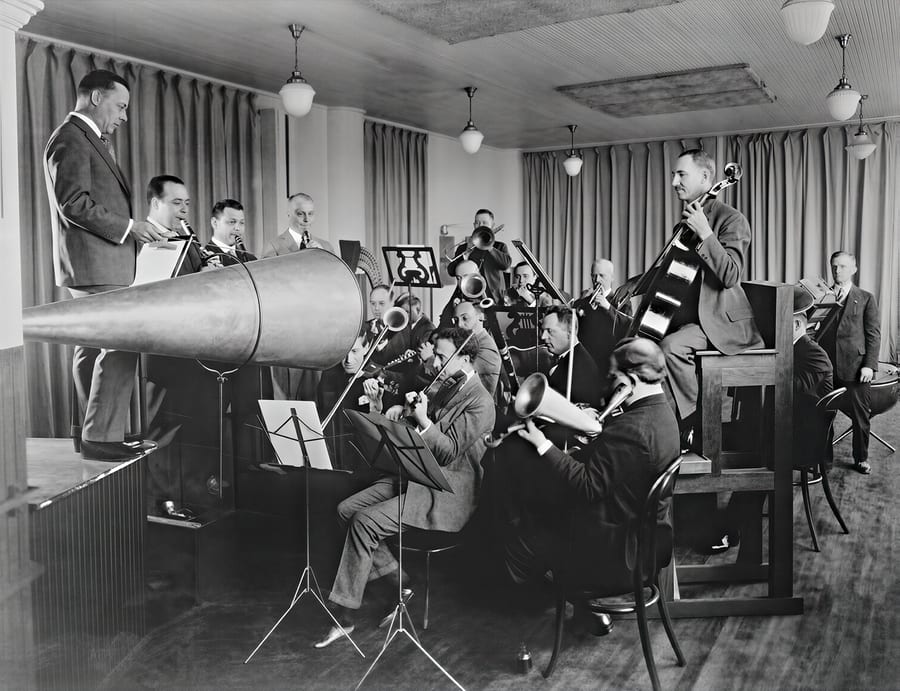
Caruso's recordings remind us where all of this began. Acoustic recording: no microphones, no electronics, only horns, mechanical energy, and physical engraving. By modern standards the technical limitations are extreme. Frequency range is narrow, dynamic range is compressed, noise is ever-present. And yet the emotional communication survives. This is perhaps the most important lesson in all of audio history: technology does not create musical meaning. It only preserves or degrades what is already there.
Kirsten Flagstad and Early Electrical Recording
With the arrival of electrical recording, singers like Kirsten Flagstad benefited from improved fidelity, but the core challenge remained unchanged: capture the voice without distortion of character. Flagstad's dramatic soprano required systems that could handle both power and subtlety. These early recordings show how quickly engineering adapted once microphones replaced acoustic horns. But they also show that even with improved technology, success still depended on judgement rather than equipment alone.
Fritz Wunderlich and the Illusion of Effortlessness
Fritz Wunderlich's recordings are often described as effortless. This perception is the result of careful engineering decisions: balanced microphone placement, controlled acoustic environments, minimal interference with the natural voice. The illusion of simplicity is created by discipline behind the scenes.
Birgit Nilsson and Controlled Intensity
Birgit Nilsson's voice posed the opposite challenge: extreme power, extreme focus, extreme projection. Capturing such a voice requires restraint in microphone technique and careful distance management. Too close and the sound becomes harsh; too far and the impact is lost. The engineering achievement lies in maintaining both power and clarity simultaneously.
Freddie Mercury and Constructed Reality
Freddie Mercury's recordings introduce a different reality entirely. The studio becomes an instrument: multiple takes, layered vocals, tape editing, different studios contributing to different parts of a single track. What sounds spontaneous is often the result of meticulous construction. Yet even here the same principle applies. Every stage in the chain either preserves or shapes the performance. The complexity does not negate the system. It reinforces it.
Michael Jackson and the SM7 Question
Michael Jackson's vocal recordings during the Thriller era are frequently associated with the Shure SM7. What matters more than the exact microphone is the reasoning behind its use. The microphone suited the voice, the room suited the production, the engineering suited the aesthetic. A relatively modest broadcast microphone became part of one of the most successful albums in history: not because it was special, but because it was appropriate.
Alison Krauss and Modern Naturalism
Alison Krauss represents a modern approach that intentionally avoids excessive processing. Her recordings rely on high-quality but restrained engineering. The goal is not transformation but preservation. This philosophy aligns closely with earlier traditions in classical and acoustic recording. It is a reminder that modern technology does not require modern excess.
Mercury Living Presence and RCA Living Stereo
The great orchestral recordings of Mercury and RCA remain benchmarks because of their disciplined simplicity: fewer microphones, careful placement, minimal processing, and strong reliance on room acoustics. These recordings demonstrate that realism often decreases as complexity increases. Not always. But often enough to be instructive.
What History Actually Teaches Us
Across all genres, eras, and technologies, the same pattern emerges repeatedly. Great recordings are not defined by equipment lists. They are defined by decisions: what to capture, what to leave out, how to position microphones, how to use space, how to balance clarity and coherence.
The Lesson for Audiophiles
This is where recording history becomes directly relevant to playback. Audiophiles often search for a single component that will transform a system: a cable, a DAC, an amplifier, a loudspeaker. But the recordings they cherish were never created that way. They were created through systems in which every element mattered, but none was sufficient alone. No single component in a playback chain can create realism on its own. Only the system as a whole can preserve it. The same argument, applied to the playback chain and its cost, runs through The Cost of Becoming Sound and Beyond Digital Purity.
Final Thoughts
The myth of the magic microphone persists because it is simple. It assigns credit to objects rather than processes. But the reality of recording is more demanding, and more rewarding. Great recordings emerge when performers, engineers, spaces, and equipment align toward a single goal: preserve the musical event. Not enhance it. Not reinterpret it. Preserve it. That principle has not changed since the earliest days of recording, and it will not change in the future. Because in the end, there are no magic microphones. Only well-executed systems. And the music they allow us to hear.
Part 2 - The Truth About Microphones
Understanding the Devices That Convert Music Into Electricity. "The microphone is the first translator in the recording chain. Its language is not music. Its language is pressure."
Introduction
Every recording ever made begins in exactly the same way: not with electricity, not with software, not with digital technology, but with moving air. A singer opens their mouth, a violin string vibrates, a drumhead is struck. Pressure waves travel through space. The microphone exists for one purpose only: to convert those pressure variations into an electrical signal while preserving as much information as possible.
That sounds straightforward. In reality, it is one of the most challenging tasks in all of audio engineering. A microphone is the first active element in the recording chain. Every subsequent stage depends entirely upon what it captures. If information is lost here, it can never be recovered later. No preamplifier can restore it. No converter can recreate it. No software can invent it.
Understanding microphones therefore means understanding the foundation of recorded sound itself. Yet microphones are often surrounded by mythology: some are treated almost as sacred objects, others dismissed because of their modest price. History suggests a more nuanced view. The best engineers rarely ask what the best microphone is. Instead they ask what they are trying to capture. The answer to that question determines everything that follows.
What a Microphone Actually Does
At its most fundamental level, a microphone is a transducer: a device that converts one form of energy into another. In this case, acoustic energy becomes electrical energy. The microphone does not hear music. It does not understand voices. It does not recognize instruments. It simply responds to variations in air pressure.
What makes microphones fascinating is that different designs respond to those pressure variations in very different ways. Each design brings advantages; each design introduces compromises. The history of microphone development is therefore not a search for perfection. It is a search for intelligent compromise.
Dynamic Microphones
The dynamic microphone is one of the simplest and most robust transducer designs ever created. A lightweight diaphragm is attached to a coil of wire suspended within a magnetic field. As sound moves the diaphragm, the coil moves with it. The motion generates a small electrical signal. Simple. Elegant. Reliable. The design has remained largely unchanged for decades because it works exceptionally well.
Dynamic microphones tolerate extremely high sound pressure levels, they are physically durable, relatively resistant to humidity and environmental abuse, and they often reject room ambience better than highly sensitive condenser designs. These characteristics explain why dynamic microphones remain common in recording studios despite the availability of far more expensive alternatives.
The Shure SM7
Few microphones illustrate this principle better than the Shure SM7. Originally designed for broadcast applications, it became famous through its association with Michael Jackson and engineer Bruce Swedien. The lesson is often misunderstood. The microphone was not chosen because it was prestigious: it was chosen because it suited the voice. Swedien repeatedly emphasized that microphone selection should be based upon results rather than reputation. The SM7 provided excellent control of sibilance, strong midrange clarity, and predictable behaviour. It solved a problem. That is what great microphones do.
The Electro-Voice RE20
Another legendary dynamic microphone, the RE20 remains a favorite in broadcasting and voice-over work. Its variable-D design minimizes proximity effect, allowing speakers to move closer without excessive bass build-up. For broadcasters this creates a more consistent sound; for engineers it reduces problems before they occur. Good engineering often means preventing problems rather than correcting them later.
Condenser Microphones
If dynamic microphones are the workhorses of recording, condenser microphones are often its thoroughbreds. Most legendary studio microphones belong to this category: the Neumann U47, the AKG C12, the Neumann M49, the Neumann U67, the Neumann U87. These microphones became famous because they combined sensitivity, detail, and musicality at a time when recording quality was advancing rapidly.
Unlike dynamic microphones, condenser designs rely on an electrically charged diaphragm and backplate. As sound alters the distance between them, electrical capacitance changes; this variation becomes the audio signal. The diaphragm can be extremely light, so condenser microphones often respond faster and more accurately to subtle details.
The advantages are substantial: greater sensitivity, extended frequency response, superior transient response, excellent low-level detail. The disadvantages are equally real. Condenser microphones capture everything, including problems: a poor room, air conditioning noise, unwanted reflections, mechanical vibrations. A condenser microphone does not discriminate. It faithfully records whatever reaches its diaphragm. This is why great studios remain important even in the digital era. A great microphone cannot rescue a poor acoustic environment, a point developed at length in The Frequency Spectrum.
Tube and FET Condensers
Within condenser microphones, two broad categories dominate professional recording. Tube microphones often exhibit gentle harmonic behaviour that many engineers find musically appealing. Classic examples include the Neumann U47, M49, and AKG C12. FET microphones replaced vacuum tubes with solid-state electronics, offering greater reliability, lower maintenance requirements, and improved consistency; the Neumann U87 became one of the most successful examples. Both approaches remain relevant today. The choice depends less upon ideology and more upon application.
The Sony C-800G
A significant chapter in modern microphone history belongs to Sony. Released in 1992, the C-800G is a large-diaphragm tube condenser built around a 6AU6 vacuum tube and a K67-type dual-diaphragm capsule. Its most distinctive engineering feature is a thermoelectric cooling system: a Peltier semiconductor device in the external power supply that actively stabilizes tube operating temperature, dramatically reducing thermal noise and bias-current distortion. The result is one of the lowest noise floors ever measured in a tube microphone.
The C-800G arrived precisely when digital recording was going mainstream. As studios moved to multitrack digital recorders with wider dynamic range and lower noise floors than analogue tape, engineers needed microphones capable of revealing what digital could actually resolve. The C-800G answered that demand. It became the defining vocal microphone of commercial hip-hop, R&B, and pop production across several decades, used on landmark recordings from artists as different as Dr. Dre and Mariah Carey. The lesson it teaches is the same one the U47 taught a generation earlier: a microphone becomes associated with landmark recordings not because it possesses magic, but because it was engineered thoughtfully, suited specific voices and production contexts, and solved real problems in the chain.
Ribbon Microphones
Ribbon microphones occupy a unique place in recording history. Instead of a diaphragm attached to a coil, an extremely thin metal ribbon moves directly within a magnetic field. The ribbon itself generates the signal. The design produces characteristics that many engineers continue to admire: smooth high frequencies, natural transient response, excellent off-axis behaviour, and a sense of ease that can be difficult to describe but easy to recognise.
During the golden age of broadcasting, ribbon microphones dominated radio studios throughout Europe and North America. The BBC relied heavily upon them and so did many major American broadcasters.
RCA and the Golden Age
The RCA 44 and RCA 77 became iconic not because they measured perfectly, but because they captured voices in a convincing and natural manner. Decades later, many engineers still consider them among the most musical microphones ever produced.
The Coles 4038
Originally developed for BBC applications, the Coles 4038 remains in production today. Its reputation rests largely upon its natural presentation and superb off-axis behaviour, particularly useful in large acoustic spaces where sound arrives from multiple directions simultaneously.
Small-Diaphragm Condensers and the Pursuit of Accuracy
The distinction between large-diaphragm and small-diaphragm condensers is not simply a matter of physical size. It reflects a fundamental difference in acoustic and mechanical behaviour. Large-diaphragm capsules typically measure 20 mm or more in active diameter. Small-diaphragm capsules are generally 12 mm or below. This matters because the diaphragm is a physical membrane with mass, and mass has consequences.
A larger diaphragm captures more acoustic energy and can achieve high sensitivity, but its greater surface area makes it more susceptible to resonance modes across its face. At high frequencies, where the wavelength of sound approaches the physical dimensions of the diaphragm, the membrane no longer moves uniformly as a piston. Different areas of the diaphragm receive sound waves at slightly different times and phases, producing ripples in the frequency response and anomalies in the polar pattern, especially off-axis. This is why large-diaphragm microphones often exhibit a brightening or "presence peak" in the upper midrange, and why their off-axis response can become colored or unpredictable at higher frequencies.
A small diaphragm behaves more like a true point receiver across a wider frequency range. Because its dimensions are small relative to the wavelengths involved throughout most of the audio spectrum, it moves as a more uniform piston, with fewer internal resonance modes. The result is typically a flatter and more consistent frequency response at all angles, not just on-axis. Off-axis coloration is reduced. Transient response is faster because the diaphragm has less mass to accelerate and decelerate. The tradeoff is that sensitivity is somewhat lower, and self-noise can be slightly higher than the best large-diaphragm designs. For recording in great rooms with well-projected sources, this is rarely a practical limitation.
Schoeps and the Colette Philosophy
Schoeps Mikrofone of Karlsruhe, Germany has been central to small-diaphragm condenser design since the 1940s. Their early M 201 was used by Mercury Living Presence engineers starting in 1953, initially as a single microphone for mono recordings, and later as the centre element in early stereo sessions. The association between Schoeps and classical recording has deepened ever since.
The modern Schoeps Colette system, based around separate capsule modules and amplifier bodies, represents one of the most principled approaches to microphone design available. Capsules such as the MK 2 omnidirectional and the MK 4 cardioid achieve their frequency response purely through mechanical architecture, without electronic filtering to compensate for acoustic deficiencies. The MK 4 cardioid in particular has earned a reputation as a problem-solver: its directional pattern remains consistent from the lowest frequencies to the highest, so off-axis sound is attenuated without coloration. The MK 2 omnidirectional is regarded by many engineers as one of the finest single capsules ever produced for classical and chamber recording, capable of revealing what a room contains with extraordinary neutrality.
This consistency is not accidental. It is the result of manufacturing precision carried to an unusual degree, and of a design philosophy that prioritizes acoustic integrity over sonic character.
Pearl Mikrofonlaboratorium
Pearl Mikrofonlaboratorium, founded in Stockholm in 1941 by Rune Rosander, is the oldest Swedish microphone manufacturer and one of the longest continuously operating microphone companies in the world. In the late 1950s Pearl introduced their signature rectangular condenser capsule, a design that remains at the heart of their current production. A rectangular membrane, unlike a circular one, has different resonant dimensions along each axis. This asymmetry suppresses certain diaphragm resonance modes that would otherwise create response irregularities, and contributes to the unusually smooth and extended frequency response that Pearl capsules are known for. The membrane is coated with vapor-deposited aluminum rather than the sputtered gold used by most other manufacturers, which also influences the mechanical properties of the diaphragm.
Pearl microphones are particularly well regarded for classical and acoustic music recording, where their combination of accuracy, smooth off-axis behaviour, and freedom from coloration makes them valuable instruments in a well-considered recording chain. Their DC-63 and DC-96 models became sought-after tools among engineers who value neutrality without sterility. When Pearl divided in 1978 to form the related brand Milab, both companies continued developing rectangular-capsule designs, and in 2018 Milab production was consolidated with Pearl's facility in Astorp, where both brands continue to be built by hand.
DPA and Scandinavian Precision
Brüel & Kjær of Denmark built measurement microphones to standards that influenced the entire profession of audio engineering. The 4006 omnidirectional microphone, developed from that tradition and now carried by DPA Microphones, has become a worldwide recording standard since its introduction in 1982. Its linear frequency response, high sensitivity, low noise floor, and exceptional on- and off-axis consistency have made it a first choice for orchestral A-B pairs, Decca Tree configurations, and spot-miking of acoustic instruments in concert halls and opera houses around the world. The 4006 comes with interchangeable acoustic modification accessories that alter its pressure-equalization characteristics, allowing the same capsule to be optimized for free-field or diffuse-field conditions without any change to its phase or time behaviour. That level of engineered flexibility reflects the same philosophy as Schoeps: understand the acoustic problem first, then solve it mechanically rather than electronically.
Earthworks and Time Coherence
Earthworks Audio of New Hampshire, founded by David Blackmer in the 1990s, approached microphone design from a different starting point: the conviction that most studio microphones, regardless of their reputation, introduce temporal distortion that conventional frequency response measurements do not reveal. Blackmer argued that larger diaphragms behave like resonant drumheads when excited: they continue to vibrate after the exciting sound has ceased, overlaying subsequent transient events with residual energy from previous ones. This is a smearing of information in the time domain, not the frequency domain, and it is largely invisible on a steady-state frequency response plot.
The Earthworks QTC series answers this problem with an extremely small capsule, approximately 6 mm in diameter, operating in pure pressure-sensing omnidirectional mode. A small omnidirectional capsule avoids several sources of temporal distortion simultaneously: it has minimal diaphragm mass, no directional ports or acoustic labyrinths that would introduce frequency-dependent phase shifts, and no proximity effect. The QTC30 specifies flat frequency response from 3 Hz to beyond 30 kHz, and its impulse response is measurably faster and more settled than that of conventional studio condensers. These are not merely marketing claims; they reflect genuine acoustic physics.
The practical result is microphones that capture transient events with an accuracy that rewards placement in a well-treated room or a genuinely good acoustic space. They are unforgiving of poor environments precisely because they are designed not to flatter. Engineers who understand this find them invaluable for acoustic recording, room miking, and any application where temporal fidelity takes precedence over a particular tonal character.
Measurement Microphones: The Standard Against Which Everything Else Is Judged
Measurement microphones occupy a category of their own, distinct from recording microphones in purpose though closely related in principle. Their function is not to capture music but to quantify the acoustic behaviour of rooms, loudspeakers, and other systems with the highest possible accuracy.
A true measurement microphone is designed to have a known, calibrated, and maximally flat frequency response over its specified range, with a polar pattern that is mathematically predictable, and an output level that allows precise conversion of acoustic pressure into a traceable electrical quantity. Every individual unit ships with its own calibration chart, typically traceable to national standards laboratories, showing the actual deviation of that specific microphone from an ideal flat response. This data is used by measurement software to correct for any residual inaccuracies.
Brüel & Kjær (now known as HBK) defined the profession of acoustic measurement for much of the twentieth century. Their 4133 and 4134 one-half-inch condenser capsules became the reference standard against which rooms and loudspeakers were characterized, and their design philosophy, based on rigorous mechanical engineering and individual calibration, influenced every serious microphone manufacturer that followed. Earthworks' M series measurement microphones carry that tradition into modern practice, offering time-coherent performance combined with the calibrated accuracy required for loudspeaker and room analysis.
For audiophiles and acousticians working with room correction software such as Dirac Live, Audyssey, or REW combined with a high-quality measurement microphone, the instrument used for measurement matters in a specific way: systematic errors in the measurement microphone will be interpreted as errors in the room or loudspeaker, and the correction filter will compensate for something that does not exist. A well-calibrated measurement microphone removes that uncertainty from the process, a discipline closely tied to treating DSP as the last resort.
There is an instructive parallel between measurement microphones and the finest recording microphones discussed elsewhere in this article. Both Schoeps and DPA produce capsules that perform dual roles: they are accurate enough for measurement applications and musical enough for recording. The Schoeps MK 2 is specified for use with acoustic calibrators. The DPA 4006 is supplied with an individual frequency response chart for each unit. Pearl ships matched pairs with their own response documentation. The distinction between a measurement microphone and a truly accurate recording microphone is less absolute than the marketing categories suggest. In both cases the underlying ambition is identical: capture what is actually there, without addition, subtraction, or interpretation.
The Importance of Microphone Placement
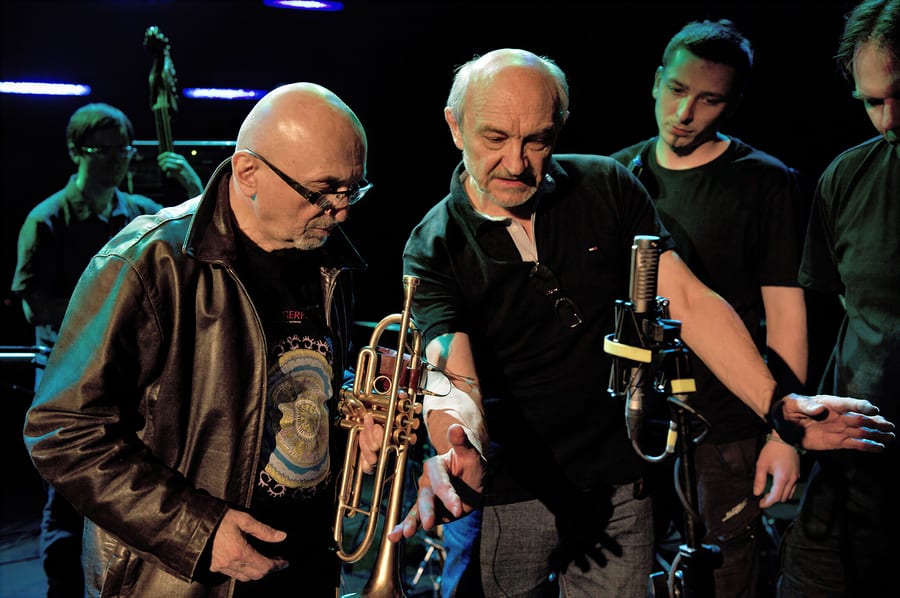
Of all the variables in recording, microphone placement is simultaneously the most powerful and the most underestimated. Engineers with decades of experience return to this conclusion repeatedly, and the physics support them entirely.
Moving a microphone by a few centimeters can produce a greater change in the recorded sound than replacing it with a microphone costing ten times as much. This is not an exaggeration. It follows directly from how sound behaves in space.
Distance from the source affects the ratio of direct sound to reflected sound. A microphone placed close to an instrument captures a high proportion of direct energy relative to room reflections: the result is an intimate, present, potentially dry sound. Move that same microphone two meters further back and the room begins to dominate. The tonal balance shifts, the sense of depth changes, and the relationship between the instrument and its acoustic environment is transformed. Neither position is inherently correct: the choice depends on what the engineer is trying to preserve.
Distance also affects tonal balance through two distinct mechanisms. Proximity effect, which applies to all directional microphones, causes the microphone to exhibit rising bass response as the source moves closer. This is a physical consequence of the directional design relying on a pressure-gradient sensing mechanism: as distance decreases, the gradient-to-pressure ratio changes in favor of lower frequencies. A cardioid microphone used for close vocal work will produce a noticeably warmer and heavier low end than the same microphone used at greater distance. Engineers either exploit this characteristic deliberately or compensate for it through physical distance and high-pass filtering. Omnidirectional microphones, which operate on pure pressure sensing, do not exhibit proximity effect and therefore maintain consistent tonal balance at any distance.
The second mechanism is the inverse-square law: sound pressure level from a point source falls at a rate of 6 dB for every doubling of distance. At close distances, small changes in position produce large changes in level. At greater distances, the same physical movement produces a smaller change. This means that close-miking demands extremely precise and stable positioning, while distant miking is more forgiving of small variations.
Height, angle, and the relationship to room boundaries all contribute further. Placing a microphone near a reflective surface introduces comb filtering through the interference of direct and reflected sound. Aiming a cardioid microphone slightly off-axis from a sound source attenuates certain high frequencies more than others, because the polar pattern is frequency-dependent: a cardioid is narrower at high frequencies than at low ones. Turning the microphone even a few degrees can alter the character of the high-frequency capture without changing the level. This is one reason why engineers who work with small-diaphragm condensers, whose polar patterns are more consistent with frequency than those of large-diaphragm designs, often describe them as more predictable in practice.
The lesson that placement matters more than equipment is not merely a practical observation. It is a reminder of where the real skill in recording resides. Equipment can be purchased. Placement is the result of listening, experience, and understanding of acoustics. A great engineer with an ordinary microphone and a good room will routinely outperform a poor engineer with legendary equipment. The microphone matters. Its position matters more.
Understanding Polar Patterns
Every microphone exhibits a directional response known as its polar pattern. The cardioid pattern primarily captures sound from the front while rejecting sound from the rear. It is one of the most versatile patterns in recording. Omnidirectional microphones capture sound from every direction; when used in excellent rooms they often sound extraordinarily natural because they avoid the phase anomalies associated with directional designs. The figure-eight pattern captures sound from the front and rear while rejecting sound arriving from the sides, and is frequently used in stereo recording techniques such as Blumlein pairs and M/S configurations. Supercardioid and Hypercardioid patterns offer tighter directivity and greater rejection of unwanted sounds, with correspondingly more demanding placement requirements. No pattern is universally superior. Each solves a different problem.
Why Engineers Love Omnidirectional Microphones
Audiophiles are often surprised to learn how many classical recordings rely heavily on omnidirectional microphones. The reason is straightforward: a well-designed omnidirectional microphone often reproduces space more naturally than directional alternatives. Without the ports and acoustic labyrinths required to create a directional response, the design can achieve a remarkably smooth and extended frequency response. The diaphragm responds to absolute pressure rather than pressure gradient, which eliminates proximity effect and produces consistent tonal balance at any distance. This is one reason why the Decca Tree became so successful. The engineers were not merely choosing microphones. They were choosing a philosophy: capture the hall, capture the orchestra, capture the event.
The Importance of Off-Axis Behaviour
Most microphone discussions focus on on-axis frequency response. Professionals often care more about what happens away from the main axis. No microphone hears only what is directly in front of it. Rooms produce reflections, walls contribute delayed energy, and ceilings and floors influence tonal balance. These sounds arrive from different directions. A microphone's ability to handle off-axis information often determines whether a recording sounds natural or artificial.
Two microphones may measure similarly on-axis while sounding dramatically different in practice. The difference frequently lies in their off-axis behaviour. This is one reason why certain microphones achieve legendary status: not because of what they do directly in front, but because of how gracefully they handle everything else. It is also a reminder of the gap between what you hear and what you measure.
The Room Dominates Everything
Perhaps the most important lesson in recording is that rooms matter. A great room can make an ordinary microphone sound extraordinary. A poor room can make an extraordinary microphone sound ordinary. This reality explains why legendary studios became legendary: Capitol, Abbey Road, Kingsway Hall, Columbia 30th Street. The acoustics existed before the microphones arrived. And they continued to matter long after those microphones changed. The room is not merely a container for sound. It is part of the sound itself.
The U47 Myth
No microphone has acquired more mythology than the Neumann U47. Its reputation is deserved. Its mythology often is not. The U47 appeared during a transformative period in recording history when magnetic tape was improving, studios were expanding, and recording quality was advancing rapidly. Many legendary performances happened to be captured through U47s, so the microphone became associated with greatness. Yet greatness originated elsewhere: in the performers, in the engineers, in the recording systems. The U47 was an important participant. Not the sole cause.
Choosing the Right Microphone
There is no perfect microphone. There never has been. Every design represents a series of compromises. The best microphone for an opera singer may be unsuitable for a kick drum; the best microphone for a podcast may be entirely wrong for a string quartet. The correct question is never what the best microphone is. The correct question is what you are trying to capture. Once that answer becomes clear, microphone selection becomes far easier.
Final Thoughts
Microphones are among the most fascinating devices in audio because they occupy the boundary between music and technology. They are the first translators in the recording chain, the first custodians of information, the first opportunity to preserve a performance or lose part of it forever. Great engineers do not begin by asking which microphone is best. They begin by asking what they are trying to capture. Only then do they choose the microphone, and only then do they decide where to place it. That sequence of priorities guided the pioneers of recording. It guided the great engineers of the twentieth century. And despite all technological progress, it remains true today.
Part 3 - From Mono to Atmos
The Evolution of Recording Formats and Humanity's Pursuit of Realism. "Every recording format is an attempt to preserve a musical event."
Introduction
Every generation believes it has finally solved the problem of recording. The technology changes, the marketing changes, the terminology changes. Yet the challenge remains remarkably constant: how do we preserve a musical event?
The history of recording is often presented as a story of continuous progress: mono gave way to stereo, stereo gave way to surround sound, surround evolved into immersive audio. Each new format promised greater realism, greater accuracy, greater involvement. Sometimes those promises were fulfilled. Sometimes they were not.
The fascinating truth is that some of the most convincing recordings ever made are now more than half a century old. This suggests that technology alone has never been the deciding factor. Understanding the evolution of recording formats reveals an important lesson: formats matter. Engineering matters more.
Before Electrical Recording
The earliest recordings contained no microphones whatsoever. Performers sang or played into large acoustic horns. The horn concentrated acoustic energy onto a diaphragm connected directly to a cutting stylus. Everything was mechanical. Everything was limited. Frequency response was restricted, dynamics were compressed, and balance depended entirely upon physical positioning: loud instruments stood farther away, quiet instruments stood closer. The entire recording was mixed before it was recorded.
By modern standards the results seem primitive, yet something remarkable survives: the performance. Even through severe technical limitations, great artists remained recognizable. This would become a recurring theme throughout recording history. Technology influences music. It does not create it.
The Arrival of Electrical Recording
The introduction of microphones during the 1920s changed everything. For the first time engineers gained genuine control over the recording process. Microphones could be positioned independently of performers, electrical amplification became possible, and frequency response improved dramatically. Recording quality advanced almost overnight. The modern era of audio had begun.
The Age of Mono
Modern listeners often dismiss mono as outdated. This is unfortunate. Many mono recordings remain astonishingly convincing. Why? Because mono possesses something many complex recordings struggle to achieve: coherence. Everything originates from a single acoustic perspective. There are no competing arrival times, no conflicting spatial information, no elaborate reconstruction of reality. The listener hears a unified event. This explains why many early jazz, vocal, and orchestral recordings continue to sound remarkably natural despite lacking stereo information. The absence of width does not automatically imply the absence of realism.
Magnetic Tape Changes Everything
The arrival of magnetic tape after the Second World War transformed recording. Editing became practical, noise performance improved, dynamic range increased, and engineers gained unprecedented flexibility. Recording sessions no longer had to be perfect from beginning to end. Mistakes could be corrected, performances could be assembled, and production entered a new era. The implications would soon reshape popular music forever.
Alan Blumlein and the Birth of Stereo
Few individuals contributed more to recording history than Alan Blumlein. During the 1930s, Blumlein developed many of the principles that continue to define stereo recording today. His insight was elegant: two channels could reproduce spatial information in a way a single channel never could. Listeners could perceive width, position, and depth. The illusion was powerful. Even now, nearly a century later, stereo remains one of the greatest achievements in audio engineering. It delivers substantial increases in realism without introducing excessive complexity.
Why Stereo Succeeded
Many recording innovations disappeared. Stereo survived. The reason is simple: the improvement was immediately obvious. Listeners required no technical explanation. Instruments occupied distinct positions, the soundstage expanded, and the listening experience became more immersive. Most importantly, stereo improved realism while preserving coherence. It struck a balance that remains difficult to surpass.
Mercury Living Presence
Few recording philosophies have achieved the legendary status of Mercury Living Presence. Their approach was radical in its simplicity: use fewer microphones, preserve natural balance, and avoid unnecessary processing. Rather than constructing an orchestra from dozens of close microphones, Mercury sought to capture the performance as a coherent event. The Schoeps M 201, used from 1953 onwards as their primary mono microphone and later as the central element in their early stereo sessions, became central to their sound. The results remain extraordinary. Many of these recordings continue to outperform modern productions despite being decades older. Their success demonstrates a lesson often forgotten: complexity is not synonymous with quality.

RCA Living Stereo
At roughly the same time, RCA pursued similar goals through a slightly different methodology. The famous Living Stereo recordings combined exceptional engineering with carefully selected recording venues. These recordings remain reference material for many audiophiles because they preserve scale, depth, dynamics, and coherence. They sound believable. And ultimately that is the goal.

The Decca Tree
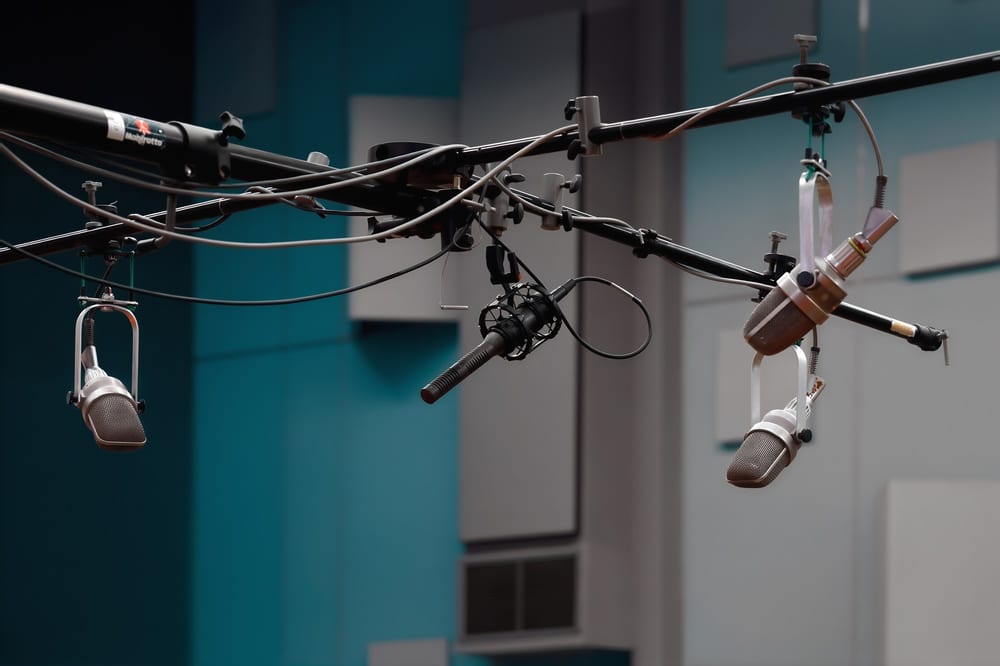
If one microphone technique deserves recognition as a milestone in recording history, it is the Decca Tree. Developed by Decca engineers during the 1950s, it employed three omnidirectional microphones arranged in a carefully defined geometry: a central microphone on a forward extension, flanked by two further microphones approximately one meter apart and set slightly further back. The arrangement provided stable imaging, strong centre focus, excellent depth, and natural orchestral scale. Decades later, it remains one of the most respected orchestral recording techniques ever developed. Its continued success demonstrates an important principle: good engineering ages remarkably well.
Multitrack Recording
If Mercury and RCA sought realism, multitrack recording pursued flexibility. Individual instruments could now be recorded separately, balance decisions could be delayed, and editing possibilities expanded dramatically. Creative freedom exploded. This changed not only recording technology but music itself. The studio became an instrument.
Les Paul
Few figures influenced multitrack recording more profoundly than Les Paul. His experiments with overdubbing demonstrated that recordings could become creative works rather than simple documentation of performances. Modern music production traces directly back to these innovations.
The Beatles
No discussion of multitrack recording is complete without The Beatles. Working alongside producer George Martin and the engineering team at Abbey Road Studios, they transformed recording from documentation into art. Albums such as Sgt. Pepper's Lonely Hearts Club Band could not have existed without multitrack techniques. The recording process itself became part of the composition.
Pink Floyd
Pink Floyd used recording technology as an artistic medium. Albums such as The Dark Side of the Moon explored spatial effects, tape manipulation, and sonic architecture in ways that still influence engineers today.
Queen
The vocal layering on recordings by Queen remains one of the most ambitious achievements in analogue recording. What sounds effortless often involved enormous technical complexity. The lesson is familiar: great engineering frequently hides itself.
The Digital Revolution
Digital recording introduced new possibilities: lower noise, greater dynamic range, perfect copying, longer recording times. The transition was not without controversy. Many listeners preferred analogue systems; others embraced the precision and consistency of digital technology. Both perspectives contain elements of truth. Digital solved many technical limitations. It did not eliminate the need for good engineering.
High Resolution Audio
Higher sample rates and greater bit depths promised additional improvements. Under the right circumstances they can indeed offer advantages. However, recording history teaches caution. A poor recording made at high resolution remains a poor recording. A great recording made decades ago often remains a great recording. Format alone never determines quality, a theme explored further in The Hi-Res Streaming Process and The Bit-Perfect Paradox.
Beyond Stereo: The Many Roads to Immersion
Stereo was never intended to be the final destination. Since the 1950s, engineers have explored numerous ways to recreate a more realistic acoustic space. Some ideas disappeared almost as quickly as they appeared, while others continue to influence modern immersive audio systems.
One of the earliest attempts was Quadraphonic Sound, introduced in the early 1970s. Instead of two loudspeakers, four channels surrounded the listener. Several incompatible formats competed for acceptance, including SQ, QS and CD-4. Although technically impressive for its time, the lack of a universal standard, expensive hardware and limited software prevented quadraphonic sound from becoming a commercial success. Nevertheless, it demonstrated that listeners could experience a convincing sense of space beyond conventional stereo.
Research into multichannel music reproduction continued throughout the following decades. Five-channel systems gradually emerged, eventually leading to the familiar 5.1 surround format. While enormously successful for cinema, many music enthusiasts found these systems to be more spectacular than natural. Rear loudspeakers frequently became carriers of effects rather than contributors to a believable acoustic environment.
One of the most elegant alternatives was the 2+2+2 concept developed by Werner Dabringhaus of MDG. Instead of using a center loudspeaker and a low-frequency effects channel, the system employed two front loudspeakers, two rear loudspeakers and two elevated front height loudspeakers. The objective was not to create dramatic surround effects, but to reproduce the natural vertical reflections and spaciousness of a concert hall. Height became an essential component of realism rather than a theatrical effect. Although never widely adopted by consumers, the concept proved remarkably convincing for the reproduction of classical music and influenced later immersive formats such as Auro-3D.
Prof. Andrew Lipinski approached the same problem from an entirely different perspective. Rather than proposing another channel format, he questioned the compromises typically built into multichannel loudspeaker systems. Lipinski argued that every loudspeaker contributing to the reproduced sound field should possess essentially identical acoustic behaviour, including frequency response, phase response, directivity, dynamic capability and transient performance. Only then could a moving or stationary sound source maintain its spectral balance while traveling through three-dimensional space. His approach emphasized identical monitors for every channel, precise geometric placement, careful time alignment and properly integrated low-frequency reproduction. The objective was not to impress the listener with movement around the room, but to eliminate discontinuities that would reveal the reproduction system itself. In this philosophy, the loudspeaker array becomes a single coherent acoustical instrument rather than a collection of independent sources. The background to that philosophy is set out in Lipinski Sound.
Today's immersive formats, including Dolby Atmos, DTS:X and Auro-3D, continue the search for greater realism by combining additional height channels with object-based rendering. These systems offer unprecedented flexibility, allowing sounds to be positioned throughout a three-dimensional space. Yet despite their technological sophistication, they pursue the same objective engineers have explored for decades: reproducing the complete acoustic environment rather than simply widening a stereo image.
The technology continues to evolve, but the underlying challenge remains unchanged. Reproducing a believable acoustic space is not simply a matter of adding more loudspeakers. It requires accurate recording techniques, carefully designed loudspeaker systems, controlled room acoustics and recordings that preserve genuine spatial information. When these elements work together, immersive audio becomes less about impressive effects and more about faithfully recreating the original musical event.
What We Learned
After more than a century of recording, certain lessons appear repeatedly. More microphones do not automatically create realism. More channels do not automatically create realism. Higher resolutions do not automatically create realism. More expensive equipment does not automatically create realism. Good engineering creates realism. Thoughtful decisions create realism. Understanding acoustics creates realism. Technology remains important. But technology is rarely the deciding factor.
The Lesson for Audiophiles
This conclusion should feel familiar. The recordings we admire were not created by chasing specifications. They were created by preserving information. The same principle applies to playback: every component either preserves information or degrades it. Transparency is not a feature. It is a process: a process that begins with performers and continues all the way to the listener.
Final Thoughts
Recording technology will continue to evolve. New formats will appear, new standards will emerge, new marketing promises will arrive. Yet the central challenge remains exactly as it was when the first performers stood before an acoustic horn: preserve the performance. Everything else is merely a tool. That was true in the age of mono. It remained true in stereo. It remains true in Atmos. And it will remain true long after today's formats become tomorrow's history.
Part 4 - The Room, Audio's Most Powerful Component
"The one component every recording depends upon and every playback system must confront."
Every sound we hear exists within a space. Whether it is a violin in a concert hall, a jazz trio in a club, a singer in a cathedral or a loudspeaker in a living room, the surrounding environment becomes part of the sound itself. Long before microphones, amplifiers or loudspeakers enter the equation, acoustics have already begun shaping the musical experience.
This simple fact is often overlooked in high-end audio. Listeners debate converters, cables, amplifiers and loudspeakers, yet the largest and most influential component in the entire signal chain cannot be purchased from a catalogue. It is the room.
A microphone records far more than an instrument. It captures the direct sound, the earliest reflections from nearby surfaces, the gradual build-up of reverberation and the complete acoustical signature of the surrounding space. The room is not an afterthought. It becomes permanently embedded in the recording.
Playback follows exactly the same principle. The loudspeaker reproduces the recording, but the listening room immediately begins adding its own reflections, resonances and colourations. Every recording therefore contains two rooms: the room in which it was captured and the room in which it is reproduced. Understanding this interaction is fundamental to understanding audio itself, and is the subject of The Frequency Spectrum and the acoustical basics.
Why Great Recording Venues Became Legendary
Capitol Studio A. Columbia 30th Street. Kingsway Hall. Abbey Road Studio One. Jesus-Christus-Kirche in Berlin. Sofiensaal in Vienna. Watford Town Hall. Teatro Colón in Buenos Aires. Japan Center Theatre in San Francisco. These places became legendary not because they housed expensive equipment, but because they solved acoustic problems before the signal ever reached a microphone.
The engineers who worked there understood a fundamental truth: a microphone cannot separate an instrument from the air surrounding it. Every reflection, every resonance and every subtle decay becomes part of the recording. The room is therefore not simply the location where music is performed. It is an active element of the recording process.
Great recording venues were designed, or carefully selected, with architecture in mind. Ceiling height, room volume, structural symmetry, reverberation time, diffusion, noise isolation and modal behaviour were considered long before microphone placement. Electronics could enhance an excellent room, but they could never compensate for a poor one.
Columbia 30th Street
Few recording venues illustrate this principle better than Columbia's legendary 30th Street Studio in New York. Originally built as a church, the immense volume and thirty-meter ceiling produced exceptionally smooth reverberation with remarkably uniform decay. Engineers frequently discovered that fewer microphones produced better results because the room itself blended the orchestra naturally. Recordings by Miles Davis, Glenn Gould and Leonard Bernstein continue to demonstrate how architecture can become an invisible participant in musical performance.
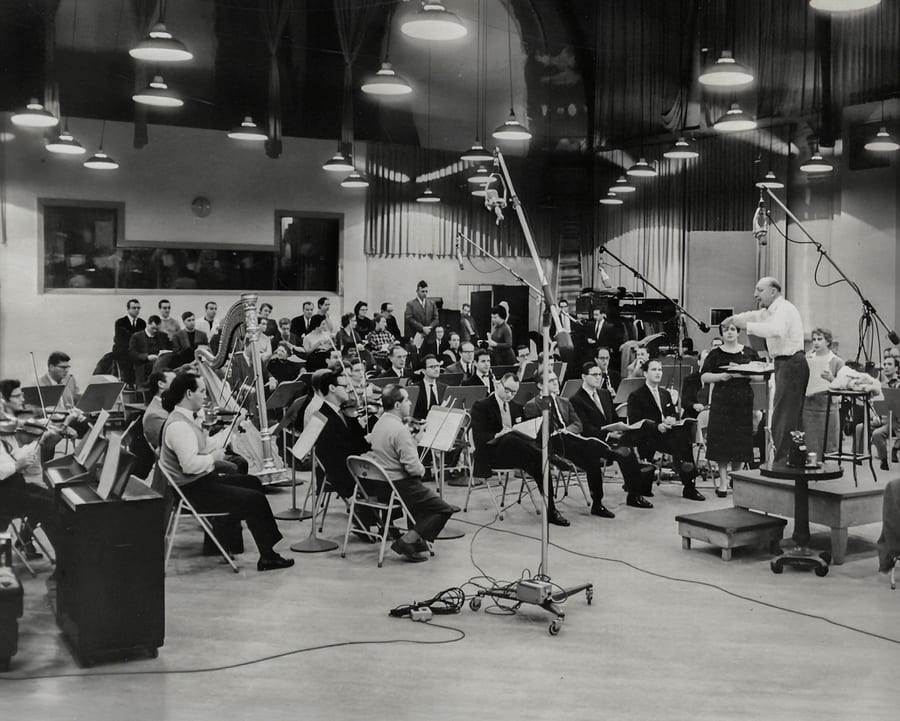
Kingsway Hall
For classical recording engineers, Kingsway Hall represented one of the finest acoustical environments ever available. Its carefully balanced reverberation allowed orchestras to sound spacious while preserving exceptional clarity. Combined with Decca's famous Tree microphone array, the hall produced recordings that remain reference material more than half a century later. Much of what listeners associate with the classic Decca sound originated not from electronics but from the room itself.
Abbey Road Studio One
Studio One at Abbey Road was conceived for large orchestral recording long before multitrack production became commonplace. Its generous dimensions produced a diffuse and highly predictable reverberant field, allowing engineers to position microphones according to musical balance rather than correcting acoustic deficiencies. Numerous orchestral recordings and film scores continue to benefit from these remarkably consistent acoustics.
Jesus-Christus-Kirche
Many of Deutsche Gramophone's most celebrated recordings were produced inside Berlin's Jesus-Christus-Kirche. Although never intended as a recording studio, the church possessed an extraordinary combination of spaciousness, clarity and exceptionally low background noise. It demonstrated once again that outstanding recording spaces are often discovered rather than designed.
Sofiensaal
Vienna's Sofiensaal became inseparable from Decca's European recording legacy. Originally constructed as a nineteenth-century bathing hall before conversion into a concert venue, its enormous volume and beautifully controlled reverberation created an ideal environment for large orchestras. Even after the devastating fire of 2001, its reputation remains firmly established among recording engineers.
Beyond the Traditional Studio
Not every legendary recording was made inside a purpose-built studio. Keith O. Johnson selected the Japan Center Theatre in San Francisco for the celebrated Däfos recording because its acoustics allowed percussion to develop naturally without artificial reverberation. The recording remains a benchmark for transient accuracy, dynamic range and spatial realism.
Producer Todd Garfinkle of M.A. Recordings followed an even more radical philosophy. Rather than bringing musicians into the studio, he travelled the world searching for remarkable acoustical spaces. Buddhist temples in Japan, ancient monasteries, historic churches and traditional concert halls became his recording venues. Working with minimal microphone techniques and virtually no signal processing, Garfinkle demonstrated that architecture itself can become one of the most important elements of musical reproduction.
Outstanding recording venues exist throughout the world. Teatro Colón in Buenos Aires remains one of the finest concert halls ever constructed. Sala São Paulo transformed a historic railway station into an internationally respected recording venue through sophisticated variable acoustics. Across Asia, numerous temples and wooden concert halls continue attracting engineers because their acoustical character cannot be duplicated electronically.
Why Rooms Sound Different
Every enclosed space shapes sound through four fundamental physical processes. Reflection determines how sound returns from surrounding surfaces and defines the timing of the earliest arrivals. Absorption converts part of the acoustic energy into heat, controlling reverberation time and reducing excessive reflections. Diffusion scatters sound energy across many directions, preventing strong echoes while maintaining a sense of spaciousness. Resonance develops whenever room dimensions reinforce particular wavelengths, creating standing waves that exaggerate or suppress specific frequencies.
These processes never occur independently. Every room represents a unique interaction between geometry, construction materials, surface finishes and enclosed air volume. Small differences in architecture can dramatically alter tonal balance, imaging precision, clarity and listener envelopment.
The Concert Hall as an Instrument
A violin sounds different in Vienna's Musikverein than it does in Amsterdam's Concertgebouw. A Steinway concert grand behaves differently in Teatro Colón than it does in Sala São Paulo. The instrument has not changed. The room has.
Acousticians often describe great concert halls as extensions of the instruments themselves. Early reflections increase clarity and apparent loudness. Later reflections contribute warmth, spaciousness and emotional engagement. Carefully controlled reverberation supports musical phrasing without masking detail, while diffusion prevents individual reflections from becoming distracting echoes. The room is therefore not passive. It actively contributes energy to every note. In many respects, it becomes the largest instrument in the orchestra.
The Forgotten Component
High-end audio frequently concentrates on electronics because electronics are measurable, marketable and replaceable. Rooms are different. They cannot be upgraded by changing a cable or installing a new converter. Yet every recording ever produced depends upon one room during recording and another during playback.
Before a microphone captures a violin, a piano or an orchestra, it first captures the surrounding air. Before a loudspeaker reaches our ears, it first energizes the listening room. The room is therefore not simply another component in an audio system. It is the one component that every recording shares, every playback system encounters and no listener can escape.
The Recording Engineer's Dilemma
Every engineer eventually faces the same question: capture the room, or minimize the room? Classical engineers typically embrace the room. Rock engineers often control it. Broadcast engineers frequently attempt to eliminate it. Different goals require different solutions. The correct answer depends upon the music.
Why Omnidirectional Microphones Love Great Rooms
Omnidirectional microphones often sound extraordinarily natural because they capture sound arriving from all directions. In a great room this can be magical. In a poor room it can be disastrous. The microphone simply reveals what already exists. This is another reason why great studios remain valuable: they allow microphones to succeed.
The Listening Room
Everything discussed so far applies equally to playback. A loudspeaker does not radiate sound only toward the listener. Much of its energy reaches walls, ceilings, floors, and furniture. These reflections then interact with the direct sound. What reaches your ears is therefore a combination of loudspeaker and room. Never one without the other.
The Great Audiophile Mistake
Many enthusiasts attempt to solve acoustic problems with electronics: a brighter loudspeaker, a different DAC, a new amplifier, a new cable. Occasionally improvements occur. But often the real problem remains unchanged: the room. Changing equipment to compensate for acoustics can become an endless cycle. Improving the room often solves multiple problems simultaneously. Many of those overlooked problems are the quiet destroyers that degrade a system without announcing themselves.
DSP and Acoustics
Digital signal processing has become increasingly sophisticated. Modern room correction systems can achieve remarkable results. They are useful tools, sometimes indispensable tools. Yet they remain tools. They do not change the physical dimensions of a room, they do not eliminate early reflections, they do not alter fundamental reverberation behaviour, and they cannot replace acoustics. The best results occur when acoustics and DSP work together rather than against each other, which is exactly why DSP belongs last, after the physical causes have been addressed.
Why Small Rooms Are Difficult
Domestic listening rooms present unique challenges. Dimensions are limited, boundaries are close, and bass resonances become dominant. The lower frequencies often require more attention than the higher frequencies. This surprises many listeners. The most visible acoustic treatments usually affect treble. The most serious problems frequently occur in the bass, where room modes create peaks and nulls of 10 dB or more at specific frequencies and listening positions. Placement is the first and most powerful control, as set out in The Subwoofer Question.
The Illusion of Transparency
Listeners often describe certain systems as disappearing: the loudspeakers vanish, the room vanishes, and only the performance remains. This is perhaps the highest compliment a system can receive. Interestingly, such experiences rarely result from a single component. They emerge when room, loudspeaker, electronics, source, and recording work together coherently. Once again the lesson is familiar: systems matter.
What Recording History Teaches Us
Throughout this series, a recurring pattern has emerged. Great performers matter. Great engineers matter. Great microphones matter. Great formats matter. Yet one element appears repeatedly in every era: the room. Capitol, Kingsway Hall, 30th Street, Abbey Road, Musikverein. The room was never an accessory. It was always part of the instrument.
Final Thoughts
Audio often encourages us to focus on objects: amplifiers, DACs, microphones, loudspeakers, cables. These things matter. But the room remains unique. It influences every recording. It influences every playback system. It cannot be bypassed. It cannot be removed from the chain. It can only be understood. And perhaps that is the final lesson of this series. The pursuit of realism has never been about finding magic components. It has always been about understanding systems. The room is not merely part of that system. The room may be the most important part of all.
Questions About Recording and the Magic Microphone
Did a single legendary microphone create the classic recordings? +
No. The greatest recordings in history were never created by a single component. The Neumann U47 on Sinatra, the Shure SM7 on Michael Jackson, the Decca Tree on opera: in every case the microphone was one part of a complete system that also included the performer, the room, the engineer, the recording medium, the producer, and the acoustics.
The microphone mattered, but it was never the entire story.
What actually makes a microphone right for a recording? +
Fitness for purpose, not prestige. The best engineers do not ask what the best microphone is; they ask what they are trying to capture. The Shure SM7 was chosen for Michael Jackson because it suited the voice and controlled sibilance, not because it was expensive.
And placement matters more than the model: moving a microphone a few centimeters can change the recorded sound more than swapping it for one costing ten times as much, because distance sets the ratio of direct to reflected sound and triggers proximity effect on directional designs.
Why do engineers favor omnidirectional microphones for classical recording? +
A well-designed omnidirectional microphone often reproduces space more naturally than directional designs. Without the ports and acoustic labyrinths needed to create directionality, it can achieve a smoother, more extended response; because it senses absolute pressure rather than pressure gradient, it has no proximity effect and keeps consistent tonal balance at any distance.
This is why techniques like the Decca Tree, built from three omnidirectional microphones, capture the hall and the orchestra as one coherent event.
Does higher resolution or surround sound automatically mean more realism? +
No. More microphones, more channels, higher sample rates, and more expensive equipment do not automatically create realism. A poor recording made at high resolution remains a poor recording, while many mono and early stereo recordings from over half a century ago remain astonishingly convincing because of disciplined engineering and great rooms.
Formats matter; engineering matters more.
What is the most important component in audio? +
The room. Every recording contains two rooms: the one in which it was captured and the one in which it is played back. A microphone records the direct sound plus the reflections and reverberation of the recording space, and at playback the listening room adds its own reflections and resonances.
The room cannot be bought from a catalogue or bypassed, which is why legendary venues like Capitol, Kingsway Hall, and Columbia 30th Street mattered as much as any equipment.